
Case 9.1 Analysis
In Case 9.1, Tony’s tax return is flagged for auditing by the Internal Revenue Service (IRS), led by Amelio, the auditor. Tony is a tax consultant, though he listed his profession as an attorney on his return. Tony took some deductions for his home office; however, Amelio rejects the deduction and calls for a discussion with Tony. Tony believes he is being treated unfairly due to his occupation and plans to give up the office deduction to close the audit quickly. Meanwhile, Amelio assumes Tony’s return cannot be correct because he has not seen a valid one aside from his own before joining the IRS.
Case Discussion
The general attribution theory explains how individuals understand the cause of events/behaviors (Martinko & Mackey, 2019; Seibert & Su, 2025). From this theory, Tony likely associates Amelio’s decision with high consistency (“Amelio often flags professionals like me”), low consensus (“most auditors I have encountered do not behave like this”), and low distinctiveness (“it is typical of him to treat professionals like me unfairly”); therefore, he decides to give up his deduction. Similarly, Amelio attributes Tony to high consistency (“I have seen many deductions on home offices”), low consensus (“these deductions are often improper”), and low distinctiveness (“it might be typical of Tony to file invalid returns”); thus, he flags Tony’s return for auditing. Both exhibit the fundamental attributional error, as they do not consider facts or external factors that might have contributed to the other’s decisions.
Tony’s perception that he is being singled out because of his profession lowered his negotiation power. Thus, rather than planning to defend his return, he plans to give up his deduction to end the audit quickly and avoid additional costs that the IRS may impose. On the other hand, Amelio’s perception leads him to approach Tony’s return with a presumption of invalidity. The perception from the two weakens the foundation for constructive negotiation.
Applying the theory of symbolic interactionism, Tony’s “me”—the part shaped by others’ expectations (Corvette, 2007)—is in fear of the IRS’s power and judgment, his “myself” (his third-person) thinks the IRS targeted him unfairly, and his “I” (him in the first person) intends maintain financial stability, leading to his plan to give up his deduction to close the audit. In contrast, Amelio’s “me” fulfills his expected role as an auditor, his “myself” reflects a skeptical IRS auditor, and his “I” carries the memory of the home office deductions that have been improper in the past.
Conclusion
This case deepened my understanding of negotiation as it showed that perception can affect one’s negotiation goals. I have learned the importance of considering facts and external factors that may contribute to people’s actions. The case is also valuable in understanding how attributional errors may affect decisions and the importance of recognizing biases to allow for constructive negotiation.
References
Corvette, B. A. B. (2007). Conflict management: A practical guide to developing negotiation strategies. Pearson Prentice Hall.
Martinko, M. J., & Mackey, J. D. (2019). Attribution theory: An introduction to the special issue. Journal of Organizational Behavior, 40(5), 523–527. https://doi.org/10.1002/job.2397
Seibert, S. E., & Su, L. (2025). Attribution theory. ScienceDirect. https://www.sciencedirect.com/topics/social-sciences/attribution-theory
ORDER A PLAGIARISM-FREE PAPER HERE
We’ll write everything from scratch
Question 
Case 9.1 Analysis
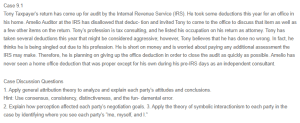
Case 9.1
Tony Taxpayer’s return has come up for audit by the Internal Revenue Service (IRS). He took some deductions this year for an office in his home. Amelio Auditor at the IRS has disallowed that deduc- tion and invited Tony to come to the office to discuss that item as well as a few other items on the return. Tony’s profession is tax consulting, and he listed his occupation on his return as attorney. Tony has taken several deductions this year that might be considered aggressive; however, Tony believes that he has done no wrong. In fact, he thinks he is being singled out due to his profession. He is short on money and is worried about paying any additional assessment the IRS may make. Therefore, he is planning on giving up the office deduction in order to close the audit as quickly as possible. Amelio has never seen a home office deduction that was proper except for his own during his pre-IRS days as an independent consultant.
Case 9.1 Analysis
Case Discussion Questions
1. Apply general attribution theory to analyze and explain each party’s attitudes and conclusions.
Hint: Use consensus, consistency, distinctiveness, and the fun- damental error.
2. Explain how perception affected each party’s negotiation goals. 3. Apply the theory of symbolic interactionism to each party in the case by identifying where you see each party’s “me, myself, and I.”
Read the case and answer the question. The assignment is submitted to Turnitin. course textbook: Budjac Corvette, B. A. (2007). Conflict management: A practical guide to developing negotiation strategies. Upper Saddle River, NJ: Pearson
Additional information: ISBN 9780131193239, Edition: 1st OER Online Option:
https://www.yumpu.com/en/document/read/65198329/conflict-management-a-practical-guide-to- developing-negotiation-strategies-by-barbara-a-budjac-corvette-z-liborg
Last Updated 06/2022
Chapter Assignments:
You will be asked to complete assignments to demonstrate your understanding of the course content.
For each chapter assignment, you will be asked to reflect on the case/task. Some assignments will require you to answer questions that are included in the text. In addition to answering each of the questions, you must include at least two credible sources to support your points (not including the textbook) in APA formatting. These do not need to be current, but they cannot be blogs or popular news sites. Each chapter assignment is worth 10 points, and grading rubrics can be found in the content area on D2L. The format for the chapter assignments are as follows:
1. Provide a brief summary of the case or expectations of the assignment, if a readable case is available (Minimum 3 full sentences)
2. Answer/expand each of the questions associated with the case (Should be more than one sentence. AVOID yes, no, or I agree as your only response)
3. Provide a brief conclusion on how or why this could help you in understanding conflict management/negotiations.
4. Provide two credible external sources in addition to the textbook
 Complete the order form and upload all of your files, including any instructions, rubrics, or other materials provided by your instructor.
  Complete the order payment after filling in the order form. We’ll receive your order and assign it to a writer.
 The assigned writer will complete your paper and forward it to our Editing Team for review and approval.
 Once approved by the editor, the completed paper will be uploaded to your account for you to download, review and approve.