
Case 18.1 – The O.J. Simpson Trial
Case 18.1 prompts the reader to reflect on the O.J. Simpson case. In the case, O.J. Simpson was tried on the murders of his wife, Nicole Brown Simpson, and Ron Goldman, Nicole’s friend. In a televised courtroom, the prosecution presented evidence they believed was strong enough to convict Simpson. However, the defense capitalized on police misconduct, racism, and handling of DNA evidence, leading to a not-guilty verdict (Linder, 2008). Nonetheless, a later civil trial found Simpson guilty of wrongfully causing the deaths of Nicole and Ronald.
Case Discussion
A Case Example of Persuasion Skills
Indeed, the O.J. Simpson trial highlights effective persuasion skills, particularly on the part of the defense team. The most valuable key in persuasion is credibility (Corvette, 2007), and because the defense was able to cast doubt concerning the credibility of the evidence against Simpson, the jury was convinced and acquitted Simpson. The defense also demonstrated effective persuasion skills by successfully shifting the court’s focus from evidence to other issues like racism and evidence mishandling.
The Attorneys’ Efforts in Negotiation
Much of the attorneys’ efforts to negotiation primarily centered on communication and persuasion. According to Corvette (2007), communication and persuasion are key components of negotiation. In this case, the attorneys engaged in communication, for example, during jury selection and when presenting evidence. They demonstrated persuasion in presenting their arguments in an effort to convince the jury to make a decision in their favor.
Public Relations Efforts
The defense took center stage in leveraging public relations via the media to shape the trial’s narrative and direction. Their objective—which they achieved—was to raise questions regarding the prosecution’s timeline, show that the defendant was physically incapable of committing the murders, and imply that the evidence was “contaminated or planted, or both” and thus raise doubts about its admissibility (Linder, 2008; Vargová, 2019).
Conclusion
This case has been valuable in furthering my understanding of negotiations. I have learned the types of third-party intervention processes, in particular litigation and its role in negotiation. The case has also highlighted the need for effective persuasion and leveraging credibility, which are crucial for successful negotiation.
References
Corvette, B. A. B. (2007). Conflict management: A practical guide to developing negotiation strategies. Pearson Prentice Hall.
Linder, D. (2008). The trial of Orenthal James Simpson. SSRN Electronic Journal. https://doi.org/10.2139/ssrn.1305244
Vargová, B. K. (2019). Defense strategies in works of O. J. Simpson case actors [Master’s Diploma Thesis, Masaryk University]. https://is.muni.cz/th/oi4j4/Final_thesis_Vargova.pdf
ORDER A PLAGIARISM-FREE PAPER HERE
We’ll write everything from scratch
Question 
Case 18.1 – The O.J. Simpson Trial
Case 18.1
You may recall the criminal trial of O. J. Simpson. Opinion regarding his guilt or innocence is sharply divided around the world.
Case Discussion Questions
1. Is this an ultimate example of effective persuasion skills? Why or why not?
2. How much of the trial attorneys’ efforts was negotiation?
3. What public relations efforts were undertaken? To what effect?
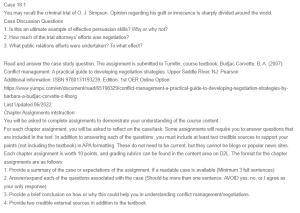
Case 18.1 – The O.J. Simpson Trial
Read and answer the case study question. The assignment is submitted to Turnitin. course textbook: Budjac Corvette, B. A. (2007). Conflict management: A practical guide to developing negotiation strategies. Upper Saddle River, NJ: Pearson
Additional information: ISBN 9780131193239, Edition: 1st OER Online Option:
https://www.yumpu.com/en/document/read/65198329/conflict-management-a-practical-guide-to-developing-negotiation-strategies-by-barbara-a-budjac-corvette-z-liborg
Last Updated 06/2022
Chapter Assignments intstruction:
You will be asked to complete assignments to demonstrate your understanding of the course content.
For each chapter assignment, you will be asked to reflect on the case/task. Some assignments will require you to answer questions that are included in the text. In addition to answering each of the questions, you must include at least two credible sources to support your points (not including the textbook) in APA formatting. These do not need to be current, but they cannot be blogs or popular news sites. Each chapter assignment is worth 10 points, and grading rubrics can be found in the content area on D2L. The format for the chapter assignments are as follows:
1. Provide a summary of the case or expectations of the assignment, if a readable case is available (Minimum 3 full sentences)
2. Answer/expand each of the questions associated with the case (Should be more than one sentence. AVOID yes, no, or I agree as your only response)
3. Provide a brief conclusion on how or why this could help you in understanding conflict management/negotiations.
4. Provide two credible external sources in addition to the textbook
 Complete the order form and upload all of your files, including any instructions, rubrics, or other materials provided by your instructor.
  Complete the order payment after filling in the order form. We’ll receive your order and assign it to a writer.
 The assigned writer will complete your paper and forward it to our Editing Team for review and approval.
 Once approved by the editor, the completed paper will be uploaded to your account for you to download, review and approve.