
Week 9 Pharmacological Case Studies
This assignment evaluates four pharmacology scenarios by analyzing medication regimens, identifying and correcting prescribing errors, reviewing mechanisms of action, considering patient-specific factors, and adjusting therapy per current clinical guidelines. Complete and valid medication orders are included for each case.
Scenario 1: Prescription Errors and Drug Profiles
In the first scenario, multiple prescription errors are identified and corrected based on drug safety, pharmacokinetics, and clinical guidelines. The prescription for tamsulosin was written as 4 mg PO daily, which exceeds the FDA-approved dose. The correct prescription is tamsulosin 0.4 mg orally once daily, 30 minutes after the same meal, with Disp: #30, Refills: 2. Tamsulosin is an alpha-1 adrenergic blocker that relaxes smooth muscle in the bladder neck and prostate, improving urinary flow in patients with benign prostatic hyperplasia (Ball et al., 2022).
The second error involves levofloxacin, incorrectly spelled as “levofloxcin.” The corrected prescription should be levofloxacin 750 mg orally once daily for 5 days, Disp: #5, Refills: 0. Levofloxacin is a fluoroquinolone antibiotic that inhibits bacterial DNA gyrase and topoisomerase IV, leading to DNA strand breakage and death of susceptible bacteria (Podder et al., 2024).
The third prescription inaccurately lists ciprofloxacin otic solution for bacterial conjunctivitis. Otic formulations are not sterile for ophthalmic use. The corrected prescription is ciprofloxacin 0.3% ophthalmic solution, 1–2 drops into the affected eye(s) every 2 hours while awake for 2 days. Every 4 hours while awake for 5 days, Disp: 1 bottle (5 mL), Refills: 0. Ciprofloxacin, like levofloxacin, disrupts bacterial DNA replication through inhibition of DNA gyrase.
The fourth prescription lists Paxlovid as “300 mg ritonavir plus 100 mg nirmatrelvir,” which is reversed. The correct regimen is nirmatrelvir 300 mg with ritonavir 100 mg taken orally twice daily for 5 days. Disp: 1 dose pack, Refills: 0 (Lam & Patel, 2023). Nirmatrelvir inhibits the SARS-CoV-2 main protease, preventing viral replication, while ritonavir boosts serum levels of nirmatrelvir by inhibiting CYP3A metabolism.
Lastly, Depo-Provera is incorrectly prescribed as a monthly injection. The correct schedule is every 12 weeks. The valid order is medroxyprogesterone acetate 150 mg intramuscularly every 12 weeks. Disp: 1 dose, Refills: 3. This progestin contraceptive suppresses ovulation and alters the endometrium and cervical mucus to prevent fertilization.
References
Ball, J. W., Dains, J. E., Flynn, J. A., Solomon, B. S., & Stewart, R. W. (2022). Seidel’s guide to physical examination: An interprofessional approach (10th ed.). Elsevier.
Lam, C., & Patel, P. (2023, August 8). Nirmatrelvir-Ritonavir. StatPearls – NCBI Bookshelf. https://www.ncbi.nlm.nih.gov/books/NBK585126/
Podder, V., Patel, P., & Sadiq, N. M. (2024, March 1). Levofloxacin. In www.ncbi.nlm.nih.gov. StatPearls Publishing. https://www.ncbi.nlm.nih.gov/books/NBK545180/
Scenario 2: Gonorrhea Treatment in a Penicillin-Allergic Patient
FS, a 26-year-old sexually active female, presents with symptoms consistent with gonorrhea and a positive culture. Given her documented penicillin allergy, the recommended treatment per CDC guidelines is a single dose of gentamicin 240 mg intramuscularly combined with azithromycin 2 g orally (Quilter et al., 2023). The complete orders are: gentamicin 240 mg IM once, Disp: 1 dose, Refills: 0, and azithromycin 2 g orally once (4 x 500 mg tablets), Disp: #4, Refills: 0. Azithromycin, a macrolide antibiotic, inhibits the 50S ribosomal subunit of susceptible bacteria, thereby suppressing protein synthesis. Gentamicin is an aminoglycoside that inhibits bacterial 30S ribosomes and disrupts cell membrane integrity, providing synergistic action when combined (Sullivan, 2019).
Since coinfection with Chlamydia trachomatis is common, empirical treatment is warranted, which is achieved with the azithromycin dose. FS should abstain from sexual activity for at least seven days after treatment completion and until all recent partners have been treated. Patient education must include proper condom use, especially recommending non-latex options due to her latex allergy. Additionally, she should be counseled on the importance of retesting in three months and screened for HIV and syphilis at follow-up visits. Explaining reinfection risks, treatment adherence, and safe sex practices is essential to avoid recurrent infection (White et al., 2025).
References
Quilter, L. A. S., St. Cyr, S. B., & Barbee, L. A. (2023). The management of gonorrhea in the era of emerging antimicrobial resistance: What primary care clinicians should know. Medical Clinics of North America, 67(76). https://doi.org/10.1016/j.mcna.2023.08.015
Sullivan, D. D. (2019). Guide to clinical documentation (3rd ed.). F.A. Davis Company.
White, J. A., Dukers-Muijrers, N. H., Hoebe, C. J., Kenyon, C. R., DC Ross, J., & Unemo, M. (2025). 2025 European guideline on the management of Chlamydia trachomatis infections. International Journal of STD & AIDS, 67(78). https://doi.org/10.1177/09564624251323678
Scenario 3: Warfarin and Bactrim Drug Interaction
JH, a 68-year-old male recently discharged on warfarin 5 mg PO daily, presents with an INR of 6.9 following the addition of Bactrim DS for a urinary tract infection. The supratherapeutic INR is due to the interaction between warfarin and sulfamethoxazole/trimethoprim. This combination leads to increased anticoagulation by two mechanisms: inhibition of CYP2C9, which metabolizes the S-enantiomer of warfarin, and displacement from plasma proteins, increasing free drug levels (Crader et al., 2023).
Management includes holding warfarin for 1-2 days and monitoring INR closely. If bleeding or an INR above 10 develops, administer oral vitamin K 2.5 mg. If renal function permits, Bactrim should be discontinued and replaced with nitrofurantoin 100 mg PO BID × 5 days, Disp: #10, Refills: 0, to eliminate the interaction (Squadrito & del Portal, 2023). Once INR falls below 3.0, warfarin may be resumed at a reduced dose, such as 4 mg PO daily, with Disp: #30, Refills: 0. The patient should be educated on avoiding NSAIDs, recognizing signs of bleeding (for example, bruising and hematuria), and maintaining a stable intake of vitamin K-rich foods. Close follow-up is required to prevent further fluctuations (Amaraneni et al., 2024).
References
Amaraneni, A., Chippa, V., Goldin, J., & Rettew, A. C. (2024, October 6). Anticoagulation safety. StatPearls – NCBI Bookshelf. https://www.ncbi.nlm.nih.gov/books/NBK519025/
Crader, M. F., Johns, T., & Arnold, J. K. (2023, May 1). Warfarin drug interactions. StatPearls – NCBI Bookshelf. https://www.ncbi.nlm.nih.gov/books/NBK441964/
Squadrito, F. J., & del Portal, D. (2023, May 29). Nitrofurantoin. Nih.gov; StatPearls Publishing. https://www.ncbi.nlm.nih.gov/books/NBK470526/
Scenario 4: Vancomycin Dose Calculation and Monitoring
A 70-kg patient is prescribed vancomycin 15 mg/kg IV every 12 hours. The total dose per administration is 1050 mg (15 mg/kg × 70 kg). Given that the pharmacy stocks 1000 mg/20 mL vials, the volume needed per dose is 21 mL (1050/50 mg/mL). Administering the dose at 10 mg/min requires 105 minutes of infusion time (Seidel et al., 2010).
A trough level drawn 30 minutes before the fourth dose results in 9 mcg/mL. For severe infections such as bacteremia or pneumonia, target trough levels should be between 15-20 mcg/mL (Rosenthal & Burchum, 2020). Therefore, the current regimen is inadequate, and the dose should be increased to 1250 mg IV every 12 hours with a new trough drawn before the fourth revised dose.
Vancomycin is generally administered intravenously because of its poor oral bioavailability; systemic infections require IV delivery. The oral form is only indicated for Clostridioides difficile colitis, where local gut action is desired. Failure to maintain therapeutic vancomycin levels may result in treatment failure and resistance (Patel et al., 2024).
References
Patel, S., Preuss, C. V., & Bernice, F. (2024, October 29). Vancomycin. National Library of Medicine; StatPearls Publishing. https://www.ncbi.nlm.nih.gov/books/NBK459263/
Rosenthal, L., & Burchum, J. (2020). Lehne’s pharmacotherapeutics for advanced practice nurses and physician assistants (2nd ed.). Elsevier.
Seidel, H. M., Ball, J. W., Flynn, J. A., Dains, J. E., Solomon, B. S., & Stewart, R. W. (2010). Mosby’s physical examination handbook (7th ed.). Elsevier Health Sciences.
ORDER A PLAGIARISM-FREE PAPER HERE
We’ll write everything from scratch
Question 
Week 9 Pharmacological Case Studies
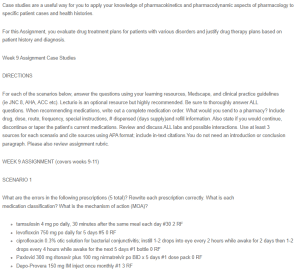
Case studies are a useful way for you to apply your knowledge of pharmacokinetics and pharmacodynamic aspects of pharmacology to specific patient cases and health histories.
Week 9 Pharmacological Case Studies
For this Assignment, you evaluate drug treatment plans for patients with various disorders and justify drug therapy plans based on patient history and diagnosis.
Week 9 Assignment Case Studies
DIRECTIONS
For each of the scenarios below, answer the questions using your learning resources, Medscape, and clinical practice guidelines (ie JNC 8, AHA, ACC etc). Lecturio is an optional resource but highly recommended. Be sure to thoroughly answer ALL questions. When recommending medications, write out a complete medication order. What would you send to a pharmacy? Include drug, dose, route, frequency, special instructions, # dispensed (days supply)and refill information. Also state if you would continue, discontinue or taper the patient’s current medications. Review and discuss ALL labs and possible interactions. Use at least 3 sources for each scenario and cite sources using APA format; include in-text citations.You do not need an introduction or conclusion paragraph. Please also review assignment rubric.
WEEK 9 ASSIGNMENT (covers weeks 9-11)
SCENARIO 1
What are the errors in the following prescriptions (5 total)? Rewrite each prescription correctly. What is each medication classification? What is the mechanism of action (MOA)?
- tamsulosin 4 mg po daily, 30 minutes after the same meal each day #30 2 RF
- levofloxcin 750 mg po daily for 5 days #5 0 RF
- ciprofloxacin 0.3% otic solution for bacterial conjunctivitis; instill 1-2 drops into eye every 2 hours while awake for 2 days then 1-2 drops every 4 hours while awake for the next 5 days #1 bottle 0 RF
- Paxlovid 300 mg ritonavir plus 100 mg nirmatrelvir po BID x 5 days #1 dose pack 0 RF
- Depo-Provera 150 mg IM inject once monthly #1 3 RF
SCENARIO 2
FS is a 26-year-old sexually active female who presents with a 5-day history of yellow vaginal discharge, pelvic discomfort, and burning with urination. She reports unprotected intercourse with a new male partner over the past month. A gonorrhea culture returns positive. FS has documented allergies to latex and penicillin. What is the recommended first-line treatment for gonorrhea in this patient? What additional sexually transmitted infection should be empirically treated, and with which medication? Provide complete medication orders. How long should she abstain from sex to avoid reinfection, and what patient education should be provided?
SCENARIO 3
JH is a 68-year-old male recently discharged from the hospital following a diagnosis of deep vein thrombosis (DVT). He was started on warfarin 5 mg PO daily with INR monitoring. At his follow-up clinic visit 6 days post-discharge, he reports that his primary care provider prescribed Bactrim DS (sulfamethoxazole/trimethoprim 800/160 mg) twice daily for 7 days to treat a urinary tract infection. Today, his INR is 6.9. He has minor bruising on his arms but no active bleeding. Additional medications include sertraline 100 mg po daily for depression and lisinopril 10 mg po daily for hypertension. What is the mechanism behind this interaction? How should JH’s medication therapy be adjusted?
SCENARIO 4
A patient is prescribed vancomycin 15 mg/kg IV every 12 hours for a 70 kg patient. The pharmacy stocks vancomycin 1 g per 20 mL vials.
- How much vancomycin (mg) should be administered per dose?
- How many milliliters of vancomycin solution should be drawn up for each dose?
- If the infusion rate is 10 mg/min, how long will it take to administer one dose?
- A trough level is drawn 30 minutes before the 4th dose, and the result is 9 mcg/mL. Is the current dosing regimen appropriate based on the trough level?Would you increase, decrease, or leave the dose the same?
- Why is vancomycin usually given IV and not PO?
This topic is closed for comments.
 Complete the order form and upload all of your files, including any instructions, rubrics, or other materials provided by your instructor.
  Complete the order payment after filling in the order form. We’ll receive your order and assign it to a writer.
 The assigned writer will complete your paper and forward it to our Editing Team for review and approval.
 Once approved by the editor, the completed paper will be uploaded to your account for you to download, review and approve.