
Week 8: Training Title 114 – Comprehensive Psychiatric Evaluation
Subjective
CC (chief complaint): “My supervisor thinks I have been drinking too much. That is ridiculous.”
HPI: Ally Chen is a 44-year-old, Asian American woman and a high school science-based teacher who has been referred to get an evaluation after concerns about alcohol misuse have been raised by her supervisor. Ally reports that she drinks nightly, usually five to six glasses of wine or mixed drinks, and admits to passing out after excessive drinking. She states alcohol “takes the edge off” the increasing stress of work and reports deteriorating classroom performance. She notes that drinking began to escalate after her divorce and increasing frustration with student behavior. She denies illicit drug use and insists she has never taught while intoxicated, despite multiple complaints. Ally’s alcohol use has become more solitary, though she occasionally drinks at school functions and with friends. She drinks to feel intoxicated and recognizes increased tolerance.
Past Psychiatric History: No prior psychiatric diagnoses or treatment. Denies history of self-harm or suicidal ideation. One DUI at age 21.
- General Statement: The patient is professionally accomplished but exhibits signs of emotional exhaustion and defensiveness when asked about her drinking habits or personal relationships.
- Caregivers (if applicable): None involved in her care.
- Hospitalizations: There are no psychiatric or medical hospitalizations reported.
- Medication trials: There are no concerns about prior psychotropic medications.
- Psychotherapy or Previous Psychiatric Diagnosis: No concerns reported.
Substance Current Use and History: Admits to daily alcohol use, increasing over the past several months. States she drinks alone most nights and uses alcohol to relieve stress. Denies drug use. Has a remote history of DUI at age 21. Her father had a history of alcohol dependence.
Family Psychiatric/Substance Use History: Father had alcoholism and was treated in AA. Other family psychiatric history is not known.
Psychosocial History: Ally is a single child, born in Philadelphia. She earned a PH.D. in biology and a master’s degree in education. She is divorced and has a 4-year-old son living with the father. The patient lives alone and reports high occupational stress and financial strain. She describes poor work-life balance, ongoing social isolation, and professional dissatisfaction.
Medical History: No known chronic medical conditions.
- Current Medications: None
- Allergies: No known allergies
- Reproductive Hx: Divorced, mother of one child. No concerns reported regarding reproductive health.
ROS:
- GENERAL: Reports fatigue but good appetite.
- HEENT: Denies headaches or visual disturbances.
- SKIN: No abnormalities noted.
- CARDIOVASCULAR: No palpitations or chest pain.
- RESPIRATORY: There is no shortness of breath indicated.
- GASTROINTESTINAL: Denies nausea or vomiting.
- GENITOURINARY: No urinary complaints.
- NEUROLOGICAL: Alert and oriented.
- MUSCULOSKELETAL: There is no joint or muscle pain.
- HEMATOLOGIC: Bleeding or bruising concerns not indicated.
- LYMPHATICS: There is no lymphadenopathy reported.
- ENDOCRINOLOGIC: No signs of metabolic disturbance.
Objective
Physical Exam
Not conducted in the session. Appearance was professional but slightly disheveled. No overt signs of intoxication. No psychomotor agitation or retardation.
Diagnostic Results
None available at this time. Suggest the use of AUDIT-C, CAGE, and a comprehensive metabolic panel to evaluate for alcohol-related organ damage in future assessments.
Assessment
Mental Status Examination
The patient is alert, oriented, and cooperative, though guarded. Speech is fluent, regular rate and volume. Irritability of mood; restlessness of affect. The thinking is rational and purposive. No psychosis. Negates suicidal or murderous thoughts. Intelligence and reasoning pertaining to her alcohol consumption appear impaired. Cognition intact.
Differential Diagnoses
Alcohol Use Disorder, Moderate to Severe (F10.20)
Meets ≥6 DSM-5-TR criteria: tolerance, craving, drinking more than intended, unsuccessful attempts to reduce use, time spent drinking/recovering, and continued use despite impairment (Nehring et al., 2024). Ally drinks nightly, often to the point of passing out, and reports functional decline at work and in social roles.
Persistent Depressive Disorder (F34.1)
Ally expresses fatigue, irritability, and loss of interest in teaching; however, these symptoms are better attributed to alcohol use and recent life stressors. The DSM-5-TR requires symptoms persisting for two years, which she does not meet (Patel et al., 2024). This diagnosis is deferred unless symptoms remain post-abstinence.
Adjustment Disorder with Disturbance of Conduct (F43.24)
Ally’s recent divorce, custody change, and work stress might suggest adjustment disorder. However, the severity and chronicity of her alcohol misuse exceed the criteria for a temporary maladaptive response to stress (Geer, 2023).
Critical Thinking Process
Alcohol use disorder is the most supported diagnosis due to clear DSM-5-TR symptom alignment and significant life impairment. Depression and adjustment disorder lack sufficient diagnostic evidence. Pertinent positives include tolerance and impaired functioning; negatives include no suicidal ideation or psychosis.
Reflections
If I could conduct the session again, I would begin by using motivational interviewing techniques to foster a more collaborative and nonjudgmental atmosphere. The patient’s defensiveness may stem from professional shame and cultural stigma around addiction. By focusing on empathy and reflective listening, I could better explore her values and ambivalence about drinking. Additionally, I would introduce validated screening tools like the AUDIT-C to quantify her alcohol use early in the session, which could support clinical objectivity and patient insight.
From a legal and ethical standpoint, I would assess workplace safety risks more thoroughly, given her role as an educator and reports of impaired performance. This includes determining whether mandatory reporting to the school administration or licensing board is necessary to protect students. Health promotion efforts would target education on the long-term impact of alcohol on liver health, mental well-being, and parenting. Considering her Asian American background, cultural sensitivity is critical, as shame and family honor may influence help-seeking behavior. Her socioeconomic stressors, co-parenting, job insecurity, and financial pressure should be addressed in treatment planning. Offering referrals to Employee Assistance Programs and trauma-informed counseling may enhance engagement and support disease prevention in the long term.
References
Geer, K. (2023). Adjustment disorder. Primary Care: Clinics in Office Practice, 50(1), 83–88. https://doi.org/10.1016/j.pop.2022.10.006
Nehring, S. M., Chen, R. J., & Freeman, A. M. (2024, March 16). Alcohol use disorder: Screening, evaluation, and management. StatPearls – NCBI Bookshelf. https://www.ncbi.nlm.nih.gov/books/NBK436003/
Patel, R. K., Aslam, S. P., & Rose, G. M. (2024, August 11). Persistent depressive disorder. StatPearls – NCBI Bookshelf. https://www.ncbi.nlm.nih.gov/books/NBK541052/
ORDER A PLAGIARISM-FREE PAPER HERE
We’ll write everything from scratch
Question 
Week 8: Training Title 114 – Comprehensive Psychiatric Evaluation
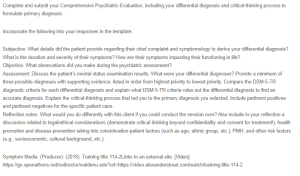
Complete and submit your Comprehensive Psychiatric Evaluation, including your differential diagnosis and critical-thinking process to formulate primary diagnosis.
Week 8 – Training Title 114 – Comprehensive Psychiatric Evaluation
Incorporate the following into your responses in the template:
Subjective: What details did the patient provide regarding their chief complaint and symptomology to derive your differential diagnosis? What is the duration and severity of their symptoms? How are their symptoms impacting their functioning in life?
Objective: What observations did you make during the psychiatric assessment?
Assessment: Discuss the patient’s mental status examination results. What were your differential diagnoses? Provide a minimum of three possible diagnoses with supporting evidence, listed in order from highest priority to lowest priority. Compare the DSM-5-TR diagnostic criteria for each differential diagnosis and explain what DSM-5-TR criteria rules out the differential diagnosis to find an accurate diagnosis. Explain the critical-thinking process that led you to the primary diagnosis you selected. Include pertinent positives and pertinent negatives for the specific patient case.
Reflection notes: What would you do differently with this client if you could conduct the session over? Also include in your reflection a discussion related to legal/ethical considerations (demonstrate critical thinking beyond confidentiality and consent for treatment!), health promotion and disease prevention taking into consideration patient factors (such as age, ethnic group, etc.), PMH, and other risk factors (e.g., socioeconomic, cultural background, etc.).
Symptom Media. (Producer). (2018). Training title 114-2Links to an external site. [Video]. https://go.openathens.net/redirector/waldenu.edu?url=https://video.alexanderstreet.com/watch/training-title-114-2
 Complete the order form and upload all of your files, including any instructions, rubrics, or other materials provided by your instructor.
  Complete the order payment after filling in the order form. We’ll receive your order and assign it to a writer.
 The assigned writer will complete your paper and forward it to our Editing Team for review and approval.
 Once approved by the editor, the completed paper will be uploaded to your account for you to download, review and approve.