
Week 1 Discussion Boards
DB Q1: Introduction and Practicum Overview
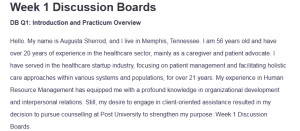
Hello. My name is Augusta Sherrod, and I live in Memphis, Tennessee. I am 56 years old and have over 20 years of experience in the healthcare sector, mainly as a caregiver and patient advocate. I have served in the healthcare startup industry, focusing on patient management and facilitating holistic care approaches within various systems and populations, for over 21 years. My experience in Human Resource Management has equipped me with a profound knowledge in organizational development and interpersonal relations. Still, my desire to engage in client-oriented assistance resulted in my decision to pursue counselling at Post University to strengthen my purpose: Week 1 Discussion Boards.
I finished my field practicum with Serenity Recovery Centers at 1094 Poplar Avenue, Memphis, TN 38105. It is a well-established agency that specializes in treating substance use disorders, promoting relapse prevention efforts, and implementing integrated recovery approaches (Serenity Recovery Centers, 2020). In this placement, I assisted clients in developing coping strategies, enhancing emotional regulation, and promoting motivation for change through individual and group counseling. I also teamed up with licensed clinicians in treatment planning and follow-up assessments to ensure uninterrupted continuity of care and adherence to ethical standards.
My key expectations for this practicum include building advanced knowledge of therapeutic processes, enhancing communication and listening skills, and applying clinical methods to assist clients in managing addiction and co-morbid issues. I expect to become more confident in clinical documentation and culturally competent to work with diverse populations. In addition, I want to engage in further professional identity development and soon become a Licensed Professional Counselor (LPC) with a focus on alcohol and drug abuse counseling and recovery assistance.
References
Serenity Recovery Centers. (2020, February 11). Serenity Recovery Centers. https://serenityrecovery.org/
DB Q2: Theoretical Orientation and Application in Practice
The theoretical orientation that best suits me is a combination of person-centered therapy and Gestalt therapy, which constitutes an integrative counselling model related to empathy and experimental interaction. These two theories align perfectly with my values and the development of my clinical style, enabling me to provide warmth and structure. The person-centred approach focuses on empathy, unconditional positive regard, and congruence, enabling clients to feel safe, validated, and empowered in the healing process (Yao & Kabir, 2023). In contrast, according to Ramu et al. (2025), Gestalt therapy promotes being mindful of the present, acting with purpose, and taking charge of oneself, which becomes imperative when dealing with recovery clients who have become addicted.
Through my experience at Serenity Recovery Centers, I have seen how the approaches inherently go hand in hand. An example of this can be seen with a client such as Marcus, who was struggling with substance abuse and emotional detachment. I applied person-centered skills to create a connection of trust, affirmation, and space to enable genuine communication.
After establishing safety, I incorporated Gestalt skills such as guided visualization and empty chair techniques to assist him in identifying unresolved grief and guilt, which were affecting his progress in recovery. The techniques assisted Marcus in projecting intrapersonal conflict onto the outside world and in making constructive emotional transformations toward personal responsibility and optimism.
As I further develop this approach, I will be able to provide emotionally responsive yet directive support when needed. The flexibility of this theoretical integration allows it to be both deep and structured, while maintaining boundaries for therapeutic relationships (Roubal et al., 2021). It is now apparent that a warm therapeutic alliance, combined with experiential tools and present-focused awareness, can enable the client to become more insightful, manage emotions effectively, and initiate a meaningful, long-term, and congruent change process aligned with their personal values.
References
Ramu, A., McNamara, S., & Gunturu, S. (2025, February 14). Gestalt therapy. StatPearls – NCBI Bookshelf. https://www.ncbi.nlm.nih.gov/books/NBK613291/
Roubal, J., Hytych, R., Čevelíček, M., & Řiháček, T. (2021). Personal therapeutic approach in Gestalt therapists working with clients suffering from medically unexplained psychosomatic symptoms. Research in Psychotherapy: Psychopathology, Process and Outcome, 24(3). https://doi.org/10.4081/ripppo.2021.535
Yao, L., & Kabir, R. (2023, February 9). Person-centered therapy (Rogerian therapy). PubMed; StatPearls Publishing. https://www.ncbi.nlm.nih.gov/books/NBK589708/
DB Q3: Reflection on First Practicum Experience
In the field practicum placement, I benefited greatly as I gained insight into my areas of strength and areas where I need to improve as a growing counselor. My biggest strength was the capacity to establish rapport easily and authentically. My capacity to be empathetic and present allowed many clients to report that they were heard, seen, and respected during our early sessions.
This testifies to my natural ability to be empathetic and present. I also had the opportunity to use reflective listening, active inquiry, and motivational interviewing, enabling even the most resistant clients to open up. These competencies were important when discussing some of the sensitive problems of relapse, guilt, or emotional disconnection.
Nonetheless, one area of improvement that came into focus was that I was initially uncomfortable with emotional confrontation and confronting problems with client ambivalence. During initial sessions, I was afraid to confront clients in cases of denial or resistance, fearing that I might break the rapport. Over time, with ongoing supervision, reading, and skills practice, I learned to confront with care, balancing empathy with accountability, and using affirming language. Implementing a structured intervention framework by utilizing miracle questions, goal setting, and silence tolerance allowed clients to consider their behaviors, expectations, and internalized narratives more honestly (Jerome et al., 2023). This development has enhanced my capability to enhance the therapeutic relationship.
To continue enhancing my strengths as a counselor, I plan to utilize consistent clinical supervision to receive constructive feedback, process emotional responses, and refine my intervention strategies. I also intend to participate in advanced workshops focused on trauma-informed care, as many clients present with complex trauma histories that require sensitive, evidence-based approaches. Staying current with counseling research will allow me to integrate new techniques and uphold ethical best practices in my sessions.
To address my areas for improvement, I will work on recognizing and managing transference and resistance, especially in high-conflict or emotionally intense sessions. I will also strengthen my crisis response skills and practice tailoring interventions to match each client’s emotional readiness. Professional growth is ongoing and shaped by reflection, supervision, and compassionate self-awareness.
References
Jerome, L., McNamee, P., Abdel-Halim, N., Elliot, K., & Woods, J. (2023). Solution-focused approaches in adult mental health research: A conceptual literature review and narrative synthesis. Frontiers in Psychiatry, 14. https://doi.org/10.3389/fpsyt.2023.1068006
ORDER A PLAGIARISM-FREE PAPER HERE
We’ll write everything from scratch
Question 
DB: Week 1DB: Week 1
DB Q1:
- Please introduce yourself to the class. Include where you live, professional experience and other relevant information. Additionally, share with the class a detailed description of your field practicum placement. What will you be doing? What do you hope to accomplish?
NOTE: You must make at least 1 substantial posting and 2 substantial replies to this thread. You must participate in the Unit discussion board (making postings/replies) at least 3 days per unit to qualify for full credit and also have at least 1 posting by Wednesday at midnight. You also must use APA style in your posting and replies so please use in-text references and provide a reference to give proper credit to the authors.
- What is the theoretical orientation that you identify most with as counselor (clinical or A + D students) or administrator (for NMP) students? Why? How will you incorporate your theoretical orientation in your work as an intern?
NOTE: You must make at least 1 substantial posting and 2 substantial replies to this thread. You must participate in the Unit discussion board (making postings/replies) at least 3 days per unit to qualify for full credit and also have at least 1 posting by Wednesday at midnight. You also must use APA style in your posting and replies so please use in-text references and provide a reference to give proper credit to the authors.
Week 1 Discussion Boards
- Class, reflect upon your first field practicum placement (60740 – HSV 593). What were some of some of your strengths and areas for growth as a practicum student? This is an opportunity to reflect upon how you can grow personally and professionally. Your response requires self reflection.Your responses should include academic references and demonstrate depth and insight. Your responses should not focus on having a “bad supervisor” or “bad placement” in your first placement. This is specific to your strengths and areas for growth. How will you continue to enhance your strengths and how will you demonstrate growth in the identified areas?
Please feel free to use the two books below to assist in thinking about your strengths, growth opportunities, and other related topics.
- Geldard & Geldard (2012): Personal counseling skills : an integrative approach
- Hutchinson (2012):The Counseling Skills Practice Manual
NOTE: You must make at least 1 substantial posting and 2 substantial replies to this thread. You must participate in the Unit discussion board (making postings/replies) at least 3 days per unit to qualify for full credit and also have at least 1 posting by Wednesday at midnight. You also must use APA style in your posting and replies so please use in-text references and provide a reference to give proper credit to the authors.
Notes:
- field experience site:
- Name of Agency: Serenity Recovery Centers
- Full address: 1094 Poplar Avenue Memphis TN 38105
- Website: serenityrecovery.org
- Name of Agency: Serenity Recovery Centers
 Complete the order form and upload all of your files, including any instructions, rubrics, or other materials provided by your instructor.
  Complete the order payment after filling in the order form. We’ll receive your order and assign it to a writer.
 The assigned writer will complete your paper and forward it to our Editing Team for review and approval.
 Once approved by the editor, the completed paper will be uploaded to your account for you to download, review and approve.