
Value Chain Analysis
Value Chain and Flow of Structure
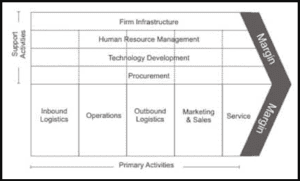
The value chain within a business’s value system describes the process of doing this as the company moves through from input to output, adding value along the way. As stated by Eisenreich et al. (2022), the value chain starts with suppliers who offer materials necessary to manufacture the products. These inputs are then carried forward to manufacturing plants which have the capacity of converting them into output: Value Chain Analysis.
At this stage, activities such as assembling, quality checks, and packaging enhance the value of the products. After the production of these goods, they are stacked in the warehouses and stored, waiting for the time when they have to be dispatched. From here, the products go through complex logistics channels to reach outlets or first-time consumers, depending on the distribution channel.
Inventory information in each stage of the value chain is managed because data systems track goods at that stage. The flow of structure is principally linear, from the raw material input to the consumer output, but may comprise a few ‘loops’ for reusing, repairing, or reordering (Knez et al., 2021). Coordinated processes accompanied by the immediate exchange of information reduce problems in the chain. The value chain and flow of structure are illustrated below.
Inputs
In a supply chain, inputs are the necessary resources needed to generate commodities or services. Raw materials are the main input and can be anything from simple goods to intricate parts. These supplies are acquired from vendors and function as the fundamental components of manufacturing procedures. Human resources are essential for supplying the labor required for manufacturing, logistics, and administrative duties in addition to raw materials.
Maintaining quality and efficiency in operations and manufacturing requires skilled staff. Input in a supply chain is the element or factor required to create commodities or services. The principal resource is raw material, which can range from a basic commodity to a complex component. These are bought from suppliers and form the basics of production processes; they are also referred to as materials.
Labor is critical as it is the human resource needed to provide labor in the production line, order and management of resources as well as a supply of other materials. The consistent delivery of quality and optimum operation and manufacturing is best achieved through the quality of staff.
Outputs
Outputs in a supply chain are the results and goods or services that are offered to the customers. It is a sign of the enhancement of other steps from acquisition to production. The main product is the production of finished goods that are marketable and produced with the quality demanded by the market. These products are available on the market through other outlets or can be sold online to consumers.
Apart from tangible products, organizations also offer services that may accompany the product, adding value to the product. For example, product installation, maintenance as well as options for customization where the customer can add value.
The customer service system, which guarantees that clients receive assistance throughout their purchase process, is an essential component of the final product. Significantly, this covers both pre- and post-sale support. Post-purchase services might include warranty management, technical support, and product return management. Transparency is increased by enabling customers to trace the progress of their purchases using order tracking systems.
Encouraging client happiness, handling feedback, and preserving solid connections all benefit from well-designed customer service structures. In essence, this guarantees that the supply chain offers satisfied customers a great overall experience in addition to product delivery.
Inventory points and forecasting
Inventory centers are strategic retail points along the supply chain for merchandise inventory that includes raw materials, working inventory, and finished products. All these points serve to ensure that the business can fulfill the customers’ demands while at the same time pursuing operational expense efficiency. The purchasing requirement estimating techniques include the prediction of the amount of a product required in the market, mainly by considering the historical data coupled with the market data and customer behavior. On the other hand, lead time forecasting is useful in predicting the time likely to be taken by suppliers to bring in more raw materials to avoid waiting longer for supplies.
Sourcing Activities
Sourcing activities are critical for approving quality inputs at the right price and sustaining a robust value chain. Sourcing commences are conducted through supplier evaluation, whereby businesses assess potential suppliers. Most importantly, this helps the business in demanding supplies that can support its operations and production sessions. After that, contract negotiation reveals the terms agreed to by both partners on things such as price, delivery time, and the consequences in the event of non-adherence to these terms.
Effective negotiation is a technique of bargaining whereby one can get far better conditions agreed upon all the time to establish a continuing relationship with the supplier. Supplier relation management is essential in the management of good relationships and, at the same time, the development of new products.
Risks
Supply chain risks have the potential to seriously impair business operations, resulting in delays, higher expenses, or a decline in consumer confidence. Supply risk is a significant concern, as it can result in the delay of raw materials, frequently because of supplier problems such as unstable finances. Abrupt changes in the market might lower client demand, resulting in surplus inventory and financial losses. This is the source of demand hazards.
Internal interruptions, including equipment breakdowns, a workforce shortage, and ineffective procedures that impede output, are examples of operational hazards. Natural catastrophes and other environmental hazards can influence production facilities and transit routes. Cross-border logistics can be made more difficult by geopolitical threats, including tariffs, trade restrictions, and political unrest (Coveri & Zanfei, 2023). Finally, data breaches may jeopardize supply chain operations, making cybersecurity concerns an increasing danger.
Locations
Supply chain locations are strategically important for maximizing delivery, distribution, and manufacturing. To save money on transportation, manufacturing facilities should be situated close to important markets and suppliers of raw materials. Strategic placement of distribution facilities near key client markets can save delivery times and expenses while improving service effectiveness.
Target customers should be able to reach retail outlets, and lead times and risk management demands that supplier locations be considered. It is also essential to be close to transportation hubs, like ports or roads, to guarantee prompt product flow across the supply chain.
Logistics
Organizing the effective flow of commodities along the supply chain requires a strong understanding of logistics. It includes outgoing logistics, which oversees delivering completed goods to consumers or merchants, and incoming logistics, which is in charge of moving raw materials from suppliers to manufacturing facilities. Selecting the best kind of transportation relies on several variables, including distance, cost, and speed.
Last-mile delivery concentrates on delivering goods to the client promptly and precisely, while effective warehousing makes sure that inventory is stored properly for speedy fulfillment. Logistics efficiency is increased by integrating technology, such as warehouse management systems and GPS tracking.
References
Coveri, A., & Zanfei, A. (2023). The virtues and limits of specialization in global value chains: analysis and policy implications. Journal of Industrial and Business Economics, 50(1), 73–90. https://doi.org/10.1007/s40812-022-00247-9
Eisenreich, A., Füller, J., Stuchtey, M., & Gimenez-Jimenez, D. (2022). Toward a circular value chain: Impact of the circular economy on a company’s value chain processes. Journal of Cleaner Production, 378, 134375. https://doi.org/10.1016/j.jclepro.2022.134375
Knez, K., Jaklič, A., & Stare, M. (2021). An extended approach to value chain analysis. Journal of Economic Structures, 10(1). https://doi.org/10.1186/s40008-021-00244-6
ORDER A PLAGIARISM-FREE PAPER HERE
We’ll write everything from scratch
Question 
Wk 6 Summative Assessment: Value Chain Analysis
This assignment is intended to help you build a supply chain plan/diagram for a new business by analyzing factors that affect sourcing, logistics, metrics, suppliers, and risk.
Create a diagram of the supply chain plan using one of the following tools:
- • Excel
- • PowerPoint
- • Visio
- • PictoGram
- • Other faculty-approved platform
Write an 875-word analysis of the supply chain. Include the following:
Value Chain Analysis
- Value chain and flow of structure
- Inputs
- Outputs, including customer service structure
- Inventory points and forecasting
- Sourcing activities
- Risks
- Locations
- Logistics
Cite references to support your assignment.
 Complete the order form and upload all of your files, including any instructions, rubrics, or other materials provided by your instructor.
  Complete the order payment after filling in the order form. We’ll receive your order and assign it to a writer.
 The assigned writer will complete your paper and forward it to our Editing Team for review and approval.
 Once approved by the editor, the completed paper will be uploaded to your account for you to download, review and approve.