
Understanding Economic Principles and Tools in Health Care Finance
In the intricate environment of health care administration, managers, researchers, and practitioners should be aware of the economic forces that can impact the state of health care provision. A solid understanding of health economics adds a firm foundation in strategically ensuring access, quality, and efficiency as the financial pressures rise, the costs to operate increase, and the reimbursement models shift. This discussion examines the financial drivers affecting health care delivery, identifies one of the significant financial issues that have plagued the U.S. health care system, identifies economic principles and tools that apply, and offers a solution to the financial problem of health care through appropriate financial planning.
Financial Forces Impacting Health Care Delivery
A number of financial forces directly affect health care delivery in the United States. Among them is a transition to value-based reimbursement compared to volume-based reimbursement. Conventional fee-for-service systems reward providers according to the number of services provided, contributing to inflation in costs without any increase in the quality of patient outcomes (Yu & Gorgone, 2024). Conversely, value-based models pay providers to provide efficient, high-quality care and minimize hospital readmissions, complications, and unnecessary utilization.
Another force is the rising cost of medical technology and pharmaceuticals. The use of technology, though effective, can be quite costly due to capital investment and maintenance costs. Also, specialty drug prices heavily impact health care spending, especially among systems that provide treatments for chronic and complex conditions.
Workforce shortages, especially among nurses and primary care physicians, further strain financial resources. The health systems are required to provide competitive salaries and benefits packages to retain qualified professionals, which adds to the payroll costs. Together with the regulatory compliance requirements, uncompensated care, and administrative overhead, these forces cause financial pressures that strain the sustainability of operations and the quality of care.
Financial Challenge: Rising Hospital Operating Costs
One of the most pressing financial challenges facing U.S. health care systems is the rising cost of hospital operations. The American Hospital Association (2023) noted that there has been a massive rise in hospital costs due to labor, supply chain, and inflation expenses. The increase in pay rates, the contract staffing arrangement, as well as the acuity of patients following COVID-19, have led to labor costs, which constituted more than 20.8 percent of all hospital expenditures.
Along with an increase in labor, the supply costs have also increased, and health systems report experiencing problems accessing the necessary medical supplies at stable prices. The constant inflation rates have also added to the operational expenses in terms of utility bills, food services, and maintenance of infrastructure. These issues have caused profit margins and have forced some hospitals, especially those in the rural and safety-net areas, to cut down on services or shut down entirely.
Economic Principles and Tools for Understanding the Challenge
A number of economic principles and analytical concepts can be used to address and understand the escalating cost of hospital operations. One foundational concept is opportunity cost, which emphasizes the trade-offs inherent in resource allocation. To illustrate, investments into expanding ICU capacity can decrease the level of investments into the provision of preventive care. Leaders are to evaluate the investments with the best value based on patient outcomes and savings over the long term.
The principle of marginal analysis is also vital. This is a tool that assesses value as an increment in cost. As an example, when the employment of two new nurses can decrease the rate of patient falls and readmission, the marginal benefit can make up the labor cost, and save the system financially, with the resultant enhancement in any quality measure (Nguyen et al., 2022).
Cost-benefit analysis (CBA) is another beneficial concept that compares the aggregate expected costs and outcomes of a proposed intervention. CBA is a tool that can be used in hospital finance to inform the decision on whether to expand services, buy new technology, or implement new staffing models. Break-even analysis is also important in understanding when a given service line is non-financially viable by identifying how much total revenue the service line has to generate to equal the total costs of the service line.
Finally, a balance between the supply of health services and the health needs of the community can be determined with the help of the principles of supply and demand. The mismatch between the level of infrastructure and personnel to sustain excessive demand for specialty services, and the overcapacity of resources in other areas, offers an overpaid profit margin and resources overconsumption.
Recommended Strategies for Addressing the Challenge
The problem of increasing the operating expenses in hospitals cannot be solved using a one-dimensional approach. First, hospitals are encouraged to implement lean management and Six Sigma tools to reduce waste and help streamline both the clinical and administrative processes. Efficiency can help health systems save duplication, decrease errors, and distribute employee time more effectively by streamlining processes (Rathi et al., 2021).
Second, strategic workforce planning is essential. This involves the funding of the retention programs, providing incentives for career development, and minimizing the use of expensive contract labor. Cross-training employees can enhance the coverage, and flexible staffing models can be used to optimize the demand periods without overspending on labor.
Third, adopting value-based purchasing models can align financial incentives with quality care. Hospitals can also enter into bundled payment agreements with payers, reimbursement that is based upon outcome, rather than quantity. This transition promotes efficiency, patient interest, and preventive care to lower the complications and expensive measures between the providers.
Fourth, predictive analytics and financial modeling tools should be used by hospitals to predict costs, anticipate changes against budget, and simulate their effect on the finances to change operations. Such tools can be used by leaders to implement data-driven decisions that are quality-centric, yet cost-effective (Nandy, 2025).
Finally, establishing cooperative purchasing systems or group purchasing organizations (GPOs) can minimize supply chain expenses, allowing bulk buying of heavy-use products at a discount through a cooperative buying mechanism. The collective bargaining power will offer a source of financial stability and stability in supply during periods of economic uncertainty.
Conclusion
The increased cost of health care delivery can be attributed to factors such as reimbursement alteration, workforce, and inflation. Lean strategies and cost-benefit analysis may offer economic remedies to hospital administrators that can heal the economic pressures to promote a healthier outcome and sustainability of a hospital and quality access.
References
American Hospital Association. (2024, May 2). 2023 costs of caring. AHA. https://www.aha.org/guidesreports/2024-05-01-2023-costs-caring
Nandy, B. (2025). Hospital investment decisions and prioritization of clinical programs. Cureus, 17(3). https://doi.org/10.7759/cureus.79998
Nguyen, K.-H., Wright, C., Simpson, D., Woods, L., Comans, T., & Sullivan, C. (2022). Economic evaluation and analyses of hospital-based electronic medical records (EMRs): A scoping review of international literature. Npj Digital Medicine, 5(1), 1–16. https://doi.org/10.1038/s41746-022-00565-1
Rathi, R., Vakharia, A., & Shadab, M. (2021). Lean six sigma in the healthcare sector: A systematic literature review. Materials Today: Proceedings, 50(5), 773–781. https://doi.org/10.1016/j.matpr.2021.05.534
Yu, Z. A., & Gorgone, M. B. (2024, May 2). Pay-for-performance and value-based care. Nih.gov; StatPearls Publishing. https://www.ncbi.nlm.nih.gov/books/NBK607995/
ORDER A PLAGIARISM-FREE PAPER HERE
We’ll write everything from scratch
Question 
Understanding Economic Principles and Tools in Health Care Finance
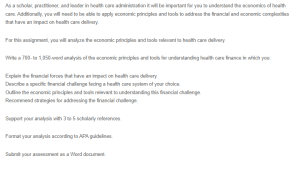
As a scholar, practitioner, and leader in health care administration it will be important for you to understand the economics of health care. Additionally, you will need to be able to apply economic principles and tools to address the financial and economic complexities that have an impact on health care delivery.
Understanding Economic Principles and Tools in Health Care Finance
For this assignment, you will analyze the economic principles and tools relevant to health care delivery.
Write a 700- to 1,050-word analysis of the economic principles and tools for understanding health care finance in which you:
Explain the financial forces that have an impact on health care delivery.
Describe a specific financial challenge facing a health care system of your choice.
Outline the economic principles and tools relevant to understanding this financial challenge.
Recommend strategies for addressing the financial challenge.
Support your analysis with 3 to 5 scholarly references.
Format your analysis according to APA guidelines.
Submit your assessment as a Word document.
 Complete the order form and upload all of your files, including any instructions, rubrics, or other materials provided by your instructor.
  Complete the order payment after filling in the order form. We’ll receive your order and assign it to a writer.
 The assigned writer will complete your paper and forward it to our Editing Team for review and approval.
 Once approved by the editor, the completed paper will be uploaded to your account for you to download, review and approve.