
Training Title 21 – Comprehensive Psychiatric Evaluation
Subjective
CC (chief complaint): “My fiancée suggested, well, demanded that I make an appointment.”
HPI
B.S., a white man, is 27 years old and a Marine veteran presenting for evaluation after an incident involving fireworks triggered a traumatic response. He reports recurrent intrusive memories, nightmares, flashbacks, and hyperarousal in response to sensory stimuli such as loud noises and diesel fumes. His symptoms have persisted and intensified over the past six months since separating from military service. He reports significant functional impairments in social and occupational domains, including avoidance of public places and difficulty sleeping.
Past Psychiatric History
- General Statement: The patient is seeking mental health care for the first time.
- Caregivers (if applicable): Not applicable.
- Hospitalizations: Denies having ever been admitted to a mental health facility
or emergency psychiatric care.
- Medication trials: Denies using mental health drugs in the past.
- Psychotherapy or Previous Psychiatric Diagnosis: Denies previous mental health diagnoses or therapy.
Substance Current Use and History
As his father abused alcohol, he avoids drinking and denies using illegal drugs. There is no history of substance misuse, withdrawal symptoms, or overdose. He drinks caffeine occasionally and does not smoke.
Family Psychiatric/Substance Use History
Despite long-term health problems, the father continues to drink and has a history of alcohol use disorder. The veteran paternal grandfather had untreated depression. Neither the mother nor the siblings have a history of mental illness.
Psychosocial History
After high school, the patient, who came from a low-income family, enlisted in the Marines. He completed three long combat deployments over eight years. He recently moved in with his fiancée after separating from active duty. He is enrolled in an online college and planning to get married. He avoids social gatherings, has difficulty in crowds, and shows emotional distress in response to conflict or reminders of trauma. He has strong family ties but limited social interaction.
Medical History: The patient has been diagnosed with seasonal allergies and asthma related to the service. There were no reports of head trauma or surgery. No history of seizures or neurological conditions is known.
- Current Medications: Albuterol inhaler PRN for asthma. No current psychiatric or other medications were reported.
- Allergies: No known drug allergies. Reports seasonal pollen allergies.
- Reproductive Hx: Engaged to be married. Heterosexual. No children. No issues noted.
ROS:
- GENERAL: No fatigue, fever, or weight changes.
- HEENT: No visual or auditory changes. No nasal congestion.
- SKIN: No rashes or lesions.
- CARDIOVASCULAR: No chest pain or palpitations.
- RESPIRATORY: Mild asthma; occasional wheezing with allergens.
- GASTROINTESTINAL: Occasional nausea in response to anxiety.
- GENITOURINARY: No complaints of the urinary system.
- NEUROLOGICAL: No headaches, dizziness, or sensory deficits.
- MUSCULOSKELETAL: No joint pain or muscle issues.
- HEMATOLOGIC: No bruising or bleeding concerns.
- LYMPHATICS: No lymphadenopathy.
- ENDOCRINOLOGIC: No endocrine concerns.
Objective
Physical Exam: Not applicable.
Diagnostic Results
No laboratory tests or imaging studies were conducted during this initial psychiatric evaluation, as the clinical presentation strongly pointed toward a trauma-related disorder. However, standardized assessment tools are recommended to support diagnostic accuracy and monitor symptom progression. Administering the PTSD Checklist for DSM-5 would help evaluate the intensity and consequences of symptoms associated with trauma (Forkus et al., 2022). Additionally, the Generalized Anxiety Disorder 7-item scale may help screen for comorbid anxiety symptoms that may require concurrent management.
Assessment
Mental Status Examination
B.S. is a neatly dressed, alert Caucasian male who appears his stated age. He cooperates but is visibly anxious during the session. Anxiety and numbness are prevalent in mood; the affect is restricted and congruent. Speech is coherent but occasionally hesitant when describing traumatic experiences. The thought process is linear but interrupted by emotional reactivity during trauma recounting. No signs of hallucinations or delusions are present. He disputes having thoughts of suicide or murder. Both insight and judgment are impartial. Cognition is intact. Startles easily when discussing triggers; demonstrates hypervigilance and avoidance behaviors.
Primary Diagnosis: Post-Traumatic Stress Disorder (PTSD), Chronic (F43.10)
The patient meets the DSM-5-TR diagnostic criteria for PTSD, which include exposure to traumatic events for this case, combat experience, presence of intrusive symptoms where he presents with flashbacks and nightmares, persistent avoidance as he avoids crowds and social settings, adverse changes in mood and thought processes where he has feelings of detachment and guilt, and marked alterations in arousal and reactivity such as hypervigilance, and startle reaction (Mann et al., 2024). The duration exceeds one month and causes significant impairment in functioning.
Differential Diagnoses
Generalized Anxiety Disorder (GAD) (F41.1)
The hallmarks of GAD are excessive concern and anxiety about various events or activities, including job, money, and family, that occur more often than not for at least six months (Munir & Takov, 2022). The person struggles to manage their anxiety. Muscle tension, impatience, exhaustion, difficulty concentrating, restlessness, and disturbed sleep are some symptoms. Although the patient presents with restlessness, hypervigilance, and disrupted sleep, these symptoms are not generalized across domains of life. Still, they are tied to trauma-specific stimuli such as fireworks, loud noises, traffic, and smells. The absence of pervasive and uncontrollable worry across multiple situations does not meet the core DSM-5-TR criteria for GAD.
Panic Disorder (F41.0)
The hallmarks of panic disorder include frequent, unplanned panic episodes and sudden spikes in extreme anxiety or discomfort that peak in a matter of minutes (Cackovic et al., 2023). Following at least one attack, there is ongoing worry about more attacks or maladaptive behavior changes linked to the attacks for at least a month. The patient does experience intense physiological reactions such as sweating, shortness of breath, or racing heart resembling panic episodes; however, these are prompted by flashbacks of trauma rather than happening suddenly. He does not describe worrying about future attacks or making behavior changes specifically to avoid panic but rather engages in avoidance linked to trauma reminders. Thus, panic disorder is ruled out.
Acute Stress Disorder (ASD) (F43.0)
ASD is a disorder linked to stress and trauma that manifests three days to a month after being exposed to a traumatic experience (Fanai & Khan, 2023). It involves symptoms from categories such as agitation, avoidance, detachment, intrusion, and negative mood. The patient’s symptoms have continued for over half a year, beyond the DSM-5-TR time frame for ASD. While he exhibits avoidance, hyperarousal, flashbacks, and dissociation, the chronicity of symptoms supports a diagnosis of PTSD rather than ASD.
Reflections
If I could repeat this session, I would go deeper into the patient’s cognitive distortions and guilt associated with survivor’s remorse. In addition to trauma screening tools, I would integrate a more structured assessment of depressive symptoms. From a legal and ethical perspective, I would explore the patient’s access to care through Veterans Affairs and address any barriers, such as stigma and cost. Given his status as a recently transitioned veteran, social determinants such as employment, trauma history, and isolation require attention. Psychoeducation on PTSD and its treatability would be critical, along with discussing the benefits of evidence-based interventions such as cognitive processing therapy and prolonged exposure (Morgado et al., 2022). Health promotion should also address coping skills, sleep hygiene, and social reintegration.
References
Cackovic, C., Nazir, S., & Marwaha, R. (2023). Panic disorder. PubMed; StatPearls Publishing. https://www.ncbi.nlm.nih.gov/books/NBK430973/
Fanai, M., & Khan, M. A. (2023, July 10). Acute stress disorder. PubMed; StatPearls Publishing. https://www.ncbi.nlm.nih.gov/books/NBK560815/
Forkus, S. R., Raudales, A. M., Rafiuddin, H. S., Weiss, N. H., Messman, B. A., & Contractor, A. A. (2022). The post-traumatic stress disorder (PTSD) checklist for DSM–5: A systematic review of existing psychometric evidence. Clinical Psychology: Science and Practice, 30(1), 110–121. https://doi.org/10.1037/cps0000111
Mann, S. K., Marwaha, R., & Torrico, T. J. (2024, February 25). Post-traumatic stress disorder (PTSD). PubMed; StatPearls Publishing. https://www.ncbi.nlm.nih.gov/books/NBK559129/
Morgado, T., Lopes, V., Carvalho, D., & Santos, E. (2022). The effectiveness of psychoeducational interventions in adolescents’ anxiety: A systematic review protocol. Nursing Reports, 12(1), 217–225. https://doi.org/10.3390/nursrep12010022
Munir, S., & Takov, V. (2022). Generalized anxiety disorder. National Library of Medicine; StatPearls Publishing. https://www.ncbi.nlm.nih.gov/books/NBK441870/
ORDER A PLAGIARISM-FREE PAPER HERE
We’ll write everything from scratch
Question 
Training Title 21 – Comprehensive Psychiatric Evaluation
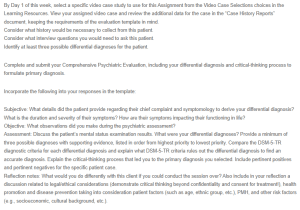
By Day 1 of this week, select a specific video case study to use for this Assignment from the Video Case Selections choices in the Learning Resources. View your assigned video case and review the additional data for the case in the “Case History Reports” document, keeping the requirements of the evaluation template in mind.
Consider what history would be necessary to collect from this patient.
Training Title 21 – Comprehensive Psychiatric Evaluation
Consider what interview questions you would need to ask this patient.
Identify at least three possible differential diagnoses for the patient.
Complete and submit your Comprehensive Psychiatric Evaluation, including your differential diagnosis and critical-thinking process to formulate primary diagnosis.
Incorporate the following into your responses in the template:
Subjective: What details did the patient provide regarding their chief complaint and symptomology to derive your differential diagnosis? What is the duration and severity of their symptoms? How are their symptoms impacting their functioning in life?
Objective: What observations did you make during the psychiatric assessment?
Assessment: Discuss the patient’s mental status examination results. What were your differential diagnoses? Provide a minimum of three possible diagnoses with supporting evidence, listed in order from highest priority to lowest priority. Compare the DSM-5-TR diagnostic criteria for each differential diagnosis and explain what DSM-5-TR criteria rules out the differential diagnosis to find an accurate diagnosis. Explain the critical-thinking process that led you to the primary diagnosis you selected. Include pertinent positives and pertinent negatives for the specific patient case.
Reflection notes: What would you do differently with this client if you could conduct the session over? Also include in your reflection a discussion related to legal/ethical considerations (demonstrate critical thinking beyond confidentiality and consent for treatment!), health promotion and disease prevention taking into consideration patient factors (such as age, ethnic group, etc.), PMH, and other risk factors (e.g., socioeconomic, cultural background, etc.).
 Complete the order form and upload all of your files, including any instructions, rubrics, or other materials provided by your instructor.
  Complete the order payment after filling in the order form. We’ll receive your order and assign it to a writer.
 The assigned writer will complete your paper and forward it to our Editing Team for review and approval.
 Once approved by the editor, the completed paper will be uploaded to your account for you to download, review and approve.