
The Theme of Conflict in Amy Tan’s Two Kinds
The theme of conflict has been intensively depicted throughout the short story “Two Kinds” by Amy Tan. Jing Mei Too recalls her childhood struggles and challenges influenced by her mother’s persistent efforts to make her become the ideal person of her desire. Too’s mother’s desires contradicted Too’s wishes and personality. “Why don’t you like me the way I am? I’m not a genius!” (Tan 33). Too often questioned her mother’s actions in trying to make her someone she was not. The primary goal of Jing Mei Too’s mother was for her daughter to become a prodigy child. Jing often contradicted her mother’s efforts by demonstrating that she was not a genius.
Jing Mei Too’s mother believed that anybody could become a famous figure in America. Following her losses in China and migrating to America, Too’s mother believed that her daughter becoming a prodigy would be the first step toward healing from the loss. Too’s mother thought that her daughter would become a Chinese Shirley Temple, a famous children’s film star during her childhood. Jing Mei Too’s mother often captured her daughter’s attention while watching related films, which acted as a tutor for the person she dreamed of her daughter becoming. In the beginning, Jing Mei Too was excited about the fame awaiting her, especially after seeing her new look with a stylish and well-groomed appearance. On the contrary, Jing Mei Too grew impatient with the prodigy’s future. “If you don’t hurry up and get me out of here, I’m disappearing for good” (Tan 32). Jing Mei Too felt disappointment toward her parents, especially her mother, for not achieving and becoming her dream daughter. Often, Jing Mei Too’s mother challenged her with questions that aimed to elevate her knowledge. However, Jing Too could not bear the pressure imposed on her. At times, she willingly disappointed her mother by giving shallow responses to her questions that portrayed her incompetency. Jing Too’s mother began losing hope in her daughter’s excellence.
Jing Mei Too’s mother was not willing to give up on her daughter becoming a prodigy. After numerous days of watching a television show, The Ed Sullivan Show, Jing Mei Too’s mother developed an interest in piano playing from the show’s music. The mother saw an opportunity for her daughter to become a prodigy. Jing Mei Too was enrolled in piano lessons with the guidance of Mr. Chong, a retired piano teacher. Jing Mei Too was very agitated by the initiative. She said, “I can’t play the piano. And even if I could, I wouldn’t go on TV if you paid a million dollars!” (Tan 33). Jing echoed to her mother as a way to demoralize her efforts. However, Too’s resistance did not shut down her mother’s determination. “Who asks you to be a genius? Just ask you to be your best. For your sake” (Tan 33). Jing Mei Too’s mother offered housekeeping services in exchange for piano lessons for her daughter. However, Jing Mei Too’s parents were disappointed following a performance by their daughter in a talent show. Despite the regular practice lessons, Jing Mei Too’s presentation was the most embarrassing piece. Even so, the performance did not diminish Jing Mei Too’s mother. She remained persistent and insisted that her daughter continue with her piano lessons. The endless efforts wore down Jing Mei Too. “You want me to be someone that I’m not! I’ll never be the kind of daughter you want me to be!” (Tan 35). In response, her mother stated that the kind of daughter she wanted was one who was obedient and followed their mind; only the obedient one is accepted in their house (Tan 35). Jing Mei Too went to the extent of disappointing her mother by wishing she had never been born or that she was not her daughter.
Different scholars have analyzed and criticized “Two Kinds” by Amy Tan. Some depict the short story as an intricate piece. The short story focuses on the mother-daughter struggle for control, which is culturally unacceptable. Jing Mei’s struggle for independence contrasts with her mother’s fight for dominance, as depicted in her Chinese culture (Hoyte 162). Jing Mei’s mother coerces her daughter to engage in various practices that would make her a prodigy. On the contrary, Jing rebels against her mother’s efforts, which is a great disappointment to her mother’s dream for her daughter. The symbolism of “Two Kinds” is also complicated, calling for critical understanding and analysis of the story’s perspectives. Tan explores the essence of self-identity as portrayed by Jing Mei through her rebellious character. The importance of embracing individualism leads to critiques of the effectiveness of parental ambitions and children’s desires for self-discovery (Rashid 35). Critics play a vital role in addressing societal changes explored by writers in their work. Individuals have the freedom to hold personal opinions, prompting writers to incorporate ethics into their creations.
Works Cited
Hoyte, Kirsten Dinnall. “Contradiction and Culture: Revisiting Amy Tan’s “Two Kinds” (Again).” Minnesota Review, vol. 61, 2004, pp. 161–69. muse.jhu.edu/article/429414/summary.
Rashid, Akm. ““Why Don’t You Like Me the Way I Am? I’m Not a Genius”: A Mistakable Understanding of a Child Prodigy in Amy Tan’s Two Kinds, the Symbolic Crisis of Identity in the Specific Contexts of the American Dream.” IOSR Journal of Humanities and Social Science (IOSR-JHSS, vol. 19, no. 1, 2014, pp. 33–36, www.iosrjournals.org/iosr-jhss/papers/Vol19-issue1/Version-2/F019123336.pdf.
Tan, Amy. “Two Kinds.” Being People Children, pp. 30–37.
ORDER A PLAGIARISM-FREE PAPER HERE
We’ll write everything from scratch
Question 
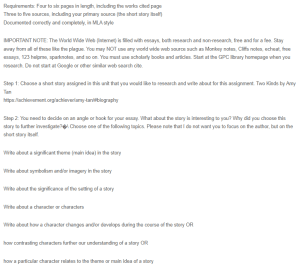
Requirements: Four to six pages in length, including the works cited page
Three to five sources, including your primary source (the short story itself)
Documented correctly and completely, in MLA style
The Theme of Conflict in Amy Tan’s Two Kinds
IMPORTANT NOTE: The World Wide Web (Internet) is filled with essays, both research and non-research, free and for a fee. Stay away from all of these like the plague. You may NOT use any world wide web source such as Monkey notes, Cliffs notes, echeat, free essays, 123 helpme, sparknotes, and so on. You must use scholarly books and articles. Start at the GPC library homepage when you research. Do not start at Google or other similar web search cite.
Step 1: Choose a short story assigned in this unit that you would like to research and write about for this assignment. Two Kinds by Amy Tan
https://achievement.org/achiever/amy-tan/#biography
Step 2: You need to decide on an angle or hook for your essay. What about the story is interesting to you? Why did you choose this story to further investigate?�\ Choose one of the following topics. Please note that I do not want you to focus on the author, but on the short story itself.
Write about a significant theme (main idea) in the story
Write about symbolism and/or imagery in the story
Write about the significance of the setting of a story
Write about a character or characters
Write about how a character changes and/or develops during the course of the story OR
how contrasting characters further our understanding of a story OR
how a particular character relates to the theme or main idea of a story
Step 3: Write down your own ideas either on note cards, on notebook paper, or typed on a page. Write a literary analysis essay using only your own thoughts/ideas and supporting your points with appropriate quotations from the story.
Step 4: Research what critics have written about the story. Do your best to locate a few very good sources. A few good sources are better than many lousy ones that don’t really have anything to do with what you really want to investigate about the story. Make sure your sources are full text and that you truly understand what each critic is saying about the story. Do not ever try to use a source that you do not understand!
Step 5: Reread your rough draft. Now rewrite it and improve it by using the material that you have found while doing your research. After researching, you may have changed your mind in some respects; this is ok. Just make any necessary changes to your argument. You may directly quote, paraphrase, or summarize the critics, but be sure to document correctly.
Step 6: Revise as many times as you see fit. Be sure you have correctly used MLA documentation to avoid plagiarism. This is VERY important. Proofread several times to correct any mistakes in grammar, punctuation, or spelling.
 Complete the order form and upload all of your files, including any instructions, rubrics, or other materials provided by your instructor.
  Complete the order payment after filling in the order form. We’ll receive your order and assign it to a writer.
 The assigned writer will complete your paper and forward it to our Editing Team for review and approval.
 Once approved by the editor, the completed paper will be uploaded to your account for you to download, review and approve.