
PSY 520 SPSS Assignment 3
Question 1
A between-subjects design compares different groups of participants, with each participant experiencing only one condition of the independent variable. This approach prevents carryover effects but requires more participants to achieve statistical power. In contrast, a repeated-measures design (also called within-subjects) tests the same participants across all conditions of the independent variable. Although this method uses fewer participants and improves statistical power by accounting for individual variations, it runs the risk of introducing order effects such as practice, weariness, or carryover effects: PSY 520 SPSS Assignment 3.
Researchers using repeated-measures designs must counterbalance conditions in order to minimize these potential confounds. Between-subjects designs are preferable when treatments have lasting effects or when practice effects are unavoidable. At the same time, repeated-measures designs work well when individual differences might significantly impact results or when participant recruitment is difficult or costly. The choice between these designs ultimately depends on the specific research question, available resources, ethical considerations, and the nature of the variables being studied.
Question 2
Part a
Part b
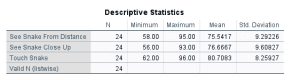
The results indicate varying levels of anxiety between the three conditions of snakes to which participants were exposed. The mean of the anxiety measure of perceiving a snake at a distance (M = 75.54, SD = 9.29) is slightly less compared to perceiving a snake at closer proximity (M = 76.67, SD = 9.61), implying that proximity might enhance anxiety. Nevertheless, the highest levels of anxiety were registered within the touch condition (M = 80.71, SD = 8.26), implying that physical touch with a snake elicits much greater levels of anxiety compared to mere vision of the snake.
The trend is that the levels of anxiety are increasing progressively with the intensity of the engagement with the feared stimulus increasing, with a difference of about 5 points between the least provoking of the conditions (perceiving at a distance) and the most provoking of the conditions (touch). The equal standard deviations between conditions indicate equal variability of participants’ responses regardless of the kind of exposure.
Question 3
Part a

Part b
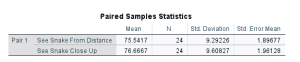
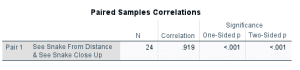
A paired-sample t-test was conducted to compare levels of anxiety at a distance to levels of anxiety up close to a snake. No significant difference was revealed between levels of anxiety at a distance (M = 75.54, SD = 9.29) and levels of anxiety up close to a snake (M = 76.67, SD = 9.61); t(23) = -1.45, p = .162. The slightly higher mean measure of anxiety was revealed within the up-close condition, although this was not statistically significant.
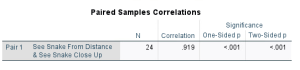
The strong positive correlation between the two conditions (r = .919, p < .001) also signifies those participants who had a high measure of anxiety at a distance also had the propensity to have a high measure of anxiety up close to a snake with the measures of individual anxiety being fairly stable between the two conditions of viewing.
Question 4
Effect of Tempo in Music on Sports Performance in Different Exercise Types
This experiment examines the influence of different tempos in music on the performance under different exercise modes. The research’s independent variable is music tempo, and this is classified into three levels: the control (no music), 60-80 BPM (slow tempo), and 140-160 BPM (fast tempo). The research’s dependent variable is the measurement of the performance, in terms of the distance covered in the 3-minute trial, under the three exercise modes such as running, cycling, and rowing.
The study will enroll 30 participants who will experience all nine conditions (3 music conditions × 3 exercise types) in random sequence in multiple sessions to eliminate the effect of fatigue. The participants will each experience each exercise type under each music condition, and there will be a sufficient rest period between the tests to provide the same quality of performance. The distance covered in each 3-minute test will be measured by standard equipment in use in each exercise type.
This experimental design requires the use of repeated-measures ANOVA because, first, the research uses two within-subject factors: music tempo and exercise type. This 3×3 between-subject design implies each person gets to experience all the conditions, making possible the examination of main and interaction effects and the control of between-subject variability in terms of athleticism, motivation, and body-related traits. Second, the repeated-measures design significantly raises the statistical power by eliminating between-subject variability. This is significant because the expected between-subject variability in the participants’ basal fitness and responsiveness to music means between-subject variability could hide the effect size.
Third, the experiment attempts to examine possible interaction effects, such as how the effect of music tempo could vary depending on the exercise. The repeated-measures ANOVA offers the most effective way to examine such complex interactions. Fourth, the design is efficient in terms of the use of participants, requiring less in comparison to the between-subject strategy, and also allows the examination of the detailed patterns between the different conditions and the control of between-subject variability.
In sum, the repeated-measures design in the current experiment makes the use of repeated-measures ANOVA appropriate. It allows proper investigation into the effect of music tempo during exercise under different exercise modalities while controlling intersubject variability and gaining the most statistical power.

Part b
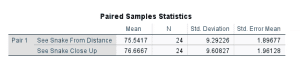
A paired-sample t-test was conducted to compare levels of anxiety at a distance to levels of anxiety up close to a snake. No significant difference was revealed between levels of anxiety at a distance (M = 75.54, SD = 9.29) and levels of anxiety up close to a snake (M = 76.67, SD = 9.61); t(23) = -1.45, p = .162. The slightly higher mean measure of anxiety was revealed within the up-close condition, although this was not statistically significant.
The strong positive correlation between the two conditions (r = .919, p < .001) also signifies those participants who had a high measure of anxiety at a distance also had the propensity to have a high measure of anxiety up close to a snake with the measures of individual anxiety being fairly stable between the two conditions of viewing.
Question 4
Effect of Tempo in Music on Sports Performance in Different Exercise Types
This experiment examines the influence of different tempos in music on the performance under different exercise modes. The research’s independent variable is music tempo, and this is classified into three levels: the control (no music), 60-80 BPM (slow tempo), and 140-160 BPM (fast tempo). The research’s dependent variable is the measurement of the performance, in terms of the distance covered in the 3-minute trial, under the three exercise modes such as running, cycling, and rowing.
The study will enroll 30 participants who will experience all nine conditions (3 music conditions × 3 exercise types) in random sequence in multiple sessions to eliminate the effect of fatigue. The participants will each experience each exercise type under each music condition, and there will be a sufficient rest period between the tests to provide the same quality of performance. The distance covered in each 3-minute test will be measured by standard equipment in use in each exercise type.
This experimental design requires the use of repeated-measures ANOVA because, first, the research uses two within-subject factors: music tempo and exercise type. This 3×3 between-subject design implies each person gets to experience all the conditions, making possible the examination of main and interaction effects and the control of between-subject variability in terms of athleticism, motivation, and body-related traits. Second, the repeated-measures design significantly raises the statistical power by eliminating between-subject variability. This is significant because the expected between-subject variability in the participants’ basal fitness and responsiveness to music means between-subject variability could hide the effect size.
Third, the experiment attempts to examine possible interaction effects, such as how the effect of music tempo could vary depending on the exercise. The repeated-measures ANOVA offers the most effective way to examine such complex interactions. Fourth, the design is efficient in terms of the use of participants, requiring less in comparison to the between-subject strategy, and also allows the examination of the detailed patterns between the different conditions and the control of between-subject variability.
In sum, the repeated-measures design in the current experiment makes the use of repeated-measures ANOVA appropriate. It allows proper investigation into the effect of music tempo during exercise under different exercise modalities while controlling intersubject variability and gaining the most statistical power.
ORDER A PLAGIARISM-FREE PAPER HERE
We’ll write everything from scratch
Question 
Complete the SPSS Assignment 3 Word document using the Snake Anxiety data set, and refer to the first half of the video tutorial (SPSS Tutorial Video 3: Repeated Measures) for guidance (watch up to around 6:43). Please disregard the second half of the video that talks about conducting a repeated-measures analysis (ANOVA), as this is not needed for this assignment.
Submit your assignment here. Make sure you’ve included all the required elements by reviewing the guidelines and rubric.
PSY 520 SPSS Assignment 3
Notes:
- For the third week in a row, we have yet another SPSS assignment. For this assignment, you will use a snake anxiety data set, which you will find in the usual place. You will also see a tutorial video in the readings and resources section in bright space. Please note that you only need to watch the first half of the video
Textbook:
 Complete the order form and upload all of your files, including any instructions, rubrics, or other materials provided by your instructor.
  Complete the order payment after filling in the order form. We’ll receive your order and assign it to a writer.
 The assigned writer will complete your paper and forward it to our Editing Team for review and approval.
 Once approved by the editor, the completed paper will be uploaded to your account for you to download, review and approve.