
Polycystic Ovary Syndrome
Polycystic Ovary Syndrome (PCOS) is a common endocrine disorder that disrupts the homeostatic balance of the female reproductive system. This condition is marked by elevated levels of androgens, irregular menstrual cycles, and multiple cysts that develop in the ovaries. Apart from that, acne problems and excessive hair growth are manifested, which are associated with high androgen levels in the body (Singh et al., 2023).
Pathophysiology of PCOS
Generally, the pathophysiology of PCOS involves dysfunction of the hypothalamic-pituitary-ovarian axis that leads to impaired hormonal regulation. High secretion of luteinizing hormone (LH) and low levels of follicle-stimulating hormone (FSH) are the chief factors that affect follicular development and hinder ovulation, which leads to anovulation and infertility. One of the main culprits of this hormonal change is insulin resistance, which has been described as a state of reduced sensitivity of body tissues to insulin, hence leading to the overproduction of insulin by the pancreas as a compensatory mechanism. This compensatory hyperinsulinemia, in turn, acts on the ovarian theca cell to produce more androgens such as testosterone. Moreover, insulin also inhibits the production of sex hormone binding globulin (SHBG) in the liver, which consequently leads to increased availability of free androgens in the blood. These explain the classical signs of PCOS, such as irregular periods, excessive hair growth, acne, and multiple immature follicles in the ovaries (Dong & Rees, 2023).
Age-Related Considerations in PCOS
PCOS has been found to affect women of childbearing age, that is, between 15 and 44 years. Symptoms may begin appearing at puberty, but many women are diagnosed in their 20s or even their 30s when they start having reproductive problems and find out that they cannot conceive. Age is a factor in symptoms; young women have irregular cycles and acne, while older women have insulin resistance and obesity. Consequently, age is one of the most significant determinants of disease presentation and its management (Deswal et al., 2020).
Gender, Genetics, and Ethnicity
PCOS can only affect individuals who were born female because it is associated with ovarian complications and androgen production. It is often hereditary, with people who have a family history of the condition or first-degree relatives being more vulnerable. Those women who have a family history of PCOS are likely to have an early onset of manifestation and are likely to be more severe, which also supports the hereditary pattern. Ethnicity is also very significant when it comes to the manifestation and overall incidence of PCOS. Hispanic and South Asian origin women have severe symptoms, including insulin resistance, excessive hair growth as well as other metabolic complications, as compared to East Asian women (Sendur & Yildiz, 2021).
Ethical Concerns in PCOS Management
There are several ethical issues arising from the management of PCOS, most of which involve informed consent and patients’ autonomy to decide on their reproductive options. Young Adolescent girls diagnosed with PCOS may have to make decisions on hormonal therapies or fertility options before they are knowledgeable or competent in processing information regarding reproductive options. Furthermore, weight-based stigma in healthcare settings puts patients at risk for unfair treatment, which is a violation of respect and equity for the patient. Ethical care revolves around the principles of respecting patients’ autonomy and confidentiality, being free from coercion, and having a nonjudgmental attitude while assisting patients in making decisions about their care (Peña et al., 2020).
Health Promotion Strategies
Patient education on modification of diet, exercise habits, and weight management is a crucial health promotion strategy for women who have been diagnosed with PCOS. Health literacy plays a critical role in giving the patient essential information regarding self-management of the condition and thus preventing possible complications such as type 2 diabetes and cardiovascular diseases. Health professionals must encourage early screening and awareness creation to diagnose the disorders at the earliest stage possible. Other approaches focus on raising awareness and reducing the stigma around the condition to enhance the support structures of those diagnosed with the condition (Cowan et al., 2023).
Health Restoration Interventions
Lifestyle changes in PCOS aim at managing the symptoms and bringing back hormonal balance to normalcy. For menstrual cycle normalizations, oral contraceptive pills can be used, while hirsutism and insulin resistance are treated with anti-androgen and insulin sensitizers, respectively. Ovulation induction agents are used for women intending to get pregnant. If these interventions are optimized according to the goals of the person and when followed up almost constantly, they will go a long way into improving quality of life and fertility-related aspects of health, making it a major achievement (Alesi et al., 2023).
Health Maintenance in Ongoing Care
The long-term management for those patients with PCOS entails routine check-ups and care to ensure that metabolic factors are under control and to avoid the development of other complications. It is also crucial to actively screen and monitor serum glucose levels, lipid profile, and blood pressure. Counseling is also essential, as women experiencing PCOS are prone to anxiety and depression. Patient-centered teamwork concepts enhance patients’ compliance with therapeutic practices, hence, resulting in quality, healthy lives (Che et al., 2023).
Conclusion
The overall strategy for managing PCOS comprises education, medical management, modification of lifestyle, and psychological intervention. While potential ethical issues have to be considered when determining care, those in the provider roles have to evaluate risk factors based on the patient’s age, ethnicity, and genetic predispositions. The intervention should focus on achieving a healthier status, achieving reproductive rights and goals, and maintaining overall health. Therefore, with a good approach, knowledge, and ethics, the effects caused by PCOS can be managed, hence allowing the patient to lead a healthy reproductive and healthy life.
References
Alesi, S., Forslund, M., Melin, J., Romualdi, D., Peña, A., Tay, C. T., Witchel, S. F., Teede, H., & Mousa, A. (2023). Efficacy and safety of anti-androgens in the management of polycystic ovary syndrome: A systematic review and meta-analysis of randomised controlled trials. EClinicalMedicine, 63, 102162. https://doi.org/10.1016/j.eclinm.2023.102162
Che, Y., Yu, J., Li, Y., Zhu, Y., & Tao, T. (2023). Polycystic ovary syndrome: Challenges and possible solutions. Journal of Clinical Medicine, 12(4), 1500. https://doi.org/10.3390/jcm12041500
Cowan, S., Lim, S., Alycia, C., Pirotta, S., Thomson, R., Gibson-Helm, M., Blackmore, R., Naderpoor, N., Bennett, C., Ee, C., Rao, V., Mousa, A., Alesi, S., & Moran, L. (2023). Lifestyle management in polycystic ovary syndrome – beyond diet and physical activity. BMC Endocrine Disorders, 23(1). https://doi.org/10.1186/s12902-022-01208-y
Deswal, R., Narwal, V., Dang, A., & Pundir, C. S. (2020). The prevalence of polycystic ovary syndrome: A brief systematic review. Journal of Human Reproductive Sciences, 13(4), 261–271. https://doi.org/10.4103/jhrs.JHRS_95_18
Dong, J., & Rees, D. A. (2023). Polycystic ovary syndrome: Pathophysiology and therapeutic opportunities. BMJ Medicine, 2(1), e000548. https://doi.org/10.1136/bmjmed-2023-000548
Peña, A. S., Witchel, S. F., Hoeger, K. M., Oberfield, S. E., Vogiatzi, M. G., Misso, M., Garad, R., Dabadghao, P., & Teede, H. (2020). Adolescent polycystic ovary syndrome according to the international evidence-based guideline. BMC Medicine, 18(1). https://doi.org/10.1186/s12916-020-01516-x
Sendur, S. N., & Yildiz, B. O. (2021). Influence of ethnicity on different aspects of polycystic ovary syndrome: A systematic review. Reproductive BioMedicine Online, 42(4), 799–818. https://doi.org/10.1016/j.rbmo.2020.12.006
Singh, S., Pal, N., Shubham, S., Sarma, D. K., Verma, V., Marotta, F., & Kumar, M. (2023). Polycystic ovary syndrome: Etiology, current management, and future therapeutics. Journal of Clinical Medicine, 12(4), 1454. https://doi.org/10.3390/jcm12041454
ORDER A PLAGIARISM-FREE PAPER HERE
We’ll write everything from scratch
Question 
Polycystic Ovary Syndrome
For this journal you will examine alterations in the homeostatic state of one condition of your choice, in the required reading, regarding the reproductive system.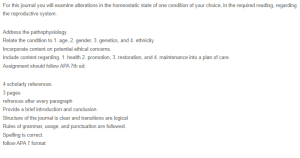
Address the pathophysiology.
Relate the condition to 1. age, 2. gender, 3. genetics, and 4. ethnicity.
Incorporate content on potential ethical concerns.
Include content regarding, 1. health 2. promotion, 3. restoration, and 4. maintenance into a plan of care.
Assignment should follow APA 7th ed.
4 scholarly references.
3 pages
refrences after every paragraph
Provide a brief introduction and conclusion.
Structure of the journal is clear and transitions are logical
Rules of grammar, usage, and punctuation are followed.
Spelling is correct.
follow APA 7 format
 Complete the order form and upload all of your files, including any instructions, rubrics, or other materials provided by your instructor.
  Complete the order payment after filling in the order form. We’ll receive your order and assign it to a writer.
 The assigned writer will complete your paper and forward it to our Editing Team for review and approval.
 Once approved by the editor, the completed paper will be uploaded to your account for you to download, review and approve.