
Pharmacology week 4 assignment
Scenario 1
Linagliptin 5 mg PO daily #30 5 RF
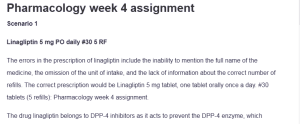
The errors in the prescription of linagliptin include the inability to mention the full name of the medicine, the omission of the unit of intake, and the lack of information about the correct number of refills. The correct prescription would be Linagliptin 5 mg tablet, one tablet orally once a day. #30 tablets (5 refills): Pharmacology week 4 assignment.
The drug linagliptin belongs to DPP-4 inhibitors as it acts to prevent the DPP-4 enzyme, which disintegrates incretin hormones (Nigro & Goldman, 2021). Linagliptin amplifies insulin discharge and stops glucagon secretion in a sugar-based direction by raising incretin levels, ultimately assisting in reducing the blood sugar in patients with type 2 diabetes.
Tresiba inject 10 units SC TID with meals #1 box of 5 pens 1 RF
Prescription of Tresiba contains mistakes that include substitution of the correct term of injectable with inject, lack of giving the correct frequency, and details on the number of pens or the number of refills. A correct prescription will be as follows: Tresiba (insulin degludec) 10 units s.c. once a day with meals. #5 pens (1 refill).
Tresiba belongs to the long-acting insulin analogs group that is supposed to behave exactly as insulin in its natural slow-release over time manner (Li & He, 2022). It also binds insulin receptors in the cells to induce glucose uptake and reduce blood glucose levels, and it has a prolonged action that lasts up to 42 hours.
Tiotropium (Spiriva) 2.5 mcg PO BID #60 1 RF
The mistakes in the prescription of tiotropium are the prescription of PO (oral route) instead of inhalation route and the failure to define the dose strength about frequency. The corrected prescription is as follows: Tiotropium (Spiriva) 2.5 mcg of inhalation powder, to inhale one capsule (via HandiHaler device) once a day. #60 capsules (1 refill). Tiotropium is an anticholinergic and bronchodilator, which means that it blocks acetylcholine receptors in the airways (Delgado & Bajaj, 2022). This inhibition helps lessen bronchoconstriction, making it cause bronchodilation, thus enhancing airflow, especially in the treatment of chronic obstructive pulmonary disease (COPD) and asthma.
Qulipta 60 mg PRN for migraine #30 1 RF
It is an incorrect prescription of Qulipta because it is suggested as a PRN (as needed) drug but is supposed to be taken regularly to prevent migraines and does not specify either the exact number of doses or refills. Corrected prescription: Qulipta (atonement) 60 mg oral tablet, amount 1, quantity; 1 every day to prevent a migraine. #30 tabs- (1 refill). Qulipta is referred to as a CGRP receptor antagonist, a medication that prevents the activation of a calcitonin gene-related peptide (CGRP) receptor (Ottawa (ON), 2024). This inhibits vasodilation and inflammation that occurs in migraines and decreases the number and severity of migraine attacks.
Levothyroxine 88 mg PO daily #30 5 RF
There is an error in the dosage of levothyroxine prescription 88 mg instead of mcg, and no clarification about the unit. A corrected prescription would read as follows: Levothyroxine 88 mcg tablet, one tablet by mouth once a day #30 tablets (5 refills). Levothyroxine can be grouped as a synthetic thyroid hormone, and it acts by raising the level of thyroid hormone in the body, hence regulating metabolism, growth, and energy production (Eghtedari & Correa, 2023). It resembles the activity of the natural thyroid hormone to normalize the thyroid activity in a hypothyroid patient.
Scenario 2
Treatment Plan for PK
The presence of frequent albuterol use, night coughing, and daily symptoms indicates that the asthma control of PK is insufficient. I recommend raising her ICS dose, which will help to control her asthma and decrease the use of rescue inhalers. I would also consider adding LABA, which would promote bronchodilation and help prevent exacerbations further (Liang & Chao, 2023). The treatment plan is to enhance the fluticasone dose add, salmeterol, and eliminate the use of diphenhydramine, which induces sleepiness.
Medication Changes
To treat PK, the change in the medications will be done by taking Flovent HFA 110 mcg two times a day, two puffs, and Serevent (salmeterol) 50 mcg, one puff at night. Fexofenadine is to be extended in case of allergic symptoms. I would stop using diphenhydramine because of its sedative side effect (Clark et al., 2025). It will improve the management of her symptoms of asthma and will minimize the demand to involve the use of albuterol.
Corrected Medication Order
The correct medication order on PK is Flovent HFA (fluticasone propionate) 110 mcg in 2 puffs twice daily (AM and PM)—order quantity amount: #30 and 3 refills. Moreover, Serevent (salmeterol) 50 mcg, one puff by inhalation at night, 30 mg dose, and one refill of #30 MDI is ordered. The Proventil HFA (albuterol) 90 mcg will be inhaled at two puffs every 4-6 hours when needed, and the amount will be # 200 MDI and three refills (Johnson et al., 2024). Lastly, Fexofenadine 180 mg is to be administered as one tablet orally once per day; product quantity #30 tablets and one refill are also prescribed.
Monitoring Effectiveness
Follow up with PK on asthma by checking on her albuterol use target less than 2 days/week, nocturnal symptoms target less than 2 nights/month, and peak flow measurement (Johnson et al., 2024). A 4-6 week follow-up is necessary to determine control and make medication adjustments should they be required. Should the symptoms persist, an additional escalation with the use of a leukotriene receptor antagonist is required.
Patient Education
PK needs to learn about the correct use of inhalers, the consistent use of Flovent, and how to avoid asthma aggravations. She must also be aware of the necessity of adhering to the asthma action plan, as well as the times during which it is necessary to consult medical help in case of symptom aggravation (Goldin et al., 2024). Effective ways of using the medications and managing the triggers can result in long-term asthma control.
Scenario 3
Information to Provide to ES
I would inform ES that his blood pressure level of 142/89 mmHg is not on target and may put him at risk of heart disease, stroke, and renal issues. It is very necessary that blood pressure medication must be regularly taken to minimize these risks regardless of side effects that may be there. I would respond to his fears concerning bisoprolol and indicate that side effects are treatable and the treatment can be altered (Bazroon & Alrashidi, 2023). The significance of the management of blood pressure by measures that include medicine and adaptation in lifestyle would be highlighted.
Goal Blood Pressure
Guidelines recommended by the American College of Cardiology (ACC), American Heart Association (AHA), and JNC 8 suggest that adults diagnosed with hypertension must have a blood pressure of less than 130/80mmHg (Mahdavi et al., 2020). The current blood pressure of 142/ 89 mmHg points to the fact that the blood pressure in ES is not appropriately controlled, and his treatment regimen needs to be revised to minimize the chances of him developing cardiovascular complications.
Hypertension Treatment per Current Guidelines
The most common treatment of hypertension is through lifestyle changes, including limiting the amount of sodium in the diet, performing more physical activities, and balanced weight. In pharmacologic therapy, ACE inhibitors, ARBs, calcium channel blockers (CCBs), and thiazide diuretics are to be used as first-line prescribers.
In African American patients, such as ES, CCBs, and thiazide diuretics are preferred since these drugs are more effective in African Americans (Khalil & Zeltser, 2023). Beta-blockers (such as bisoprolol) are not considered first-line therapy in the group, with some exceptions, such as the presence of other conditions, such as heart failure.
Improving His Treatment
To enhance the symptoms of ES, I would change bisoprolol to Amlodipine 5 mg, a CCB, and Chlorthalidone 25 mg, a thiazide diuretic agent. This combination will work better in African American patients and will bring their blood pressure under control. The whole prescription would consist of the following: Amlodipine 5 mg, one tablet by mouth once per day; Chlorthalidone 25 mg, one tablet by mouth once per day in the morning. Both drugs would be ordered with a 30-day supply and three fills (Patel & Patel, 2024). I would also arrange a follow-up session after 2-4 weeks in order to determine the effectiveness of the new treatment.
Scenario 4
Goal A1C for TF
The aim of TF A1C should be equal to or below 7 percent, which is suggested by the American Diabetes Association (ADA) in most adult people with diabetes. His A1C at present is 8.5%; this means that his blood glucose is not under control, and the aim is to reduce his A1C without compromising the risks of complications like cardiovascular diseases, kidney damage, and neuropathy (Eyth et al., 2025).
Best Medication for TF
Since TF has impaired renal function (eGFR 28), and also since he has early Alzheimer’s disease, canagliflozin (Invokana) 100 mg PO daily presents the most appropriate option for him. Canagliflozin is an SGLT2 that facilitates the release of glucose into the urine, thereby reducing the level of blood glucose. It is also known to improve renal function and cardiovascular health, which are important to TF since he has renal impairment (Khalid & Patel, 2024). Compared to other drugs, such as sulfonylureas (glimepiride, glyburide), canagliflozin is associated with a reduced probability of hypoglycemia, which makes it a more appropriate drug for TF.
Complete Medication Order
The whole medication order of TF would be as follows: Canagliflozin (Invokana) 100 mg PO qd. 1 tablet per mouth once a day. #30 tablets (3 refills) (Khalid & Patel, 2024). Such a treatment regimen would aid in decreasing the blood glucose level of TF and prevent the development of additional complications.
References
Bazroon, A. A., & Alrashidi, N. F. (2023, August 17). Bisoprolol. StatPearls – NCBI Bookshelf. https://www.ncbi.nlm.nih.gov/books/NBK551623/
Clark, J. H., Meltzer, E. O., & Naclerio, R. M. (2025). Diphenhydramine: It is time to say a final goodbye. World Allergy Organization Journal, 18(2), 101027. https://doi.org/10.1016/j.waojou.2025.101027
Delgado, B. J., & Bajaj, T. (2022, February 15). Tiotropium. StatPearls – NCBI Bookshelf. https://www.ncbi.nlm.nih.gov/books/NBK541127/
Eghtedari, B., & Correa, R. (2023, August 28). Levothyroxine. StatPearls – NCBI Bookshelf. https://www.ncbi.nlm.nih.gov/books/NBK539808/
Eyth, E., Zubair, M., & Naik, R. (2025, June 2). Hemoglobin A1C. StatPearls – NCBI Bookshelf. https://www.ncbi.nlm.nih.gov/books/NBK549816/
Goldin, J., Hashmi, M. F., & Cataletto, M. E. (2024, May 3). Asthma. StatPearls – NCBI Bookshelf. https://www.ncbi.nlm.nih.gov/books/NBK430901/
Johnson, D. B., Merrell, B. J., & Bounds, C. G. (2024, January 10). Albuterol. StatPearls – NCBI Bookshelf. https://www.ncbi.nlm.nih.gov/books/NBK482272/
Khalid, Z., & Patel, P. (2024, February 27). Canagliflozin. StatPearls – NCBI Bookshelf. https://www.ncbi.nlm.nih.gov/books/NBK603733/
Khalil, H., & Zeltser, R. (2023, May 8). Antihypertensive medications. StatPearls – NCBI Bookshelf. https://www.ncbi.nlm.nih.gov/books/NBK554579/
Li, J., & He, Q. (2022). Evaluation of Tresiba combined with Six Ingredient Rehmannia Pill in the treatment of type 2 diabetes. Journal of Healthcare Engineering, 2022, 1–6. https://doi.org/10.1155/2022/2177176
Liang, T. Z., & Chao, J. H. (2023, May 8). Inhaled corticosteroids. StatPearls – NCBI Bookshelf. https://www.ncbi.nlm.nih.gov/books/NBK470556/
Mahdavi, M., Parsaeian, M., Mohajer, B., Modirian, M., Ahmadi, N., Yoosefi, M., Mehdipour, P., Djalalinia, S., Rezaei, N., Haghshenas, R., Pazhuheian, F., Madadi, Z., Sabooni, M., Razi, F., Samiee, S. M., & Farzadfar, F. (2020). Insight into blood pressure targets for universal coverage of hypertension services in Iran: The 2017 ACC/AHA versus JNC 8 hypertension guidelines. BMC Public Health, 20(1). https://doi.org/10.1186/s12889-020-8450-1
Nigro, S. C., & Goldman, J. D. (2021). Linagliptin-Induced arthralgia. Clinical Diabetes, 40(1), 109–112. https://doi.org/10.2337/cd20-0110
Ottawa (ON). (2024, July). Atogepant (Qulipta). Canadian Agency for Drugs and Technologies in Health. NCBI Bookshelf. https://www.ncbi.nlm.nih.gov/books/NBK606535/
Patel, P., & Patel, J. B. (2024, May 1). Chlorthalidone. StatPearls – NCBI Bookshelf. https://www.ncbi.nlm.nih.gov/books/NBK553174/
ORDER A PLAGIARISM-FREE PAPER HERE
We’ll write everything from scratch
Question 
DIRECTIONS
For each of the scenarios below, answer the questions using your learning resources, Medscape, and clinical practice guidelines (ie JNC 8, AHA, ACC etc). Lecturio is an optional resource but highly recommended. Be sure to thoroughly answer ALL questions. When recommending medications, write out a complete medication order.
What would you send to a pharmacy? Include drug, dose, route, frequency, special instructions, # dispensed (days supply) and refill information. Also state if you would continue, discontinue or taper the patient’s current medications.
Review and discuss ALL labs and possible interactions. Use at least 3 sources for each scenario and cite sources using APA format; include in-text citations. You do not need an introduction or conclusion paragraph. Please also review assignment rubric.
To Prepare:
- Review assignment rubric and case studies. Be sure to answer ALL thoroughly
- Explain the problem and discuss how you would address the problem.
- When recommending medications, write out a complete prescription for each medication. What order would you send to a pharmacy? Include drug, dose, route, frequency, special instructions, # dispensed (days supply), refills, etc. Also, state if you would continue, discontinue or taper the patient’s current medications.
- Answer questions using your learning resources, Medscape, and clinical practice guidelines (ie JNC 8, AHA, ACC etc). Lecturio is an optional resource but highly recommended Include at least three references to support each scenario and cite them in APA format. Please include in-text citations. You do not need an introduction or conclusion paragraph.
- Assignments require evidence-based literature (primary resources and clinical guidelines) to support decisions/recommendations. Also, sources should be from within the last 5 years. Please review the rubric each week for EACH assignment to maximize points. The course resources (Lecturio) should be used as a starting point, but further research on the topic should include the most recent, up-to-date clinical resources and guidelines.
- References MUST include applicable clinical guidelines to support and provide a rationale for ALL RECOMMENDATIONS. Please review the following course announcements: Scholarly Sources Expectations and Evidence-Based Literature.
WEEK 4 ASSIGNMENT (covers weeks 3-6)
Pharmacology week 4 assignment
SCENARIO 1
What are the errors in the following prescriptions (5 total)? Rewrite each prescription correctly. What is each medication classification? What is the mechanism of action (MOA)?
- linaglipton 5 mg PO daily #30 5 RF
- Tresiba inject 10 units SC TID with meals #1 box of 5 pens 1 RF
- tiotropium (Spiriva) 2.5 mcg PO BID #60 1 RF
- Qulipta 60 mg PRN for migraine #30 1 RF
- levothyroxine 88 mg PO daily #30 5 RF
SCENARIO 2
PK is a 16-year-old female diagnosed with mild persistent asthma since age 12. During her visit today, she reports having to use her albuterol MDI 3 days per week over the past 2 months. Over the past week she has been using albuterol at least once per day. She reports being awakened by a cough 5 nights during the last month.
She also has a fluticasone MDI, which she uses “most days of the week.” Her current medications include: Flovent HFA 44 mcg two puffs BID, Proventil HFA two puffs Q 4-6 hr PRN shortness of breath, fexofenadine 180 mg po daily, diphenhydramine 50 mg qhs prn. What treatment plan would you implement for PK?
What medication changes would you make? Include a complete medication order. How would you monitor the effectiveness of this plan, and what patient education would you provide?
SCENARIO 3
ES is a 45-year-old African American male that was prescribed bisoprolol for his high blood pressure. Blood pressure today is 142/89 HR 60 RR 15. He states that he only occasionally takes the medication because he does not like the side effects.
What information would you provide to the patient at his visit? What is his goal blood pressure? How is hypertension treated per current guidelines (JNC 8, ACC, AHA)? How would you improve his treatment?
Include a complete medication order.
SCENARIO 4
TF is a 60 year old male presenting to the clinic for medication refills. Current medications include acetylcholinesterase inhibitor donepezil 5 mg po qhs, anti-amyloid monoclonal antibody lecanemab (Leqembi) 10 mg/kg IV every 2 weeks for early Alzheimer’s disease, and atorvastatin 40 mg po daily.
His lab work today includes: fasting BG is 195 mg/dL; HgA1C = 8.5%. Basic Metabolic Profile (BMP) is normal except for Cr 1.9 and eGRF 28.What is his goal A1C? Please SELECT and DISCUSS which of the following would be best to prescribe for TF: (Include a complete medication order)
- canagliflozin (Invokana) 100 mg PO daily
- exenatide (Byetta) 5 mcg SC twice daily
- glimepiride 1 mg PO daily
- glyburide 2.5 mg PO daily
- metformin 500 mg PO daily
- semaglutide (Ozempic) 0.25 mg SC once weekly
- sitagliptin (Januvia) 50 mg PO daily
Resources
- Rosenthal, L. D., & Burchum, J. R. (2021). Lehne’s pharmacotherapeutics for advanced practice nurses and physician assistants (2nd ed.). Elsevier.
- Chapter 64, “Drugs for Peptic Ulcer Disease” (pp. 589a–597)
- Chapter 65, “Laxatives” (pp. 598–604)
- Chapter 66, “Other Gastrointestinal Drugs” (pp. 605–616)
- Chapter 68, “Drugs for Weight Loss” (pp. 627–637)
 Complete the order form and upload all of your files, including any instructions, rubrics, or other materials provided by your instructor.
  Complete the order payment after filling in the order form. We’ll receive your order and assign it to a writer.
 The assigned writer will complete your paper and forward it to our Editing Team for review and approval.
 Once approved by the editor, the completed paper will be uploaded to your account for you to download, review and approve.