
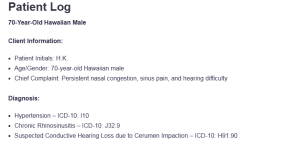
Patient Log
70-Year-Old Hawaiian Male
Client Information:
- Patient Initials: H.K.
- Age/Gender: 70-year-old Hawaiian male
- Chief Complaint: Persistent nasal congestion, sinus pain, and hearing difficulty
Diagnosis:
- Hypertension – ICD-10: I10
- Chronic Rhinosinusitis – ICD-10: J32.9
- Suspected Conductive Hearing Loss due to Cerumen Impaction – ICD-10: H91.90
Procedure:
- Blood pressure readings were obtained on three occasions
- Otoscopic evaluation for cerumen impaction
- Whisper test conducted and failed
- An ENT referral was requested for further hearing and sinus evaluation: Patient Log
Treatment Plan and Notes:
H.K. is a 70-year-old male with uncontrolled hypertension and chronic nasal congestion associated with purulent drainage and facial pressure. He failed the whisper test and has impaction of earwax in both ears, which indicates hearing problems. The patient is a smoker and unemployed, which can potentially be an obstacle in the context of care compliance.
A referral to an ENT specialist was made to determine the hearing and condition of the sinus. Quitting smoking was advised. Blood pressure is to be monitored and controlled. The resumption of nasal corticosteroid treatment can also be reevaluated and supervised in the case of toleration.
45-Year-Old White Male
Client Information:
- Patient Initials: R.B.
- Age/Gender: 45-year-old White male
- Chief Complaint: Chronic nasal congestion and sinus-related symptoms
Diagnosis:
- Allergic Rhinitis – ICD-10: J30.9
- Chronic Rhinosinusitis – ICD-10: J32.9
Procedure:
- Review of upper respiratory history
- Evaluation of nasal and sinus symptoms
- Assessment of medication effectiveness
- ENT referral requested
Treatment Plan and Notes:
R.B. is a 45-year-old male presenting with persistent nasal congestion, purulent drainage, post-nasal drip, nasal crusting, and sinus pressure localized to the frontal and maxillary regions. He also complains about daily headaches and mouth breathing. His past medical history is characterized by allergic rhinitis and sinusitis, which occurred back in 2015. His previous prescription was with Flonase, which he abandoned because it was not alleviating his symptoms, and he complained of headaches.
He denies having undergone a surgical procedure and has asked to be referred to ENT to have the case further investigated. The patient is unemployed, having quit his job as a basketball coach. The plan consists of ENT consultation, such as sinus assessment, examination of other nasal treatments, and referral to an allergist. Future management is recommended in terms of supportive care measures and symptom following.
72-Year-Old Black Male
Client Information:
- Patient Initials: L.W.
- Age/Gender: 72-year-old Black male
- Chief Complaint: Chronic low back pain with lower extremity discomfort
Diagnosis:
- Chronic Low Back Pain – ICD-10: M54.5
- Type 2 Diabetes Mellitus – ICD-10: E11.9
- Hypertension – ICD-10: I10
- Peripheral Edema – ICD-10: R60.0
- Paresthesia of Lower Extremities – ICD-10: R20.2 (Hammi & Yeung, 2022)
Procedure:
- Musculoskeletal and neurological exam
- Pain scale and functional impact assessment
- Lower extremity inspection for edema and sensation
- Medication review and PT history
Treatment Plan and Notes:
L.W. is a 72-year-old male with a history of chronic low back pain dating to 1978. He describes daily tender, cramping, and sharp pain of 8/10 with occasional flares of 9/10 that last several hours with motion or standing still. He has typical numbness and tingling sensations in both legs and wears a back brace over time. There is bilateral edema (2+) with no use of compression socks.
He had undergone physical therapy before but did not undergo back surgery. The existing prescriptions involve Metformin, Tramadol, Hydrochlorothiazide, and Lidocaine patch 5%. The plan entails pain management, lower extremity sensation monitoring, reassessment to resume compression therapy, and reassessment of the effectiveness of the medication.
73-Year-Old Black Male
Client Information:
- Patient Initials: D.T.
- Age/Gender: 73-year-old Black male
- Chief Complaint: Chronic foot pain and recurring toenail infections
Diagnosis:
- Onychomycosis (Recurring Toenail Infection) – ICD-10: B35.1
- Tinea Pedis (Athlete’s Foot) – ICD-10: B35.3
- Diabetic Neuropathy – ICD-10: E11.40
- Acquired Flat Foot – ICD-10: M21.42
Procedure:
- Podiatric evaluation every 3 months
- Neurologic and dermatologic foot assessment
- Review of orthotic compliance and pain triggers
- Functional mobility evaluation
Treatment Plan and Notes:
D.T. is a 73-year-old male with chronic recurring fungal toenail infections since 1972. He has a previous history of diabetes, peripheral neuropathy, tinea pedis, and flat foot. He has orthotic footwear and ambulates with a stick. He has dull, painful pains along the toes with a rating of 7/10, where he has flare-ups five times weekly, with several minutes of duration, which is worsened by standing up or walking.
He is physically active through yoga and tai chi. He denies any history of surgery. The drug regimen is Gabapentin 600 mg TID, Metformin, and triamcinolone acetonide 0.1% cream (Yasaei et al., 2024). His movements are restricted, and he is no longer able to swim or run. Continued podiatry care, neuropathic pain management, and support of foot hygiene and protective footwear are recommended.
60-Year-Old Latina Female
Client Information:
- Patient Initials: A.
- Age/Gender: 60-year-old Latina female
- Chief Complaint: None currently; past muscle injury
Diagnosis:
- Resolved Right Thigh Muscle Strain – ICD-10: S76.11XA
Procedure:
- Historical musculoskeletal review
- Mobility and function screening
Treatment Plan and Notes:
M.A. is a 60-year-old Latina woman with a distant history of right lateral thigh muscle strain dated 1981. At the time, she did not seek any medical attention. At the present time, she does not experience any pain, weakness, or restrictions and is fully mobile and functional daily. No residual impairment is evidenced.
No imaging, medication, or treatment is required. It was recommended that she continue to exercise and be informed about any musculoskeletal complaints in the future. Prevention education was undertaken, and she will give subsequent wellness check-ups. There is currently no active treatment required.
60-Year-Old White Male
Client Information:
- Patient Initials: R.C.
- Age/Gender: 60-year-old White male
- Chief Complaint: Persistent nasal congestion and sneezing
Diagnosis:
- Chronic Rhinosinusitis – ICD-10: J32.9
- Systemic Lupus Erythematosus (SLE) – ICD-10: M32.9
Procedure:
- Review of allergy and sinus history
- Symptom-based assessment
- Medication review: Flonase and Claritin
- CPAP nasal unit usage
Treatment Plan and Notes:
R.C. is a 60-year-old White male with a longstanding history of chronic rhinosinusitis since 2010. He is having continuous nasal congestion, sneezing during physical activities, and transparent nasal secretions following chilling showers. He does not complain about headaches, and he has not had imaging or an ENT assessment. Management of the existing symptoms involves Flonase and Claritin, yet symptoms remain despite the current symptom control measures.
He further has a comorbidity of systemic lupus erythematosus, and it could be a factor that leads to persistent mucosal inflammation and immune dysregulation. At night, he sleeps with a CPAP nasal unit, which is possibly contributing to nasal dryness and/or irritation. His signs and symptoms have a tremendous impact on daily comfort and quality of life, which cannot be overcome by pharmacologic interventions.
The plan consists of referring him to ENT to get diagnostic imaging and potentially changing his sinus regimen (Dai et al., 2025). Rheumatology coordination is advised to help maximize the control of SLE, which can also mitigate nasal inflammation. CPAP treatment should be continued, and the nebulizer should be integrated for dryness.
55-Year-Old Black Male
Client Information:
- Patient Initials: T.J.
- Age/Gender: 55-year-old Black male
- Chief Complaint: Chronic back pain with previous sciatica
Diagnosis:
- Degenerative Disc Disease – ICD-10: M51.36 (Donnally et al., 2023)
- History of Sciatica, now resolved – ICD-10: M54.30
Procedure:
- MRI confirming mild disc degeneration and bulging
- Physical therapy completed
- Pain management referral
- Evaluation for a spine specialist
Treatment Plan and Notes:
T.J. is a 55-year-old Black male presenting with a history of chronic lower back pain and previously reported right-sided sciatica. MRI showed some mild degree of degenerative changes and a slightly protruding disc. He underwent physical therapy, which helped mildly. He was initially on Ibuprofen without much effect.
Nevertheless, on switching to meloxicam, his pain level dropped considerably and is currently reported as 3/10 with no experienced sciatica symptoms. He notes that he has better operations in everyday life. The structural results, along with the ongoing nature of his pain, conspired to result in a referral to pain management and a spine specialist to be evaluated further and a long-term treatment strategy.
Meloxicam should be continued, and gastrointestinal tolerance should be monitored. Lifestyle changes such as back support, posture correction, and shunning high-impact exercises are recommended to avoid exacerbation of symptoms (Farley et al., 2024).
39-Year-Old White Male
Client Information:
- Patient Initials: C.L.
- Age/Gender: 39-year-old White male
- Chief Complaint: Cognitive, emotional, and sensory disturbances following TBI
Diagnosis:
- Traumatic Brain Injury (TBI) – ICD-10: S06.9X9A
- Post-Traumatic Stress Disorder (PTSD) – ICD-10: F43.10
- Generalized Anxiety Disorder – ICD-10: F41.1
- Major Depressive Disorder – ICD-10: F33.1 (Bains & Abdijadid, 2023)
- Chronic Adjustment Disorder – ICD-10: F43.23
- Attention-Deficit/Hyperactivity Disorder (ADHD) – ICD-10: F90.9
Procedure:
- Comprehensive mental health evaluation
- Cognitive assessment for memory deficits
- Referral and ongoing psychotherapy
Treatment Plan and Notes:
C.L. is a 39-year-old homeless White male with a complex psychiatric and neurologic history following a traumatic brain injury from a motor vehicle accident. He is oriented and alert yet exhibits degraded short- and long-term memory, recurrent intrusive thoughts, insomnia, irritability, and hypersensitivity to any sensory input, such as light and sound. Other symptoms include tinnitus, blurred vision, and headaches. He has PTSD comorbidity, anxiety, depression, chronic adjustment disorder, and ADHD.
He speaks grossly and is demotivated in an impulsive nature. He does not have a job and used to work as a paramedic. He is under the treatment of a psychologist. Further mental health treatment, cognitive rehabilitation, and social services outreach are suggested. Multidisciplinary coordination is needed to address his mental health and homeless instability.
47-Year-Old White Male
Client Information:
- Patient Initials: B.S.
- Age/Gender: 47-year-old White male
- Chief Complaint: Ongoing follow-up for prostate cancer
Diagnosis:
- Prostate Cancer – ICD-10: C61
Procedure:
- Radiation therapy (5 sessions completed)
- Urologic evaluation (last visit: January 2025)
- Medication management with Tamsulosin
Treatment Plan and Notes:
B.S. is a 47-year-old White male diagnosed with prostate cancer in the summer of 2024. He completed five sessions of radiation therapy and has had no surgical intervention. He denies any acute urinary symptoms, such as incontinence, urgency, frequency, erectile dysfunction, and urinary tract infection. He has a job and runs his own business.
He continues to be functional and has minimal disturbances in his daily life. He uses Tamsulosin 0.4 mg once a day to facilitate urinary flow and prostate conditions. His last follow-up with his urologist was in January 2025. The patient will also have regular urology check-ups to monitor progress.
Despite being asymptomatic, it is important to regularly measure PSA and follow up on recommendations as an early method of recurrence. There must be no immediate alteration of treatment. Modification of lifestyle involves ensuring the consumption of healthy, balanced diets, regular physical activities, and immediate reporting of new changes in urinary and sexual health. Psychosocial support and survivor education can be useful in the future.
46-Year-Old Black Male
Client Information:
- Patient Initials: M.C.
- Age/Gender: 46-year-old Black male
- Chief Complaint: Right shoulder pain, sore throat, hydrocele, and back skin lesion
Diagnosis:
- Hydrocele – ICD-10: N43.3
- Shoulder Pain – ICD-10: M25.511
- Pharyngitis – ICD-10: J02.9
- Tobacco Use Disorder – ICD-10: F17.200
- Vitamin D Deficiency – ICD-10: E55.9
Procedure:
- Right shoulder X-ray (negative)
- ENT exam for sore throat
- BP checks: 140/90 and 138/88
- Physical assessment of the throat and lymph nodes
- Imaging follow-up for hydrocele
Treatment Plan and Notes:
M.C. is a 46-year-old Black male with a medical history notable for a left-sided hydrocele (greater than right), recent incarceration, and current smoking status. He was returning as a follow-up due to right shoulder pain with a negative X-ray, two weeks of sore throat, a few painful bumps on the skin, and a wet spot on his back. Physical examination showed nasal erythema on both sides, swollen tonsils on the right, and a tender lymph node. He had slightly elevated blood pressure figures.
He asked to be refilled with vitamin D and to increase Cialis, but it was not permitted because of hypertension. He was referred to dermatology for skin lesions, ENT for pharyngitis, and urology for the management of hydrocele.
An MRI and physical therapy of his shoulder was ordered. Smoking cessation was highly recommended, and he was prescribed nicotine patches (Huzaifa & Moreno, 2023). Further blood pressure checks, as well as smoking habits, would be encouraged.
51-Year-Old Black Female
Client Information:
- Patient Initials: L.N.
- Age/Gender: 51-year-old Black female
- Chief Complaint: Anxiety and follow-up after workplace needlestick injury
Diagnosis:
- Needlestick Exposure – ICD-10: Z20.9
- Acute Stress Reaction/Anxiety – ICD-10: F41.9 (Fanai & Khan, 2023)
Procedure:
- HIV screening – non-reactive
- Hepatitis B serology – immune
- Emergency Department visit and initial lab work
- Occupational exposure incident report and documentation
Treatment Plan and Notes:
L.N. is a 51-year-old Black female who presented for follow-up after a workplace-related needlestick injury. She is a housekeeper in a healthcare institution where she accidentally hurt her gloved finger, stabbing a bed using a butterfly needle. The location bled instantaneously, and she was rushed to emergency care, where work found her to be HIV HIV-negative, not susceptible to Hepatitis B. She is physically stable but indicates great anxiety, such as neck pain, headaches, and palpitations, claiming that this is a result of the stressful event.
Then, she was recommended to repeat H/HIV and Hepatitis C after six months, according to the protocol. Referral to mental facilities was also advised, owing to escalated anxiety symptoms. She was advised to find supportive counsel and apply mechanisms for managing stress.
There has been a notification to the employer about workplace follow-up. Further reassurance and examination will be necessary as she finishes the surveillance time frame.
32-Year-Old White Male
Client Information:
- Patient Initials: J.P.
- Age/Gender: 32-year-old White male
- Chief Complaint: Bilateral knee pain and post-surgical wrist discomfort
Diagnosis:
- Bilateral Knee Pain with a History of Hyperextension – ICD-10: M25.569
- Right Wrist Pain Post Carpal Tunnel Surgery – ICD-10: G56.01
Procedure:
- MRI of right knee (partial tears, healed)
- EMG of right wrist prior to surgery (2024)
- Functional and pain assessment for both the knee and wrist
Treatment Plan and Notes:
J.P. is a 32-year-old right-handed White male presenting with bilateral knee pain and post-operative right wrist discomfort. In 2024, he injured his right knee in a hyperextension case, and this resulted in partial tears of the ligament that have since healed. He has developed compensatory pain in his left knee. He explains the pain in his knees as sharp and shooting, with a pain scale of 5/10 per day, escalating to 7/10 thrice a week with long walks or sitting positions.
Temporary relief is enabled by Ibuprofen and rest. He also complains of chronic pain in the right wrist (4/10), which is mostly in the mornings or when he is applying pressure. This discomfort followed carpal tunnel release surgery in 2025, which was preceded by an EMG in 2024. Treatment options consist of conservative procedures with NSAIDs, joint protection strategies, and ongoing physical therapy. Surveillance of residual neuropathy and joint instability is recommended, and imaging or orthopedic evaluation can be considered for the worsening of symptoms.
77-Year-Old White Male
Client Information:
- Patient Initials: E.W.
- Age/Gender: 77-year-old White male
- Chief Complaint: Prostate cancer under watchful waiting
Diagnosis:
- Prostate Cancer – ICD-10: C61
Procedure:
- Annual urology follow-up
- PSA and urine samples were refused
Treatment Plan and Notes:
E.W., a 77-year-old male, was diagnosed with prostate cancer in 2009. He preferred watchful waiting and has not undergone any surgery or radiation. He does not report urinary problems or kidney infections. His final visit to a urologist was normal, and he refused a PSA laboratory and urine test.
He is a homeless man, and he denies having suicidal thoughts. Further surveillance and patient education regarding the necessity of lab screening are advised. Referral to social services can be helpful in stabilizing the situation and getting access to services.
75-Year-Old White Male
Client Information:
- Patient Initials: G.H.
- Age/Gender: 75-year-old White male
- Chief Complaint: Chronic neck and lower back pain
Diagnosis:
- Cervical Strain – ICD-10: M54.2
- Degenerative Disc Disease of Lumbar Spine – ICD-10: M51.36
- Paresthesia of Upper and Lower Extremities – ICD-10: R20.2
Procedure:
- Pain history review
- Neurological assessment for numbness/tingling
- Four spinal ablations (most recent: 12/2024)
- No imaging performed
Treatment Plan and Notes:
G.H. is a 75-year-old male with chronic pain dating back to a cervical strain in 1980 and lumbar disc degeneration diagnosed in 1969. He denies any injury, surgery, or physical therapy. His daily neck pain is 7/10, and flare-ups are 10/10 two to three times a week, and the pain is aggravated by looking up. He also claims moderate intermittent paresthesia of both the upper extremities.
On his lower back, he scores pain experienced daily as 7/10 and flare as 10/10 on a daily basis, which increases with prolonged standing or bending. He has already experienced four spinal ablations; the last one was in December 2024, and it gave some relief. Tylenol is utilized as a pain medication.
He denies bowel or bladder dysfunction and notes that he has limited mobility, so, in some instances, he uses a cane. His condition has had a major impact on his daily life—he no longer hunts, fishes, or camps. Further conservative treatment, such as referral to physical therapy and imaging, could be helpful.
References
Bains, N., & Abdijadid, S. (2023, April 10). Major depressive disorder. StatPearls – NCBI Bookshelf. https://www.ncbi.nlm.nih.gov/books/NBK559078/
Dai, X., Fan, Y., & Zhao, X. (2025). Systemic lupus erythematosus: Updated insights on the pathogenesis, diagnosis, prevention, and therapeutics. Signal Transduction and Targeted Therapy, 10(1). https://doi.org/10.1038/s41392-025-02168-0
Donnally, C. J., III, Hanna, A., & Varacallo, M. A. (2023, August 4). Lumbar degenerative disk Disease. StatPearls – NCBI Bookshelf. https://www.ncbi.nlm.nih.gov/books/NBK448134/
Fanai, M., & Khan, M. A. (2023, July 10). Acute stress disorder. StatPearls – NCBI Bookshelf. https://www.ncbi.nlm.nih.gov/books/NBK560815/
Farley, T., Stokke, J., Goyal, K., & DeMicco, R. (2024). Chronic low back pain: History, symptoms, pain mechanisms, and treatment. Life, 14(7), 812. https://doi.org/10.3390/life14070812
Hammi, C., & Yeung, B. (2022, October 15). Neuropathy. StatPearls – NCBI Bookshelf. https://www.ncbi.nlm.nih.gov/books/NBK542220/
Huzaifa, M., & Moreno, M. A. (2023, July 3). Hydrocele. StatPearls – NCBI Bookshelf. https://www.ncbi.nlm.nih.gov/books/NBK559125/
Yasaei, R., Katta, S., & Saadabadi, A. (2024, February 21). Gabapentin. StatPearls – NCBI Bookshelf. https://www.ncbi.nlm.nih.gov/books/NBK493228/
ORDER A PLAGIARISM-FREE PAPER HERE
We’ll write everything from scratch
Question 
Throughout this course, you will also keep a log of patient encounters using Meditrek. AGPCNP students must record at least 100 encounters with GYN patients; FNP students must record at least 125 encounters with patients (100 GYN and 25 OB patients) by the end of this practicum.
The patient log must include the following:
- Client Information
- Diagnosis
- Procedure (Note: Make sure that, as you perform procedures at your practicum site, you also note those on your printed-out Clinical Skills List.)
- Treatment Plan and Notes
Please see attached.
70 Hawaiian make
- Hypertension 169/90, 147/83, 132/68
- Bilateral cerumen impaction
- Failed whisper test
- Glasses eye exam 20/25
- Urine specific gravity 1.020
- Smoker
- Neck 15″, 165.4#, 68″, 84 pr
45 years old white male
- Allergies rhinitis, sinusitis 2015
- s/s: daily nasal congestion, purulent drainage, nasal dripping, nasal crusting, headache, has to breath with mouth, pressure & pain on frontal & maxillary
- Denies surgery or procedure
- Was on Flonase, stop using due to do not feel like helping & giving him headache
- Request to see ENT
- No longer work as a basketball coach, currently unemployed
72 years black male
- Low back pain 1978 from day to day activities
- PHM: Hypertension, Diabetes, chronic low back pain
- Denies surgery, procedure on Back
- Completed PT
- Daily pain, average 8/10 achiness, cramping, and sharp
- Flare up 4 days per week, severity 9/10, last 6-7 hours a day
- Pain Aggravated by prolonged sitting, standing, laying down, walking
- Wear back brace occasionally
- Intermittent mild numbness/tingling BLEs
- 2+ edema BLEs, no compression sock noted.
- Medication: Metformin, Tramadol, hydrochlorothiazide, Lidocaine patch 5%
73 years old black male
- Reoccuring toenails infection, started 1972
- PHM: bilateral tinea pedis, diabetic, neuropathy, flat foot
- Follow by Podiatry & see every 3 months
- Have Orthotic shoes
- Reported pain on feet going across the toes, pain average 7/10 achiness, sharp
- Flare up 5 days per week, last 2-3 mins
- Pain aggravate by prolonged stand & walking
- Denies surgery or procedure
- Use cane, yoga, tai chi,
- Medication: Gabapentin 600mg po TID, Metformin, triamcinolone acetonide 0.1 topical cream
- Limited mobility, no longer able to swimrun
Latina female 60
- Pulled a muscle in her right lateral thigh in 1981. No medical care or follow up. No residual issues
- 60 white male
- Chronic rhinosinusitis since 2010
- Uses CPAP nasal unit
- Flonase
- Claritin
- Constant stuffy nose
- Sneezes incessantly with physical activity
- No headaches
- No imaging
- Nasal discharge after showering
- Also has lupus diagnosis

Patient Log
55 black make
- Back pain
- MRI=mild degeneration and slightly bulging disk
- PT completed- helped a little
- Ibuprofen didn’t help
- Now taking meloxicam
- Helping a lot!
- Pain used to be 5/10 daily with right sciatica
- Now 3/10 no sciatica
- Referral to pain management and spine specialist
39 years old white male
- TBI from MVA
- Homeless, alert and oriented
- PHM, PTSD, Anxiety, Depression, Chronic adjustment disorder, ADHD
- Impacted short and long term memory
- Projective, intrusive thought, curse alot, insomnia, irritability, lack of motivation, frequent tinnitus, Headache, blurry vision, hypersensitivity to light and sound
- Follow by psychologist
- Occupation: used to be Paramedic, unemployment
47 years old white male
- Prostate cancer summer 2024
- Last urology visit 1/2025
- Had 5 radiation sessions
- Denies surgery or procedure
- Denies leakage, urgency or frequency, erectile dysfunction, UTI
- Occupation, still working, own business
- Tamsulosin 0.4mg po daily
46 black male
- Follow up on 6.2 A1c last year, imaging by urology -hydrocele left greater than right, right shoulder pain x-ray negative
- Smoker, recently incarcerated
- Requested refill on vitamin D, increase on cialis
- C/0 periodic “wet spot” on back with mild pain on “skin bump”
- C/o sore throat (right side) x 2 weeks, increased cough, SOB on exertion
- LCTA, non-labored
- HRR, S1S2 no murmur, click, rub
- Bowel sounds normo-active in all quadrants
- TMs pearly gray with landmarks
- Bilateral nasal mucosa erythemetous/edemetous no discharge
- Oral mucosa pink moist
- Right tonsil +2
- left tonsil +1
- Right tonsillar lymph node tender to palpation no enlargement
- Left superior anterior cervical node firm/nontender
- B/P 140/90
- RECHECK 138/88
- Refer to derm for back
- Refer to ENT for throat
- Refer to urology for hydrocele TX
- Order MRI and PT right shoulder
- Refill vitamin D
- No increase on cialis r/t hypertension
- Recommend smoking cessation
- Prescribe nicotine patch
51 black female
- Follow up after workplace accidental needle stick that drew blood
- HIV non-reactive
- Hepatic B immune
- Housekeeper in Healthcare facility was wiping a bed and felt a needle penetrate her gloved finger. She pulled the butterfly needle out of her finger and it began to bleed. She went to the ED and had blood tests done.
- Her anxiety is peaked, causing neck pain, headaches, heart racing.
- Return in 6 months for repeat blood labs. Seek mental help as necessary.
32 white male
- Bilateral knee pain. Right knee hyperextended in 2024
- MRI shows partial tears that healed
- Left knee pain due to compensation for right
- Daily 5/10 sharp, shooting, pain with tightness and instability worsens with increased walking and sitting. Flares 3/7 days to 7/10. Relieved with ibuprofen and rest
- Right- handed
- Right wrist pain post carpal tunnel surgery 2025
- Daily constant 4/10 pain on waking for 10 minutes or when pushing a button hard
- EMG 2024 prior to surgery
77 years old white male
- Prostate cancer 9/2009
- Follow by urology once yearly
- Denies issues with urination, leakage, kidney infection
- Denies radiation treatment
- Currently doing watchful waiting at this time
- Denies SI & Homeless
- Refused PSA lab and urine sample
75 years old white male
- Cervical strain 1980, from day to day activity
- Denies injuries, surgery, procedure
- Denies PT, Chiropractor
- No MRI or X-ray done
- Daily neck pain average 7/10, flare up to 10/10 as someone climbing on his neck and squishing it. Fare up 2-3 days/wk last 24 hours a day, pain aggravate by looking upward
- Numbness/tingling moderate intermittently on both upper extremities
- Use cane occasionally
- Low back pain 1969, from degenerated disc disorder
- 4 spinal ablation done in the past, last one done 12/2024, help with pain
- Denies surgery of the back
- Daily back pain, average 7/10, flare up daily 10/10 last 24 hours
- Pain aggravate by prolong standing, walking, bending over
- Denies issue bowel/bladder control
- Moderate intermittent numbness/tingling lower extremities
- Take Tylenol for pain
- Impacted day to day activity, limited mobility, no longer hunting, fishing, or camping.
 Complete the order form and upload all of your files, including any instructions, rubrics, or other materials provided by your instructor.
  Complete the order payment after filling in the order form. We’ll receive your order and assign it to a writer.
 The assigned writer will complete your paper and forward it to our Editing Team for review and approval.
 Once approved by the editor, the completed paper will be uploaded to your account for you to download, review and approve.