
Pathways Mental Health Psychiatric Patient Evaluation
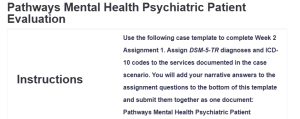
Instructions |
Use the following case template to complete Week 2 Assignment 1. Assign DSM-5-TR diagnoses and ICD-10 codes to the services documented in the case scenario. You will add your narrative answers to the assignment questions to the bottom of this template and submit them together as one document: Pathways Mental Health Psychiatric Patient Evaluation. | |||||||||||||||||||||||||||||||||||||||||
Identifying Information |
Identification was verified by stating their name and date of birth.
Time spent for evaluation: 1103am-1151am |
|||||||||||||||||||||||||||||||||||||||||
Chief Complaint |
“My primary doctor thinks I need more help than she can give me now.” | |||||||||||||||||||||||||||||||||||||||||
HPI |
42 young female was evaluated for psychiatric evaluation and referred by her primary care provider for worsening depression and panic symptoms. She is currently prescribed escitalopram 5mg po daily for depression, alprazolam 1mg po daily for anxiety.
Today, the client reported symptoms of worsening in past month for depression with anergia, anhedonia, motivation, reports anxiety, frequent worry, reports feeling restlessness, palpitations “feels like everything is closing in on me, can’t focus, hard time breathing,” no reported obsessive/compulsive behaviors. Client reported feelings like want to sleep and never wake up.. There is no evidence of psychosis or delusional thinking. Client denied past episodes of hypomania, hyperactivity, erratic/excessive spending, involvement in dangerous activities, self-inflated ego, grandiosity, or promiscuity. Client reports increased irritability and easily frustrated. Has low frustration tolerance, sleeping 10-12 hrs/24hrs, appetite decreased. She has somatic concerns with GI upset and headaches. Client denied any current binging/purging behaviors, denied withholding food from self or engaging in anorexic behaviors. No self-mutilation behaviors. |
|||||||||||||||||||||||||||||||||||||||||
Diagnostic Screening Results |
Screen of symptoms in the past week: Severity Measure for Panic Disorder = Total Score 38 |
|||||||||||||||||||||||||||||||||||||||||
Past Psychiatric and Substance Use Treatment |
· Entered mental health system when she was age 29 after a family suicide.
· Previous Psychiatric Hospitalizations: · Previous Detox/Residential treatments: · Previous psychotropic medication trials: sertraline (became suicidal), trazodone (worsened nightmares), bupropion (became suicidal) · Previous mental health diagnosis per client/medical record: |
|||||||||||||||||||||||||||||||||||||||||
Substance Use History |
Have you used/abused any of the following (include frequency/amt/last use):
Any history of substance related: · Blackouts: – · Tremors: – · DUI: – · D/T’s: – · Seizures: – Longest sobriety |
|||||||||||||||||||||||||||||||||||||||||
Psychosocial History |
Client was raised by single mother. She is married; has 2 children.
Employed at local day care as administrative assistant. Education: High School Diploma Denied current legal issues. |
|||||||||||||||||||||||||||||||||||||||||
Suicide / Homicide Risk Assessment |
Suicide Inquiry: Denies active suicidal ideations, intentions, or plans. | |||||||||||||||||||||||||||||||||||||||||
Mental Status Examination |
She is a 42 yo Hispanic female who looks her stated age. She is cooperative with examiner. She is disheveled, dressed appropriately. There is psychomotor restlessness. Her mood is anxious and mildly irritable. She denies any auditory or visual hallucinations. There is no evidence of any delusional thinking. She denies any current suicidal or homicidal ideation. |
|||||||||||||||||||||||||||||||||||||||||
Clinical Impression |
The client is a 42 yo Hispanic female who presents with a history of treatment for depression and panic symptoms.
Moods are anxious and irritable. She has reported symptoms related to her depression and panic. no evident mania/hypomania, no psychosis, denied current cravings for drugs/alcohol, exhibits no withdrawal symptoms, has somatic concerns of GI upset and headaches. At the time of disposition, the client adamantly denies SI/HI ideations, plans, or intent and has the ability to determine right from wrong and can anticipate the potential consequences of behaviors and actions. |
|||||||||||||||||||||||||||||||||||||||||
Diagnostic Impression |
Major Depressive Disorder, recurrent, moderate (ICD-10: F33.1) and Panic Disorder (ICD-10: F41.0)
Double click inside this text box to add/edit text. Delete placeholder text when you add your answers. |
|||||||||||||||||||||||||||||||||||||||||
Treatment Plan |
1) Medication:
· Increase escitalopram 10mg po daily · Continue with alprazolam
2) Order labs
3) Patient has emergency numbers: Emergency Services 911, the national Crisis Line 800-273-TALK, the MHC Crisis Clinic. Patient was instructed to go to nearest ER or call 911 if they become actively suicidal and/or homicidal.
4) Time allowed for questions and answers provided. Provided supportive listening.
5) RTC in 30 days
6) Follow up with PCP for GI upset and headaches |
|||||||||||||||||||||||||||||||||||||||||
Narrative Answers
| Reimbursement Billing Code and Justification
The appropriate reimbursement billing code for this psychiatric session is 99205, which corresponds to a new outpatient visit involving high medical decision-making complexity or a visit that lasts between 60 to 74 minutes (American Medical Association, 2021). Although the session lasted 48 minutes, the nature and intensity of the clinical work, including assessing worsening depressive and panic symptoms, medication management, suicide risk evaluation, and functional impairment, justify this high-level code based on medical decision-making. According to E/M coding guidelines, complexity, not just time, can determine code selection. The provider engaged in a comprehensive assessment and established a detailed treatment plan, meeting the requirements for 99205. Additionally, the patient was referred by a primary care provider and was new to the psychiatric clinic, making a new patient code appropriate. The history of medication-induced suicidal ideation, along with her worsening condition, required reviewing multiple medication trials, current symptoms, substance use, and psychosocial background. The provider adjusted medications and planned coordinated care, including follow-up with a primary care physician for somatic complaints. The extensive evaluation, combined with diagnostic formulation and medication decisions, satisfies the requirements of a high-complexity encounter, justifying the use of 99205. Required Documentation for Diagnoses, ICD-10, and Billing To support the DSM-5-TR diagnoses and ICD-10 coding, comprehensive documentation is essential. For Major Depressive Disorder, recurrent, moderate (ICD-10: F33.1) and Panic Disorder (ICD-10: F41.0), the documentation must include clear evidence of symptoms aligned with diagnostic criteria, such as anhedonia, fatigue, sleep disturbance, somatic complaints, worry, restlessness, and panic-like episodes (World Health Organization, 2024). The documentation must also describe functional impairment in occupational or social domains. Psychiatric documentation should link observed and reported symptoms to the diagnostic criteria from DSM-5-TR and explain how this impact daily functioning and require pharmacologic and/or psychotherapeutic intervention. For the billing code 99205, specific documentation elements are also required: a detailed history of present illness (HPI), a thorough mental status examination (MSE), past psychiatric and substance use history, risk assessment, and a well-reasoned treatment plan. The chart should include clinical rationale for changes in medications, the complexity of decision-making, time spent, and discussion of differential diagnoses (American Medical Association, 2021). The provider should clearly document the interaction with the patient, any coordination of care, and informed consent discussions. These elements validate the level of service provided and support reimbursement for higher complexity care. Missing Documentation and Additional Information Needed Despite a solid case structure, several key components of documentation are missing from the scenario, limiting the accuracy and defensibility of the diagnosis and billing. First, a comprehensive review of systems (ROS) is not documented, and there is no mention of cardiovascular, neurologic, or other systemic symptoms outside GI upset and headaches. Second, the case lacks a detailed past psychiatric history, including prior diagnoses and exact timelines for medication trials. Third, allergies and past medical history are not documented, which are crucial for pharmacologic safety. Fourth, the provider omits discussion of patient adherence, response, or side effects related to current medications. Fifth, psychiatric family history, essential in assessing genetic susceptibilities, is not present. Sixth, legal, trauma, or abuse history is not assessed even though they have a significant effect on mood and anxiety disorders. Seventh, the patient’s functional level in work and familial relationships is only mentioned without further description. Eighth, the use of routine tools like PHQ-9 or GAD-7, which can aid diagnostic findings, is not evident. Ninth, the simple physical examination or vital signs are missing, and tenth, patient consent to treatment and safety planning is not documented. Eleventh, no provider’s signature, credentials, or time stamping, and twelfth, no individual documentation of counseling or education provided exists, which would also enhance higher-level coding. Legal and Ethical Dilemmas and Ethical Strategies Overbilling, upcoding, and fraud are serious legal and ethical dangers. Upcoding, the practice of employing more complex codes than are justified, can produce audits, licensure revocation, and penalization under the False Claims Act, as stated by Joiner et al. (2024). Ethically, these practices destroy patient trust, increase the price of healthcare, and violate the codes of integrity and responsibility in professional life. In response to these challenges, one such reliable strategy is to provide constant ethics and compliance training related to psychiatric billing, including recent coding changes, e.g., yearly CPT updates and CMS guidelines. The second strategy is to implement real-time clinical documentation practices where the notes are recorded upon or immediately following the patient visit, as alleged by Demsash et al. (2023). This reduces dependency on memory and allows billing from accurate, contemporaneous records. Anticipatory measures guarantee ethical accountability and minimize legal exposure to practitioners. Improving Documentation for Maximum Reimbursement The process of improving any kind of documentation starts with using structured templates aligned with the DSM5 TR and the E/M coding requirements. While these templates will show providers the various documentation elements such as HPI, ROS, MSE, risk assessment, and treatment plan), they should do so through well-crafted templates. Validated screening tools, PHQ-9, GAD-7, and C-SSRS, are not limited to quantifying symptom severity; they also enhance diagnostic accuracy, not only for substance use disorder but for other mental health conditions. Seligson et al. (2021) state that the documentation should explain in detail the provider’s medical decision-making, including differential diagnoses and rationale for any treatment or change in treatment. Thus, ensure that the coding level assigned is transparent and defends it. Also, providers should record time spent, especially when charges are related to time. Clinical activities such as History gathering, counseling, and coordination of care should be studied in terms of time. Enhancing documentation, as demonstrated by Demsash et al. (2023), is also about making a note of patient education, safety planning, and follow-up instructions. Legal defensibility is improved by including patient response to the treatment plan and shared decision-making. Better documentation improves clarity, thoroughness, and accuracy to help providers get paid properly and serve patients with better quality, patient-centered care. |
References
American Medical Association . (2021). CPT ® Category I Evaluation and Management (E/M) Services Guidelines Guidelines Common to All E/M Services Time. https://www.ama-assn.org/system/files/2019-06/cpt-office-prolonged-svs-code-changes.pdf
Demsash, A. W., Kassie, S. Y., Dubale, A. T., Chereka, A. A., Ngusie, H. S., Hunde, M. K., Emanu, M. D., Shibabaw, A. A., & Walle, A. D. (2023). Health professionals’ routine practice documentation and its associated factors in a resource-limited setting: a cross-sectional study. BMJ Health & Care Informatics, 30(1), 1–7. https://doi.org/10.1136/bmjhci-2022-100699
Joiner, K. A., Lin, J., & Pantano, J. (2024). Upcoding in medicare: where does it matter most? Health Economics Review, 14(1). https://doi.org/10.1186/s13561-023-00465-4
Seligson, M. T., Lyden, S. P., Caputo, F. J., Kirksey, L., Rowse, J. W., & Smolock, C. J. (2021). Improving Clinical Documentation of Evaluation and Management Care and Patient Acuity Improves Reimbursement as well as Quality Metrics. Journal of Vascular Surgery, 74(6). https://doi.org/10.1016/j.jvs.2021.06.027
World Health Organization. (2024). International classification of diseases (ICD). Www.who.int. https://www.who.int/standards/classifications/classification-of-diseases
ORDER A PLAGIARISM-FREE PAPER HERE
We’ll write everything from scratch
Question 
Client’s Note: This is for my PMHNP course. Please follow rubric and let me know if you have any questions
Insurance coding and billing is complex, but it boils down to how to accurately apply a code, or CPT (current procedural terminology), to the service that you provided. The payer then reimburses the service at a certain rate. As a provider, you will have to understand what codes to use and what documentation is necessary to support coding.
For this Assignment, you will review evaluation and management (E/M) documentation for a case study patient. You will analyze the documentation to formulate DSM-5-TR diagnoses and ICD-10 coding. You will formulate a billing code for reimbursement of the case study.
You will consider legal and ethical considerations for coding and billing. You will analyze and consider the documentation necessary to support accurate billing and coding procedures.
Pathways Mental Health Psychiatric Patient Evaluation
To Prepare
- Review this week’s Learning Resources on coding, billing, reimbursement.
- Review the E/M patient case scenario provided. (ATTACHED)
The Assignment
- Assign DSM-5-TR diagnoses, ICD-10, and reimbursement codes to services based on the patient case scenario.
Then, in 2-3 pages, address the following. You will add your narrative answers to these questions to the bottom of the case scenario document and submit them altogether as one document.
- What reimbursement billing code would you use for this session? Provide your justification for using this billing code.
- Explain what pertinent information is required in documentation to support your chosen DSM-5-TR diagnoses, ICD-10 coding, and billing code.
- Explain what pertinent documentation is missing from the case scenario and what other information would be helpful to narrow your coding and billing options. (There are at least 12 missing pertinent components of documentation).
- Discuss legal and ethical dilemmas related to overbilling, upcoding, and fraudulent practices. Propose 2 strategies for promoting legal and ethical coding and billing practices within your future clinical roles.
- Finally, explain how to improve documentation to support coding and billing for maximum reimbursement.
 Complete the order form and upload all of your files, including any instructions, rubrics, or other materials provided by your instructor.
  Complete the order payment after filling in the order form. We’ll receive your order and assign it to a writer.
 The assigned writer will complete your paper and forward it to our Editing Team for review and approval.
 Once approved by the editor, the completed paper will be uploaded to your account for you to download, review and approve.