
Overview of the Significance of Standardized Nursing Terminologies in Healthcare Documentation
Standardized nursing terminologies (SNTs) are used in the modern healthcare sector to help nurses have a common way of reporting on the patient in different care environments. This particular standard helps in the continuity of communication among different healthcare personnel to avoid cases of communication breakdown, hence embracing efficiency when relaying patient details. Furthermore, SNTs primarily address the issue of data sharing across several EHR systems to ensure continuity of care. SNTs help the nurses record the assessments, the interventions made, and the results collectively, which is important in helping the advancement of knowledge-based practice (Monsen et al., 2023). In addition, the use of standardized terminologies makes the accumulation and analysis of nursing data possible and, therefore, useful for assessing the quality of nursing and, therefore, the quality of healthcare organizations, workforce management, and the development of programs and policies for improving the quality of care.
Selected ANA-Recognized Standard Nursing Terminology
The Clinical Care Classification (CCC) System is a standardized nursing terminology recognized by the ANA and aimed at capturing the nature of patient care in EHR systems. This consists of two related taxonomic structures, which include The Collaborative Clinical Conceal of Nursing Diagnoses and Outcomes and the Collaborative Clinical Conceal of Nursing Interventions and Actions (Herdman et al., 2021). These taxonomies are grouped under twenty-one Care Components, which cover almost all areas of patient care, creating an appropriate structure for nursing notes. The CCC System manages the creation of nursing plans of care (POCs) electronically and helps collect, store, and retrieve nursing data for clinical decision-making and policy formulation.
The Purpose and Components of the Terminology
The CCC System is required to be implemented as a coded nursing terminology for documenting the meaning and essence of patient care in the context of an EHR. Its main function is to support the documentation of discrete patient care data concerning registered nurse assessments, interventions, and outcomes. The CCC System is actually a taxonomic structure that encompasses two comprehensive classifications: 176 diagnoses related to nursing and 804 interventions/actions that may be practiced in nursing; both of these are based on 21 care domains that can be translated to several aspects of patient care. This structured framework increases the purpose and organization of documentation to benefit all clinicians involved as well as improve overall patient care planning. Standardized nursing terminology makes it easier to collect and analyze data relating to nursing, which is essential in facilitating the assessment of care outcomes, research, and policy-making (Cho et al., 2023). Its incorporation in EHRs enhances documentation of nursing’s contribution to patient care and provides enhanced information support to nurses and other patient care practitioners, leading to better patient outcomes.
Example Of CCC System Application in Clinical Documentation
A 62-year-old Mr. John Doe is admitted to the hospital with a primary diagnosis of heart failure. He complains of shortness of breath, fatigue, and swelling of both lower limbs. It was evident in the nursing assessment report that the patient had crackles in the lungs, increased in weight by 5 lbs for the last three days, and had high Blood pressure. His oxygen saturation level is a bit low, and he complains of having poor sleep, particularly due to too much shortness of breath.
According to the Clinical Care Classification (CCC) System, the nurse records Mr. Doe’s status with the nursing diagnosis of Excess Fluid Volume (F02.1) associated with an impaired cardiac output. The presence of such symptoms as overweight, bilateral swelling, and wet lungs have led to this diagnosis (Malik et al., 2023). With this diagnosis formulated, the nurse comes up with an individual patient care plan/prescription of interventions that are supported by research knowledge to address the issues of fluid imbalances and respiratory distress.
The nursing interventions recorded using the CCC System are as follows: Fluid Management entails observing and noting the patient’s intake and output to check the balance in the body. Medication management is then used to give diuretics in accordance with the prescription and to also check on the electrolytes and kidneys (Ernstmeyer & Christman, 2021a). Moreover, respiratory monitoring is conducted by auscultation of the lungs and frequently checking his oxygen status. Patient education is also provided in detail by the nurse. Mr. Doe is informed on ways of monitoring his weight daily, checking fluid balancing signs, and identifying the worsening of his heart failure symptoms.
Some of the expected outcomes included in the CCC System are decreased lower extremity edema and improved lung sounds, which may signify a reduction in signs of fluid overload. The patient is also supposed to demonstrate that he understands his medication schedule and the kind of foods he is allowed to eat. His respiratory status should improve with better oxygenation of his tissues. Therefore, he should have a better night’s sleep (Ernstmeyer & Christman, 2021b). In this way, through the use of the CCC System, the nursing documentation remains clear and concise, and all the members of the healthcare team are able to make informed decisions based on complete and accurate information regarding the patient.
Enhancing Communication, Evidence-based Practice, and Patient Care Outcomes
One of the benefits of the CCC System is that it increases the efficiency of communication by using a common language that can be understood easily by every single healthcare professional to exchange information about patient care, hence avoiding cases of confusion in patient care. It helps promote practice based on scientific research by providing systemized nursing data, research, and clinical information. Also, the CCC System enables complete and specific patient approaches to planning and organizing the care process and monitoring the effectiveness of care (Simpson et al., 2022). The integration of the CCC system provides easy access to patient data in EHRs, enhances clinical decisions, and improves the quality of nursing care.
References
Cho, I., Cho, J., Hong, J. H., Choe, W. S., & Shin, H. (2023). Utilizing standardized nursing terminologies in implementing an AI-powered fall-prevention tool to improve patient outcomes: A multihospital study. Journal of the American Medical Informatics Association, 30(11), 1826–1836. https://doi.org/10.1093/jamia/ocad145
Ernstmeyer, K., & Christman, E. (2021a). Fluids and electrolytes. Nursing Fundamentals – NCBI Bookshelf. https://www.ncbi.nlm.nih.gov/books/NBK591820/
Ernstmeyer, K., & Christman, E. (2021b). Respiratory assessment. Nursing Skills – NCBI Bookshelf. https://www.ncbi.nlm.nih.gov/books/NBK593192/
Herdman, T. H., Kamitsuru, S., & Lopes, C. T. (Eds.). (2021). NANDA International, Inc. nursing diagnoses: Definitions and classifications 2021-2023 (12th ed.). Thieme. https://doi.org/10.1055/b000000515
Malik, A., Chhabra, L., & Doerr, C. (2023, November 5). Congestive heart failure (nursing). StatPearls – NCBI Bookshelf. https://www.ncbi.nlm.nih.gov/books/NBK574497/
Monsen, K. A., Langford, L. H., Bakken, S., & Lopez, K. D. (2023). Standardized nursing terminologies come of age: Advancing quality of care, population health, and health equity across the care continuum. Journal of the American Medical Informatics Association, 30(11), 1757–1759. https://doi.org/10.1093/jamia/ocad173
Simpson, K., Nham, W., Thariath, J., Schafer, H., Greenwood-Eriksen, M., Fetters, M. D., Serlin, D., Peterson, T., & Abir, M. (2022). How health systems facilitate patient-centered care and care coordination: A case series analysis to identify best practices. BMC Health Services Research, 22(1). https://doi.org/10.1186/s12913-022-08623-w
ORDER A PLAGIARISM-FREE PAPER HERE
We’ll write everything from scratch
Question 
Overview of the Significance of Standardized Nursing Terminologies in Healthcare Documentation
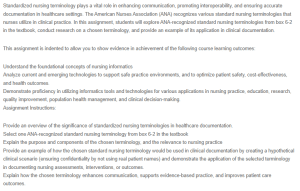
Standardized nursing terminology plays a vital role in enhancing communication, promoting interoperability, and ensuring accurate documentation in healthcare settings. The American Nurses Association (ANA) recognizes various standard nursing terminologies that nurses utilize in clinical practice. In this assignment, students will explore ANA-recognized standard nursing terminologies from box 6-2 in the textbook, conduct research on a chosen terminology, and provide an example of its application in clinical documentation.
Overview of the Significance of Standardized Nursing
This assignment is indented to allow you to show evidence in achievement of the following course learning outcomes:
Understand the foundational concepts of nursing informatics
Analyze current and emerging technologies to support safe practice environments, and to optimize patient safety, cost-effectiveness, and health outcomes.
Demonstrate proficiency in utilizing informatics tools and technologies for various applications in nursing practice, education, research, quality improvement, population health management, and clinical decision-making.
Assignment Instructions:
Provide an overview of the significance of standardized nursing terminologies in healthcare documentation.
Select one ANA-recognized standard nursing terminology from box 6-2 in the textbook
Explain the purpose and components of the chosen terminology, and the relevance to nursing practice
Provide an example of how the chosen standard nursing terminology would be used in clinical documentation by creating a hypothetical clinical scenario (ensuring confidentiality by not using real patient names) and demonstrate the application of the selected terminology in documenting nursing assessments, interventions, or outcomes.
Explain how the chosen terminology enhances communication, supports evidence-based practice, and improves patient care outcomes.
 Complete the order form and upload all of your files, including any instructions, rubrics, or other materials provided by your instructor.
  Complete the order payment after filling in the order form. We’ll receive your order and assign it to a writer.
 The assigned writer will complete your paper and forward it to our Editing Team for review and approval.
 Once approved by the editor, the completed paper will be uploaded to your account for you to download, review and approve.