
Medical Apartheid 2
The 1840 Census
The 1840 U.S. Census claimed to reveal that free Black Americans suffered significantly worse health outcomes than enslaved Black Americans, particularly regarding mental health. According to the census, mental defects were “eleven times more common among free Blacks in the North than among slaves” (Washington 167). These findings suggested that “free blacks died sooner and suffered dramatically higher rates from every known disease” (Washington 167). However, these results were not valid but rather represented manipulated statistics designed to support pro-slavery arguments. The census data was used to bolster the claim that “slavery was essential to preserve the health of blacks” (Washington 167). The data ignored environmental factors affecting free Black populations and falsely attributed their health conditions to inherent racial inferiority rather than socioeconomic conditions, discrimination, and lack of access to healthcare.
“Black Diseases”
“Black Diseases” were fictitious medical conditions that white physicians invented to pathologize Black behavior and physiology. Examples included “Cachexia Africana (‘dirt eating,’ or pica), hebetude, pellagra, and Dysthesia Aethiopica” (Washington 168, 174). These were not genuine Black diseases but rather misdiagnoses of conditions caused by environmental factors like malnutrition or racist fabrications used to justify slavery. For instance, pellagra was “actually neither a black disease nor infectious, but a deficiency disease caused by poor blacks’ sparse and monotonous diet of white corn and inferior fatty pork, which was severely deficient in niacin” (Washington 176). Dr. Samuel A. Cartwright prescribed “punishment by whips or hard labor” (Washington 279) for these imaginary disorders, revealing their purpose as tools of control rather than legitimate medical diagnoses.
The History and Progression of the Tuskegee Experiment
The Tuskegee Syphilis Study was a federal experiment conducted by the U.S. Public Health Service between 1932 and 1972 that observed the natural progression of untreated syphilis in Black men. The study involved “six hundred black men, their wives, and their children [who] were deceived into participating in a research study that denied them treatment” (Washington 47). Participants were not informed they had syphilis, nor were they given treatment even after penicillin became widely available as an effective cure. The study was conducted in Macon County, Alabama, a site chosen partly because of its large Black population and high rates of syphilis. Participants received minimal compensation, like free meals and burial insurance, but were denied crucial medical care.
The purpose of the study was to trace “the progress of the disease in blacks” (Washington 47) based on the racist belief that syphilis affected Black people differently than White people. The researchers falsely claimed that the disease “worked its most feared damage within the neurological system of whites but that the less evolved nervous system of blacks was left relatively unimpaired” (Washington 47). The study’s legacy is profound and continues to impact Black Americans’ trust in the medical establishment. As Washington’s text states, “Many African Americans’ distrust in today’s medical establishment can be attributed to Tuskegee” (205). However, Washington also emphasizes that this distrust should be understood as “an understandable, reasonable reaction to the persistent experimental abuse that has characterized American medicine’s interaction with African Americans” (206) throughout history rather than a reaction to a single event.
Eugenics and the Role of Margaret Sanger in The Negro Project
The term “eugenics” was coined by Francis Galton, a cousin of Charles Darwin, derived from the Greek word eugenes meaning “well-born” (215). Racial hygiene was frequently invoked by eugenicists as almost synonymous with eugenics, with both concepts focusing on promoting “desirable” traits while eliminating “undesirable” ones, often defined along racial lines. As Washington’s text explains, “Eugenicists invoked the term racial hygiene as frequently as they did the word eugenics” (215), revealing how racial discrimination was fundamental to eugenic theory.
The goal of eugenicists was to use “medical information about disease and trait inheritance to end social ills by encouraging the birth of children with good, healthy, and beautiful traits” (Washington 215). This “positive eugenics” was coupled with “negative eugenics” that sought to prevent the birth of children with supposedly “bad” genetic profiles. Significantly, eugenicists “constantly confused the concepts of biological hereditary fitness with those of class and race” (Washington 215), using pseudoscientific arguments to justify racial discrimination.
Margaret Sanger played a crucial role in The Negro Project, which she devised in 1939 as part of her birth control movement. While often celebrated as a feminist and birth control pioneer, Sanger “exploited black stereotypes in order to reduce the fertility of African Americans” (Washington 220). The Negro Project “sought to find the best way of reducing the black population by promoting eugenic principles” (Washington 222) through experimental “family planning centers” in Black communities. Sanger strategically recruited Black doctors, social workers, and ministers to gain the trust of Black communities, writing, “We do not want the word to get out that we want to exterminate the Negro population, and the minister is the man who can straighten out that idea if it occurs to any of their more rebellious members” (Washington 222).
Works Cited
Washington, Harriet A. Medical Apartheid: The Dark History of Medical Experimentation on Black Americans from Colonial Times to the Present. Harlem Moon, 2008.
ORDER A PLAGIARISM-FREE PAPER HERE
We’ll write everything from scratch
Question 
Medical Apartheid 2
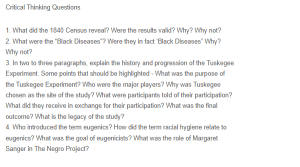
Critical Thinking Questions
1. What did the 1840 Census reveal? Were the results valid? Why? Why not?
2. What were the “Black Diseases”? Were they in fact ‘Black Diseases” Why?
Medical Apartheid 2
Why not?
3. In two to three paragraphs, explain the history and progression of the Tuskegee
Experiment. Some points that should be highlighted – What was the purpose of
the Tuskegee Experiment? Who were the major players? Why was Tuskegee
chosen as the site of the study? What were participants told of their participation?
What did they receive in exchange for their participation? What was the final
outcome? What is the legacy of the study?
4. Who introduced the term eugenics? How did the term racial hygiene relate to
eugenics? What was the goal of eugenicists? What was the role of Margaret
Sanger in The Negro Project?
 Complete the order form and upload all of your files, including any instructions, rubrics, or other materials provided by your instructor.
  Complete the order payment after filling in the order form. We’ll receive your order and assign it to a writer.
 The assigned writer will complete your paper and forward it to our Editing Team for review and approval.
 Once approved by the editor, the completed paper will be uploaded to your account for you to download, review and approve.