
Issue Statement and Identification of a Policy
Issue Statement
Social Problem and the Population Impacted
Housing insecurity, a serious and growing social issue in the United States, encompasses a variety of challenges, such as affordability issues with rent, overcrowding, frequent relocation, and homelessness. There is a shortage of 7.2 million affordable and available rental homes for extremely low-income renters in the country (National Low Income Housing Coalition, 2024). This crisis is especially alarming for vulnerable populations, including communities of color, single mothers, LGBTQ+ youth, people with disabilities, and veterans. These communities are up against systemic challenges, including discrimination, no rental assistance, and insufficient access to supportive housing programs (Hess et al., 2025). It leaves them with unstable housing prospects that harm their health, diminish their prospects of success, and pose barriers to upward mobility. Rachel Litchman, for instance, documented her lived experience as a person experiencing homelessness with disability. She underscored how her mental and physical health impairments undeniably influenced her housing insecurity (Wong, 2021). Her experience serves as an example of how disability can compound a person’s susceptibility to homelessness based on abuse, institutionalization, and a lack of supportive services.
The Need to Advocate for Change
The public and decision-makers, as well as social workers, need to advocate for change because housing insecurity continues to harm millions of vulnerable individuals and families across the country. Without the resources for stable, affordable housing comes poor health outcomes, children’s educational interruptions, and higher-than-average mental illness and drug addiction (Hock et al., 2024). In the absence of policy change, the space between increasing housing costs and stagnating income for working-class people will continue driving people into homelessness. NASW Code of Ethics is rooted in a set of core values. It is demonstrated by social workers’ commitment to promoting social justice and the dignity and worth of every person, which includes advocacy for policies that promote fair housing. Decision-makers must prioritize housing reform, which is the lifeblood of community stability, public health, and long-term economic well-being.
Positive Impact on Communities
If the aspiration to ease housing insecurity is achieved, communities will be healthier, and residents’ stress will decline. Families will be securely housed, a key factor in children’s academic and emotional growth. Adults will be better able to keep and hold down jobs, free from the stress of moving around all the time or homelessness. Crime could decrease as stable housing makes people less desperate and less likely to engage in risky survival habits. The community members will be more involved and connected, leading to an enhanced sense of identity and safety. Local economies will benefit as working, spending, and participating are more likely among stable households.
Policy Review
Selected Policy
The State Housing Initiatives Partnership (SHIP) Program is a Florida state-funded program that provides funding to local governments to increase the supply of affordable housing available to very low, low, and moderate-income residents of the state (Kang et al., 2023). The policy is intended to reduce homelessness and enhance housing stability for those who are most vulnerable, such as those with disabilities. The program can develop housing solutions responsive to local needs with locally owned and locally controlled resources.
The SHIP program is mandated by state statute under the William E. Sadowski Affordable Housing Act of 1992. This approach addresses housing insecurity, as it assists local governments in promoting affordable housing, potentially lowering the number of individuals most vulnerable to homelessness. However, limited funding and unequal coverage across the countries diminish its effectiveness. This deficit underscores the necessity of improved monitoring and continued financial investment to fulfill the program’s aspirations.
Different Sections or Components of the SHIP Policy
Primary components of SHIP include owner-occupied rehabilitation, purchase and rehabilitation assistance, disaster repair/mitigation, and special needs barrier removal. SHIP funds may also be used for new construction, down payment and closing cost assistance, gap financing, or SHIP matching dollars for other federal programs. SHIP has been effective since 1992. Housing advocates, local governments, and developers with public-private development agreements widely support the program. In contrast, critics and opponents are typically concerned that funding is inadequate and communities receive insufficient compensation for the loss of tax revenues.
Recent revisions to Florida’s SHIP program permit up to 25% of funds dedicated to ongoing rental housing, giving counties and cities new options for helping low- to moderate-income renters. Under the program, a new system has been used to track rental housing program activity, and exceptions to previously stringent restrictions on continuing rent subsidies have been added, which would facilitate oversight of local housing assistance programs. The time to review local housing assistance plans was lengthened to 30 days and extended to 45 days, which provides the Florida Housing Finance Corporation with additional time to review and approve local plans.
How This Policy Affects Clients in a Clinical Setting
The SHIP policy influences clients in a clinical setting by opening access to safe and affordable shelter in a way that acutely impacts their psychological and physical health. Housing-insecure clients frequently have long-term stress, anxiety, and depression that may impact therapeutic or case management progress (Bhat et al., 2025). SHIP can help stabilize living arrangements, freeing clients to concentrate on treatment, work, and education. Nonetheless, constrained funding and eligibility requirements mean that other vulnerable populations, including people with disabilities or who are undocumented, may still fall through the cracks. As a clinical social worker, it is vital to champion broader eligibility, increased funding, and comprehensive support services. This commitment ensures housing policies like SHIP are accessible and successful for the populations served.
References
Bhat, A. C., Fenelon, A., & Almeida, D. M. (2025). Housing insecurity pathways to physiological and epigenetic manifestations of health among aging adults: A conceptual model. Frontiers in Public Health, 13. https://doi.org/10.3389/fpubh.2025.1485371
Hess, C., Abdulla, Z., Finzel, L., Semkina, A., Harris, J., Boaz, A., & Manthorpe, J. (2025). A systematic narrative review of the research evidence of the impact of intersectionality on service engagement and help-seeking across different groups of women, trans women, and non-binary individuals experiencing homelessness and housing exclusion. PLOS One, 20(4), e0321300. https://doi.org/10.1371/journal.pone.0321300
Hock, E. S., Blank, L., Fairbrother, H., Clowes, M., Cuevas, D. C., Booth, A., Clair, A., & Goyder, E. (2024). Exploring the impact of housing insecurity on the health and wellbeing of children and young people in the United Kingdom: A qualitative systematic review. BMC Public Health, 24(1). https://doi.org/10.1186/s12889-024-19735-9
Kang, S., Kim, J., Ray, A., Watson, M., Nguyen, D., Nesbitt, A., Andujar, A., & Denton, B. (2023). Do localized housing programs lead to racial equity? Evidence from the State Housing Initiatives Partnership program. Housing Studies, 39(12), 3189–3216. https://doi.org/10.1080/02673037.2023.2248920
National Low Income Housing Coalition. (2024). The problem. NLIHC. https://nlihc.org/explore-issues/why-we-care/problem
Wong, A. (2021, November 14). Reflecting on my experiences as a homeless youth with disabilities. Disability Visibility Project. https://disabilityvisibilityproject.com/2021/11/14/reflecting-on-my-experiences-as-a-homeless-youth-with-disabilities/
ORDER A PLAGIARISM-FREE PAPER HERE
We’ll write everything from scratch
Question 
Issue Statement and Identification of a Policy
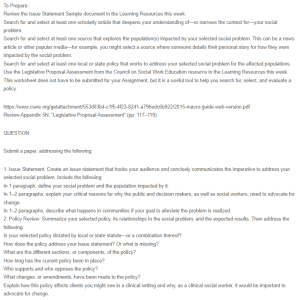
To Prepare:
Review the Issue Statement Sample document in the Learning Resources this week.
Search for and select at least one scholarly article that deepens your understanding of—or narrows the context for—your social problem.
Search for and select at least one source that explores the population(s) impacted by your selected social problem. This can be a news article or other popular media—for example, you might select a source where someone details their personal story for how they were impacted by the social problem.
Search for and select at least one local or state policy that works to address your selected social problem for the affected populations.
Use the Legislative Proposal Assessment from the Council on Social Work Education resource in the Learning Resources this week. This worksheet does not have to be submitted for your Assignment, but it is a useful tool to help you search for, select, and evaluate a policy.
Issue Statement and Identification of a Policy
https://www.cswe.org/getattachment/553d03b4-c1f5-4f23-8241-a796edc6b922/2015-macro-guide-web-version.pdf
Review Appendix 5N, “Legislative Proposal Assessment” (pp. 117–119)
QUESTION:
Submit a paper, addressing the following:
1. Issue Statement: Create an issue statement that hooks your audience and concisely communicates the imperative to address your selected social problem. Include the following:
In 1 paragraph, define your social problem and the population impacted by it.
In 1–2 paragraphs, explain your critical reasons for why the public and decision makers, as well as social workers, need to advocate for change.
In 1–2 paragraphs, describe what happens in communities if your goal to alleviate the problem is realized.
2. Policy Review: Summarize your selected policy, its relationships to the social problem, and the expected results. Then address the following:
Is your selected policy dictated by local or state statute—or a combination thereof?
How does the policy address your issue statement? Or what is missing?
What are the different sections, or components, of the policy?
How long has the current policy been in place?
Who supports and who opposes the policy?
What changes, or amendments, have been made to the policy?
Explain how this policy affects clients you might see in a clinical setting and why, as a clinical social worker, it would be important to advocate for change.
 Complete the order form and upload all of your files, including any instructions, rubrics, or other materials provided by your instructor.
  Complete the order payment after filling in the order form. We’ll receive your order and assign it to a writer.
 The assigned writer will complete your paper and forward it to our Editing Team for review and approval.
 Once approved by the editor, the completed paper will be uploaded to your account for you to download, review and approve.