
Impact of the No Surprises Act of 2022
The No Surprises Act (NSA) is a component of healthcare legislation from 2022 that focuses on the issue of surprise billing. This legislation was passed to prevent balance billing practices commonly associated with emergency and out-of-network services. The purpose of this assessment is to discuss how different stakeholders in the healthcare field have been affected by NSA. Each group will be evaluated on the financial costs, gains and disadvantages so that a proper understanding of the effects of the reform can be achieved (Kannan & Song, 2024).
Definition of the No Surprises Act of 2022
The No Surprises Act went into effect on January 1, 2022, as part of the Consolidated Appropriations Act 2021. It bars medical professionals from billing patients unexpected bills for emergencies or when the patients unknowingly receive treatment from out-of-network providers at in-network hospitals. Under this legislation, patients are subject to in-network cost-sharing only. The act also integrates independent dispute resolution (IDR), where the providers and insurers have billing discrepancies. The adoption of the NSA alters the flow of financial responsibility from the patient to the provider and insurer, and this is a significant change in patient protection measures (Nguyen et al., 2022).
Stakeholders Affected by the NSA
Three primary stakeholder groups affected by the NSA include patients, healthcare providers (especially those in emergency medicine and anesthesiology), and health insurance companies. All of these groups have experienced significant changes due to the law’s implementation (American Medical Association, 2024).
For patients, the NSA provides essential defense against unforeseen medical expenses. Prior to the law, patients often faced exorbitant charges after unknowingly receiving out-of-network care, even in emergencies. With the NSA, patients now benefit from more predictable and transparent healthcare costs. This change improves patient satisfaction and reduces financial strain (Lieneck et al., 2023).
Healthcare providers, particularly those offering ancillary services like anesthesiology, radiology, and emergency medicine, have seen substantial operational changes. These specialists frequently worked at in-network hospitals while remaining out-of-network themselves. The NSA now limits specialists’ ability to bill patients directly, reducing their leverage in price negotiations with insurers (Lieneck et al., 2023).
Health insurance companies are also significantly impacted. They are now responsible for covering a greater share of previously out-of-network claims and must engage in arbitration processes when disputes arise. While this increases their administrative burden, it also strengthens their bargaining power with providers (Kannan & Song, 2024).
Financial Impact on Stakeholders
The financial implications of the NSA vary among the stakeholder groups. For patients, the act dramatically reduces out-of-pocket expenses. In the past, unexpected bills could amount to thousands of dollars, leading to medical debt and financial hardship. By capping patient costs at in-network rates, the NSA provides critical financial relief (Lieneck et al., 2023).
Healthcare providers may face revenue loss due to the inability to balance bills. Specialists who previously relied on higher out-of-network fees are now limited to in-network rates or must seek payment through arbitration. This change has introduced revenue uncertainty and administrative complexity, potentially affecting staffing and service availability (Nguyen et al., 2022).
Insurance companies have seen an increase in claim payouts and arbitration costs. However, they also gain from reduced pressure to expand their provider networks, as the NSA reduces the impact of out-of-network care. Over time, insurers may benefit from the downward pressure on service pricing created by the arbitration process (Lieneck et al., 2023).
Benefits of the NSA
The most apparent benefit of the NSA is for patients, who now enjoy greater financial protection and peace of mind when seeking emergency or in-network hospital care. It also encourages providers and insurers to be more transparent about costs and network status, improving the patient experience and confidence in the medical system (American Medical Association, 2024)
For healthcare professionals, the law can reduce billing-related disputes and enhance trust with patients. In the long term, standardization of payment processes may result in more stable reimbursement models. Some providers also benefit from access to a neutral arbitration process instead of having to negotiate solely with powerful insurers (American Medical Association, 2024).
Insurance companies benefit from a more structured and predictable billing environment. With arbitration and capped patient liability, they can better manage risk and maintain lower premium growth over time. The act also shifts focus toward value-based care and cost-containment strategies (American Medical Association, 2024).
Drawbacks of the NSA
Despite its gains, the NSA has introduced several problems. For patients, understanding the new protections and navigating disputes can be confusing. Additionally, limited network availability may still lead to care access issues in some regions (Lieneck et al., 2023).
Healthcare providers face significant drawbacks, particularly around reimbursement and increased administrative burdens. The arbitration process can be time-consuming and expensive, leading to frustration and possible reductions in service availability, especially in high-cost specialties (Kannan & Song, 2024).
Insurers may experience higher costs in the short term due to arbitration fees and required adjustments to claim systems. There’s also concern that arbitrators could side more frequently with providers, driving up overall healthcare costs (Lieneck et al., 2023).
Conclusion
The No Surprises Act of 2022 represents a major development in protecting consumers from unfair billing practices in the context of healthcare. Although the reform is advantageous to patients through financial risk and cost prediction, it poses financial and bureaucratic burdens to providers and payoffers. In general, the NSA leads to increased fairness and transparency throughout the healthcare sector. In the future, further assessments and adjustments of its strategies will be required to guarantee fairness for all the parties involved.
References
American Medical Association. (2024, June 7). Implementation of the No Surprises Act. American Medical Association. https://www.ama-assn.org/health-care-advocacy/access-care/implementation-no-surprises-act
Kannan, S., & Song, Z. (2024). Surprise billing in intensive care unit (ICU) hospitalizations. Health Affairs Scholar, 89(57). https://doi.org/10.1093/haschl/qxae025
Lieneck, C., Gallegos, M., Ebner, M., Drake, H., Mole, E., & Lucio, K. (2023). Rapid review of “No Surprise” medical billing in the United States: Stakeholder perceptions and challenges. Healthcare, 11(5), 761. https://doi.org/10.3390/healthcare11050761
Nguyen, T. H., Heller, R. E., Keysor, K., Milburn, J. M., Rula, E. Y., Spangler, R., & Hirsch, J. A. (2022). The No Surprises Act: What neuroradiologists should know. American Journal of Neuroradiology, 44(1), 7–10. https://doi.org/10.3174/ajnr.a7739
ORDER A PLAGIARISM-FREE PAPER HERE
We’ll write everything from scratch
Question 
Impact of the No Surprises Act of 2022
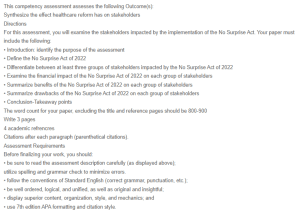
This competency assessment assesses the following Outcome(s):
Synthesize the effect healthcare reform has on stakeholders
Directions
Impact of the No Surprises Act of 2022
For this assessment, you will examine the stakeholders impacted by the implementation of the No Surprise Act. Your paper must include the following:
• Introduction: identify the purpose of the assessment
• Define the No Surprise Act of 2022
• Differentiate between at least three groups of stakeholders impacted by the No Surprise Act of 2022
• Examine the financial impact of the No Surprise Act of 2022 on each group of stakeholders
• Summarize benefits of the No Surprise Act of 2022 on each group of stakeholders
• Summarize drawbacks of the No Surprise Act of 2022 on each group of stakeholders
• Conclusion-Takeaway points
The word count for your paper, excluding the title and reference pages should be 800-900
Write 3 pages
4 academic refrencres
Citations after each paragraph (parenthetical citations).
Assessment Requirements
Before finalizing your work, you should:
• be sure to read the assessment description carefully (as displayed above);
utilize spelling and grammar check to minimize errors.
• follow the conventions of Standard English (correct grammar, punctuation, etc.);
• be well ordered, logical, and unified, as well as original and insightful;
• display superior content, organization, style, and mechanics; and
• use 7th edition APA formatting and citation style.
 Complete the order form and upload all of your files, including any instructions, rubrics, or other materials provided by your instructor.
  Complete the order payment after filling in the order form. We’ll receive your order and assign it to a writer.
 The assigned writer will complete your paper and forward it to our Editing Team for review and approval.
 Once approved by the editor, the completed paper will be uploaded to your account for you to download, review and approve.