
Final Research Proposal: Academic Procrastination
Introduction and Research Framework
Graduate student academic procrastination is a common problem affecting both psychological adjustment and academic achievement within graduate higher educational settings. The issue has risen to the level of significance where graduate program enrollments remain on the rise, with literature indicating 80-95% of graduate students having procrastination tendencies with significant impacts on academic performance (Steel, 2007). The pressure of graduate-level studies, with the coexistence of multiple competing obligations plus heightened expectations for performance, constitutes an ideal situation within which procrastination tendencies can become highly problematic and consequential.
Statement of the Problem
The fundamental problem o the study is that academic procrastination is detrimental to the well-being and academic achievement of graduate students. Graduate students experience high levels of academic procrastination that may indicate elevated stress levels and reduced academic performance, creating barriers to successful degree completion. This procrastination can manifest through voluntary delay behaviors in academic tasks, ultimately compromising both psychological health and academic outcomes in ways that can have long-lasting effects on career trajectories and personal development.
Purpose Statement
The purpose of this quantitative correlational study is to investigate the predictive relationships between the extent to which students procrastinate academically and the level of stress, along with academic performance among graduate students pursuing accredited master’s and doctoral degrees. The researcher endeavors to garner empirical insights on the extent to which procrastination tendencies influence key outcomes determining the success of graduate students.
Research Questions and Hypotheses
RQ1: To what extent does academic procrastination predict stress levels in graduate students?
- H1: Higher levels of academic procrastination will significantly predict higher stress levels in graduate students.
RQ2: To what extent does academic procrastination predict academic performance in graduate students?
- H2: Higher levels of academic procrastination will significantly predict lower academic performance (GPA) in graduate students.
Research Methods
Research Design
This study will employ a correlational design with multiple regression analysis to explore predictive relationships among naturally occurring variables. The correlational approach is particularly appropriate because the research questions include relationships among variables for which experimental manipulation cannot be ethically or practically introduced (Edmonds & Kennedy, 2017). More specifically, a time-series correlational design will be employed, collecting measures four times over time (Weeks 2, 6, 10, and 14 of a college semester) to enhance causal inference by ascertaining temporal precedence while controlling prior levels of variables.
The time-series approach transforms the traditional static regression into a lagged-panel analysis where earlier procrastination levels predict subsequent stress and cumulative GPA while accounting for baseline measurements. This design offers superior causal inference capabilities compared to single-point cross-sectional studies by demonstrating temporal precedence and accommodating intra-individual variability over time (Creswell & Creswell, 2018).
Population and Sample
The population to be targeted includes all graduate students registered for accredited master’s and doctoral degrees within the higher education institution. Practical limitations, however, mean the research needs to target the population of graduate students enrolled within University X during the 2025-26 academic year, a population of circa 1,200 students, as it has institutional addresses for emailing the survey to them, along with the facilitation of GPA access with the right administrative help and ethical approval.
A stratified random sampling technique will be employed, using academic colleges (for example, STEM, social sciences, and professional programs) as strata. This stratification approach guards against over-representation of large programs and enhances external validity by ensuring proportional representation across diverse academic disciplines. A priori power analysis conducted using G*Power 3.1.9.7 indicated that a minimum of 55 participants is required to detect medium effect sizes (f² = 0.15) with 80% power and α = .05. To account for expected non-response and incomplete data, approximately 65 students will be invited to participate, representing a 15% oversample.
Variables and Measurement
The study includes one independent variable and two dependent variables; all measured at the interval or ratio level. Academic procrastination serves as the independent variable, operationally defined as scores on the Academic Procrastination Scale representing voluntary delay behaviors in academic tasks. This variable is measured at the interval level using continuous scores derived from Likert-scale responses. Dependent variables include stress levels, measured on the interval level with standardized stress inventory test scores, and academic performance, operationally defined as cumulative GPA on the ratio level. The variables collectively encompass the major outcomes theorized to be impacted by procrastination behavior among graduate student samples.
Data Collection Instruments
Primary data collection will employ the Academic Procrastination Scale (APS) by McCloskey (2011), a 25-item scale specifically designed to assess procrastination behavior across academic settings. The APS follows a five-point Likert scale from “never” to “always,” with items like “I procrastinate starting to do things I don’t like to do” and “I procrastinate making tough choices.” The scale has excellent psychometric characteristics, with Cronbach’s alpha coefficients all above .94 across various populations, revealing high internal consistency reliability.
Construct validity for the APS has been established through several factor analyses validating the unidimensionality, while convergent validity has been demonstrated with significant correlations between the APS and other established procrastination measures. The non-specificity to academic settings of the scale distinguishes the scale for graduate student samples, making it highly applicable to them. Stress will be assessed with standardized stress measures with established psychometric characteristics, while GPA data will be obtained from official university records with the required authorization. The measures directly relate to the theoretical framework of the study and the questions of the study, so the operational definitions of the variables translate perfectly to the conceptual definitions proposed for the problem statement and purpose statement.
Data Analysis Plan
The analytical methodology revolves around multiple regression analysis, which is the best statistical method for dealing with the study’s predictive research questions. Multiple regression is especially suited to this study because it enables the exploration of predictive associations between continuous variables while also controlling for the possibility of confounding factors (Field, 2018). The analysis will entail the use of two different multiple regression models: the first will predict stress levels from scores on academic procrastination, and the second will predict GPA from scores on academic procrastination.
The selection of multiple regression fits well with the correlational design of the study and the level of measurement of all the variables. Academic procrastination (interval level), stress (interval level), and GPA (ratio level) all satisfy the assumptions needed for regression analysis. The time-series design will be accommodated via multilevel modeling procedures, allowing for the adjustment for repeated measures within participants, thus enhancing statistical power and offering more robust estimates for the predictive relationships.
Prior to the main analysis, assumption testing will be conducted to determine whether or not the data meet the assumptions for multiple regression, linearity, error independence, homoscedasticity, and normal distribution of the residuals. The analytical approach also includes the testing of the effect size using Cohen’s conventions, with particular attention to practical significance rather than statistical significance. The comprehensive analytical approach ensures the statistical methods address the main questions of the study while providing informative insight into the relationships among academic procrastination and the main graduate student outcomes.
References
Creswell, J. W., & Creswell, J. D. (2018). Research design: Qualitative, quantitative, and mixed methods approach (5th ed.). SAGE.
Edmonds, W. A., & Kennedy, T. D. (2017). An applied guide to research designs: Quantitative, qualitative, and mixed methods (2nd ed.). SAGE.
Field, A. (2018). Discovering statistics using IBM SPSS statistics (5th ed.). SAGE Publications.
McCloskey, J. (2011). Finally, my thesis on academic procrastination [Master’s thesis, University of Texas at Arlington]. UTA ResearchCommons. https://mavmatrix.uta.edu/psychology_theses/30/
Steel, P. (2007). The nature of procrastination: A meta-analytic and theoretical review of quintessential self-regulatory failure. Psychological Bulletin, 133(1), 65-94. https://doi.org/10.1037/0033-2909.133.1.65
ORDER A PLAGIARISM-FREE PAPER HERE
We’ll write everything from scratch
Question 
Final Research Proposal: Academic Procrastination
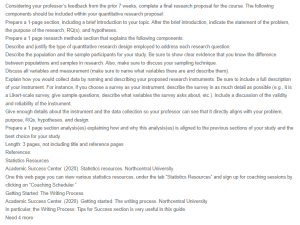
Considering your professor’s feedback from the prior 7 weeks, complete a final research proposal for the course. The following components should be included within your quantitative research proposal:
Prepare a 1-page section, including a brief introduction to your topic. After the brief introduction, indicate the statement of the problem, the purpose of the research, RQ(s), and hypotheses.
Final Research Proposal – Academic Procrastination
Prepare a 1 page research methods section that explains the following components:
Describe and justify the type of quantitative research design employed to address each research question.
Describe the population and the sample participants for your study. Be sure to show clear evidence that you know the difference between populations and samples in research. Also, make sure to discuss your sampling technique.
Discuss all variables and measurement (make sure to name what variables there are and describe them).
Explain how you would collect data by naming and describing your proposed research instruments. Be sure to include a full description of your instrument. For instance, if you choose a survey as your instrument, describe the survey in as much detail as possible (e.g., it is a Likert-scale survey, give sample questions, describe what variables the survey asks about, etc.). Include a discussion of the validity and reliability of the instrument.
Give enough details about the instrument and the data collection so your professor can see that it directly aligns with your problem, purpose, RQs, hypotheses, and design.
Prepare a 1 page section analysis(es) explaining how and why this analysis(es) is aligned to the previous sections of your study and the best choice for your study.
Length: 3 pages, not including title and reference pages
References:
Statistics Resources
Academic Success Center. (2020). Statistics resources. Northcentral University.
One this web page you can view various statistics resources, under the tab “Statistics Resources” and sign up for coaching sessions by clicking on “Coaching Scheduler.”
Getting Started: The Writing Process
Academic Success Center. (2020). Getting started: The writing process. Northcentral University
In particular, the Writing Process: Tips for Success section is very useful in this guide.
Need 4 more
 Complete the order form and upload all of your files, including any instructions, rubrics, or other materials provided by your instructor.
  Complete the order payment after filling in the order form. We’ll receive your order and assign it to a writer.
 The assigned writer will complete your paper and forward it to our Editing Team for review and approval.
 Once approved by the editor, the completed paper will be uploaded to your account for you to download, review and approve.