
Discussion: Understanding Employee Unionization
Introduction
Employee unionization is one of the common workplace characteristics that shapes industrial relations in the public and private sectors. The primary objective of employee unions is to advocate for and enhance benefits for employees. The relationship between the organization and the union is determined by management’s acceptance or resistance to employee unionization. Besides, commitment to either the organization or the union determines the nature of the relationship between the organization and the union. Employee unions play a central role in creating collective bargaining agreements, which influence wages and firms’ employment decisions.
Unionization Process for Employees
The process of employee unionization begins with employees organizing around an area of collective interest. By having conversations with coworkers, employees can decide to organize around a common issue (Brändle, 2024). After gathering enough support, the next step is to form committees alongside other employees. Subsequently, employee unions engage directly with organizational management while advancing employees’ interests. Even though unions address multiple issues, such as work conditions, they primarily delve into employee compensation.
Collective Bargaining Benefits
Collective bargaining is viewed as the process of negotiating and reaching agreements upon employees’ requests. The process involves employee union representatives meeting organizational management and discussing employment terms, such as salaries, working hours, and benefits. A key tenet in collective bargaining is good faith. For successful negotiation, both parties involved in the process must persistently exercise collective trust and be willing not to be influenced by the law. Since the request for benefits emanates from employees, the management determines whether the requests are feasible, depending on employees’ productivity.
Notably, employee unionization offers employees the leverage they require in collective bargaining. Based on the power resources approach, engaging employers through a union offers employees the power resources they require to influence a positive outcome (Gautam & Gautam, 2023). For instance, factory workers protesting poor working conditions, such lack of sufficient breaks, stand a better chance if they pursue a Collective Bargaining Agreement (CBA) with the management. If such employees threaten to withdraw their labor through their unions, a move that is legally protected, the management will respond by addressing their needs (Gautam & Gautam, 2023). CBAs give employees the power to safeguard their interests by collectively mobilizing power resources.
Right to Work Considerations
The right to work laws permit employees to willfully withdraw from labor unions. Since labor unions depend on members’ remittances to conduct day-to-day operations, a mass withdrawal may affect their operations significantly (Baker & West, 2020). To that end, operating in states that have adopted the right-to-work laws may require employees to organize using alternative means. However, Baker and West (2020) aver that the National Labor Relations Act compels employees to remit union premiums even if they do not require representation; hence, sustaining union operations.
Conclusion
In summary, employee unionization and collective bargaining determine the nature of industrial relations. The organizational management’s acceptance or resistance to employee unions determines the nature of industrial relations. Besides, employees’ commitment to the union or the organization will determine the nature of organizational-employee union relations. Union membership allows employees to leverage their power resources to bargain for enhanced benefits from the organization through collective bargaining agreements. Although labor unionization applies to both the public sectors, employees in states where the right-to-work laws are applicable can withdraw union membership and remittances promptly.
References
Baker, A., & West, T. (2020). Labor relations, professional perspective – ‘Right to Work’ laws and impact on unionization. Bloomberg Law. https://www.bloomberglaw.com/external/document/X8JDHS0O000000/labor-relations-professional-perspective-right-to-work-laws-and-
Brändle, T. (2024). Unions and collective bargaining: The influence on wages, employment and firm survival. In EconStor (GLO Discussion Paper, No. 1457). Global Labor Organization (GLO), Essen. https://hdl.handle.net/10419/300248
Gautam, P. K., & Gautam, R. R. (2023). Organizational culture orientation and union influence. Management Dynamics, 26(1), 43–55. https://doi.org/10.3126/md.v26i1.59150
ORDER A PLAGIARISM-FREE PAPER HERE
We’ll write everything from scratch
Question 
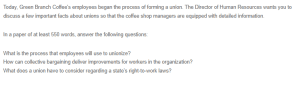
Today, Green Branch Coffee’s employees began the process of forming a union. The Director of Human Resources wants you to discuss a few important facts about unions so that the coffee shop managers are equipped with detailed information.
Understanding Employee Unionization
In a paper of at least 550 words, answer the following questions:
What is the process that employees will use to unionize?
How can collective bargaining deliver improvements for workers in the organization?
What does a union have to consider regarding a state’s right-to-work laws?
 Complete the order form and upload all of your files, including any instructions, rubrics, or other materials provided by your instructor.
  Complete the order payment after filling in the order form. We’ll receive your order and assign it to a writer.
 The assigned writer will complete your paper and forward it to our Editing Team for review and approval.
 Once approved by the editor, the completed paper will be uploaded to your account for you to download, review and approve.