
Discussion – Trade Deficit
Key Term and Why You Are Interested in It
The key global trade and investment term I chose to analyze for this task is trade deficit. My interest in understanding the trade deficit concept is mainly due to the efforts by the newly elected Trump administration to reduce the US’s trade deficit. To reduce the US’s trade deficit, the Trump administration has taken some tough stances, including promoting the ‘buy America’ policy, attempting to negotiate new trade deals favorable to the US, and confronting China and Canada. I will investigate how a trade deficit status affects a country’s economy and jobs. Understanding the impact of trade deficits on the economy will influence how a country responds to a deficit- whether it will be eliminated or sustained.
Explanation of the Key Term
According to Mann and Plück (2007), a trade deficit refers to the numerical difference between a country’s exports and imports of services and products. A negative trade deficit is typically undesirable because it implies that a country imports more than it exports, but a positive deficit is welcome. Apart from trade, macroeconomic policies and the imbalance of trade and investment lead to an increase in a country’s trade deficit. Some economic observers contend that a negative trade deficit should not be sustained since it costs a country the much-needed jobs to sustain its economy. However, most economists have concluded that trade deficits have benefits and costs, but the overall net effect in the long run is positive.
Major Article Summary
Kyambalesa (2019) examines the causes, effects, and remedies of a trade deficit. From the outset, Kyambalesa explains that the impact of trade deficit results from the excess outflow of a country’s currency reserves as it covers the cost of importing from another country. One of the causes of a trade deficit is a budget deficit caused by tax cuts and high national government expenditure. If there is a budget deficit, a country’s central bank raises the benchmark interest rate to control inflation. As a result, investors demand more of a country’s currency for speculation purposes, leading to its appreciation. Currency appreciation causes the prices of a country’s commodities to rise; hence, countries with weaker currencies will demand less, leading to fewer imports. Other causes of trade deficits include budget cuts, currency-related deficits, and income deficits, among others.
On the effects of trade deficits, Kyambalesa (2019) avers that such deficits do not necessarily imply that a country is in economic trouble. Besides, a country experiencing a trade surplus is not necessarily experiencing economic well-being. A deficit is not a debt but rather a book entry. For instance, the last time the US recorded a surplus was in 1975, yet the economy has been doing great over the years. The remedies for reducing trade deficits, if deemed undesirable, may include imposing tariffs and duties to encourage consumers and investors to buy locally.
Discussion
The explanation above relates to the cited work because it reinforces the fact that a negative trade deficit is not an indicator of a country’s economic status. Governments and countries do not trade with each other, but individuals do. Although the government may implement policies that encourage consumers to buy locally to reduce a trade deficit, such policies may not work in some sectors. Ahmad et al. (2021) assert that exports from some sectors have a competitive advantage in international trade and could reduce a country’s trade deficit. As shown, agro-based produce such as mangoes, tomatoes, and onions usually have a competitive advantage in the global market. Pan et al. (2022) also aver that China has managed to reduce its trade deficit by investing heavily in the industry sector. For instance, by investing heavily in the oil sector, an oil price increase curbs the trade deficit. The cited work relates to the module content because, as Satterlee (2023) avers, global trade is complex and relies on multiple external factors.
Overall, the cited sources indicate that a trade deficit is not necessarily an undesirable economic phenomenon. Mann and Plück (2007) emphasize this point by stating that internal economic policies such as tax cuts may lead to a trade deficit. On the other hand, Ahmad et al. (2021) emphasize that countries that export products with a competitive advantage in a global market, such as agro-based products including fruits, onions, and tomatoes, will have a low trade deficit. Kyambalesa (2019) also talks about how macroeconomic policies and investment and saving decisions could affect a country’s trade deficit. Finally, Pan et al. (2022) show that investment in certain high-demand sectors, such as the oil industry, may reduce a country’s trade deficit.
References
Ahmad, B., Anwar, M., Badar, H., Mehdi, M., & Tanwir, F. (2021). Analyzing export competitiveness of major fruits and vegetables of Pakistan: An application of revealed comparative advantage indices. The Pakistan Journal of Agricultural Sciences, 58(2), 719–730
Kyambalesa, H. (2019). Trade deficits: Causes, effects and remedies. SSRN Electronic Journal. https://doi.org/10.2139/ssrn.3471015
Mann, C. L., & Plück, K. (2007). Understanding the US trade deficit: A disaggregated perspective. In G7 Current Account Imbalances: Sustainability And Adjustment (pp. 247-282). University of Chicago Press. https://ideas.repec.org/h/nbr/nberch/0129.html
Pan, L., Amin, A., Zhu, N., Chandio, A. A., Naminse, E. Y., & Shah, A. H. (2022). Exploring the asymmetrical influence of economic growth, oil price, consumer price index and industrial production on the trade deficit in China. Sustainability, 14(23), 15534. https://doi.org/10.3390/su142315534
Satterlee, B. (2023). International business with biblical worldview. (2nd ed.). McGraw-Hill.
ORDER A PLAGIARISM-FREE PAPER HERE
We’ll write everything from scratch
Question 
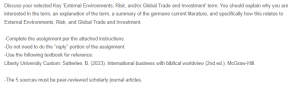
Discuss your selected Key ‘External Environments, Risk, and/or Global Trade and Investment’ term. You should explain why you are interested in the term, an explanation of the term, a summary of the germane current literature, and specifically how this relates to External Environments, Risk, and Global Trade and Investment.
Discussion – Trade Deficit
-Complete the assignment per the attached instructions.
-Do not need to do the “reply” portion of the assignment.
-Use the following textbook for reference:
Liberty University Custom: Satterlee, B. (2023). International business with biblical worldview (2nd ed.). McGraw-Hill.
-The 5 sources must be peer-reviewed scholarly journal articles.
 Complete the order form and upload all of your files, including any instructions, rubrics, or other materials provided by your instructor.
  Complete the order payment after filling in the order form. We’ll receive your order and assign it to a writer.
 The assigned writer will complete your paper and forward it to our Editing Team for review and approval.
 Once approved by the editor, the completed paper will be uploaded to your account for you to download, review and approve.