
Discussion – Free Trade Agreements
Key Term
The key term I am interested in researching is free trade agreements. I am interested in researching free trade agreements because of their apparent impact on foreign direct investment (FDI). When countries in a region come together and create free trade agreements, they create a broader regional marketplace through which multinational corporations from member countries can benefit. With free trade agreements in place, multinational corporations benefit from lower transactional costs and exploit economies of scale due to an expanded market (Plummer et al., 2011). In the long run, FTAs become an incentive for increased foreign direct investment. Besides, a free trade agreement may encourage intra-bloc investment by multinationals with a regional origin.
Explanation of Key Term
According to Baier and Bergstrand (2009), Free Trade Agreements refer to agreements between two or more countries on diverse aspects relating to international trade. Among other areas, FTAs elaborate on obligations for trading goods and services, investor protection, and intellectual property rights. For instance, reduced tariffs imply that a company can enter and compete in the global marketplace fairly. Although different FTAs are formed for different purposes, the primary goal is to reduce trade barriers and create a predictable and certain trade regulatory environment. Also, FTAs foster trade relationships based on reciprocity, implying that one country will treat investors from another country as good as their investors are treated in that country.
Major Article Summary
Athukorala (2019) delves into the debate regarding the economic case for adopting the FTA path over unilateral trade, multilateral trade, and customs unions. In the past decade, FTAs have become an integral part of the global trading systems, with the total number of FTAs globally rising from 90 in 1990 to 292 by 2019. However, there are key trading themes that question the suitability of FTAs over bilateral or multilateral trade relations. One of the reasons why FTAs are preferred over customs unions is that member countries maintain their ability to impose tariffs to avert trade deflection. Based on the Rules of Origin (RoO) framework, a country can discover that goods have been transferred from a non-member country to a member country and impose tariffs.
Further, the article addresses the emergence of ‘modern’ FTAs that focus on more than trade integration. The new FTAs seek to foster institutional harmonization among member countries in a range of sectors, including labour regulation, banking and finance, migration laws, health and safety, and dispute resolution. A key objective for revolutionizing FTAs is to achieve economic integration beyond the shallow trade agreements presented by traditional FTAs. Athukorala (2019) further asserts that before revolutionization, traditional FTAs did not offer much because they only sought to eliminate trade tariffs, which are mostly insignificant.
Discussion
Free Trade Agreements relate to regional economic integration, discussed in the module. Lopez and Carvajal (2020) aver that at the start, FTAs tend to generate trade creation effects. However, this changes as trade diversion begins, with developing member and non-member countries being most sensitive to such diversion. However, with the emergence of new FTAs, regional economic integration is possible as the new model focuses on multiple key issues beyond shallow regional trade. Also, FTAs affect the local financial market environment. In particular, Izurieta et al. (2018) aver that as capital comes in through foreign direct investment, regulatory changes in the financial markets to protect investors are inevitable.
Baier and Bergstrand (2009) illustrate the key tenets of international trade upon which FTAs are based as investor protection, services and goods trade obligations, and intellectual property rights. On the other hand, Plummer et al. (2011) state that MNCs benefit from FTAs through low transaction costs and by exploiting economies of scale. Lopez and Carvajal (2020) introduce the concept of trade diversion that emerges from the creation of FTAs, negatively affecting developing member and non-member countries the most. Finally, Izurieta et al. (2018) affirm that FTAs trigger regulatory changes to protect foreign capital inflow, hence impacting the local financial market.
References
Athukorala, P. (2019). Free Trade Agreements in the World Trade System: Substance and Semantics. Foreign Trade Review, 55(1), 001573251988677. https://doi.org/10.1177/0015732519886771
Baier, S. L., & Bergstrand, J. H. (2009). Estimating the effects of free trade agreements on international trade flows using matching econometrics. Journal of International Economics, 77(1), 63–76. https://doi.org/10.1016/j.jinteco.2008.09.006
Izurieta, A., Kohler, P., & Pizarro, J. (2018). Financialization, Trade, and Investment Agreements: Through the Looking Glass or Through the Realities of Income Distribution and Government Policy? https://www.bu.edu/eci/files/2020/01/18-02_IzurietaKohlerPizarro_FinancializationTradeInvestmentAgreements.pdf
Lopez, O. D., & Carvajal, A. (2020). The Trade Effects of Regional Agreements and Economic Integration Processes in Europe, South America, and North America. Latin American Journal of Trade Policy, 3(8), 32. https://doi.org/10.5354/0719-9368.2020.57980
Plummer, M. G., Cheong, D., & Hamanaka, S. (2011). Methodology for Impact Assessment of Free Trade Agreements. https://aric.adb.org/pdf/FTA_Impact_Assessment.pdf
ORDER A PLAGIARISM-FREE PAPER HERE
We’ll write everything from scratch
Question 
Discussion – Free Trade Agreements
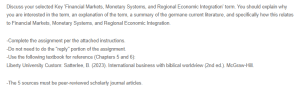
Discuss your selected Key ‘Financial Markets, Monetary Systems, and Regional Economic Integration’ term. You should explain why you are interested in the term, an explanation of the term, a summary of the germane current literature, and specifically how this relates to Financial Markets, Monetary Systems, and Regional Economic Integration.
Discussion – Free Trade Agreements
-Complete the assignment per the attached instructions.
-Do not need to do the “reply” portion of the assignment.
-Use the following textbook for reference (Chapters 5 and 6):
Liberty University Custom: Satterlee, B. (2023). International business with biblical worldview (2nd ed.). McGraw-Hill.
-The 5 sources must be peer-reviewed scholarly journal articles.
 Complete the order form and upload all of your files, including any instructions, rubrics, or other materials provided by your instructor.
  Complete the order payment after filling in the order form. We’ll receive your order and assign it to a writer.
 The assigned writer will complete your paper and forward it to our Editing Team for review and approval.
 Once approved by the editor, the completed paper will be uploaded to your account for you to download, review and approve.