
Case Study: Assertive ACT Survey
Total of ACT
Total column A: 142
Total column C: 188
Total column T: 190
Percentages
T-score percentage = T-score divided by A-score multiplied by 100
= 190 ÷ 142 × 100
= 133%
Discussion
According to the ACT survey, a score above 90% indicates that the individual is highly assertive. Assertiveness is a critical trait in a negotiation. The more an individual can express their desires in a negotiation, the more likely they will obtain what they need (Corvette, 2007). With a T-score percent of 133, it means that I can express what I need without fear, which is a positive behavior pattern. Notably, assertiveness does not have to be aggressive, as an individual can express their desires inoffensively.
Another survey outcome relating to behavioral patterns is the gap between the C score and the A score. Based on the self-assessment outcome, my C score is 46 points above my A score. A C score that is 50 points above the A score is an indication that one is fairly assertive, which is a welcome trait.
Additionally, based on the self-assessment, I can characterize myself as someone with hostile-aggressive behavior. A hostile-aggressive behavior is when one directly responds to an attack without holding back (Corvette, 2007). It is the opposite of passive-aggressive behavior, where someone may hold back responses to avoid confrontation. Hostile-aggressiveness is deemed not ideal in communication, unless it is a defensive response, especially in a physical attack. Aggressiveness hinders positive communication in a negotiation since, at best, only a bad agreement can be reached. It involves dominance and anger rather than positive engagement. In some worst-case scenarios, it can deteriorate to physical violence. Based on these insights, one should be assertive but avoid being aggressive.
References
Corvette, B. A. B. (2007). Conflict management: A practical guide to developing negotiation strategies. Pearson Prentice Hall.
ORDER A PLAGIARISM-FREE PAPER HERE
We’ll write everything from scratch
Question 
Case Study: Assertive ACT Survey
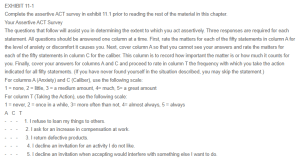
EXHIBIT 11-1
Complete the assertive ACT survey in exhibit 11.1 prior to reading the rest of the material in this chapter.
Your Assertive ACT Survey
Case Study – Assertive ACT Survey
The questions that follow will assist you in determining the extent to which you act assertively. Three responses are required for each statement. All questions should be answered one column at a time. First, rate the matters for each of the fifty statements in column A for the level of anxiety or discomfort it causes you. Next, cover column A so that you cannot see your answers and rate the matters for each of the fifty statements in column C for the caliber. This column is to record how important the matter is or how much it counts for you. Finally, cover your answers for columns A and C and proceed to rate in column T the frequency with which you take the action indicated for all fifty statements. (If you have never found yourself in the situation described, you may skip the statement.)
For columns A (Anxiety) and C (Caliber), use the following scale:
1 = none, 2 = little, 3 = a medium amount, 4= much, 5= a great amount
For column T (Taking the Action), use the following scale:
1 = never, 2 = once in a while, 3= more often than not, 4= almost always, 5 = always
A C T
– – – 1. I refuse to loan my things to others.
– – – 2. I ask for an increase in compensation at work.
– – – 3. I return defective products.
– – – 4. I decline an invitation for an activity I do not like.
– – – 5. I decline an invitation when accepting would interfere with something else I want to do.
 Complete the order form and upload all of your files, including any instructions, rubrics, or other materials provided by your instructor.
  Complete the order payment after filling in the order form. We’ll receive your order and assign it to a writer.
 The assigned writer will complete your paper and forward it to our Editing Team for review and approval.
 Once approved by the editor, the completed paper will be uploaded to your account for you to download, review and approve.