
Call Time Analysis – PE and PT Protocol Test Results
MEMORANDUM
TO: Regional Director
FROM: Call Center Manager
DATE: April 17, 2025
SUBJECT: Analysis of PE Protocol Test Results
Impact Analysis of New Protocol Implementation
Based on analysis of the data from our new test of the new expertise-based routing protocol (PE) compared to our old protocol (PT), I can report that both Time in Queue (TiQ) and Service Time (ST) measurements show notable improvements. The new PE protocol has shown an impressive enhancement in service time, from an average of 212.16 seconds using the old protocol to 149.28 seconds using the new one—a decrease of 62.88 seconds, or a 30% drop (Mehrotra et al., 2012). The decrease is statistically significant with a t-statistic of -6.831 and a very low p-value (5.91E-12), showing that the improvement is by no chance but a direct effect of the change in the protocol.
Regarding Time in Queue (TiQ), our current performance shows a mean of 147.9 seconds, which is technically below the industry standard of 150 seconds. However, the hypothesis test revealed a test statistic of -0.62, which falls outside the rejection region (z < -1.645). With a p-value of 0.2689, we cannot conclusively state that our average TiQ is significantly lower than the industry standard. The 95% confidence interval (141.313 to 154.532 seconds) includes the industry standard value, suggesting our performance is statistically equivalent to the industry benchmark.
Implementation Recommendation:
Based on the early data, I suggest continuing a broader rollout of the PE protocol. The impressive decrease in service time (almost a minute per call) equates to huge efficiency gains that both our bottom lines and customer satisfaction levels (Aksin et al., 2007). Although the TiQ data does not illustrate that we’re conclusively outperforming industry norms, the adoption of the PE protocol can only improve this metric as more efficient call handling times naturally decrease queue buildups. The routing by expertise is evidently assisting in handling the problems faster, the main objective of the test.
Additional Data Needs
While the outcomes are encouraging, we stand to gain from gathering more data before large-scale deployment. To begin, we need to continue the test to make sure the improvements hold up over longer durations at different times of the day and during differing call volumes (Aksin et al., 2007). Customer satisfaction measures under both protocols need to be compared to make sure the speedier servicing is not sacrificing resolution quality. Further, we need to look at first-call resolution percentages to see that the routing by expertise is causing a decrease in the same issues being called back, offering a better perspective of operational effectiveness (Mehrotra et al., 2012).
Projection of Current Protocol
If the PT protocol continues, as our data indicates, the average service times are, and continue to be, 212 seconds, higher than the industry average. The increased handling time has a compounding effect such that longer calls cause longer queue times as fewer of the available CSRs can be freed up to answer new calls. The statistical analysis indicates that the PT protocol would not naturally improve over time. Furthermore, the TiQ of the company would likely still be statistically indistinguishable from the industry average, forfeiting the possibility of becoming a customer service industry leader.
Impact of Call Volume Increase
A sudden 20% increase in call volume would significantly impact both protocols but with different magnitudes. Under the PT protocol with longer service times (212.16 seconds), this increase would create a multiplicative effect on queue times—potentially pushing TiQ well above the industry standard as the system becomes increasingly congested. Conversely, with the PE protocol’s shorter service times (149.28 seconds), the system would demonstrate greater resiliency to volume fluctuations. The PE protocol would help mitigate the impact of increased call volume by processing calls approximately 30% faster, allowing more calls to be handled within the same timeframe and keeping queue times more manageable during volume spikes.
Conclusion and Recommendations
Although the data so far is statistically robust enough to point to the value of the PE protocol to improve service time, we need to augment our analysis with other measures before making implementation decisions. My suggestion is to gather data for customer satisfaction, first-call resolution rates, CSR utilization rates, and abandon rates for both protocols (Aksin et al., 2007). Let us also study the call distribution patterns during the day so that staffing can be optimized in relation to the needs of experts. The evidence continues to point to the PE protocol to bring about increased operational efficiency (Ibrahim et al., 2016), but these other measures will enable us to fine-tune the implementation to maximize effectiveness in all dimensions of the performance of the call centers.
References
Aksin, Z., Armony, M., & Mehrotra, V. (2007). The modern call center: A multi-disciplinary perspective on operations management research. Production and Operations Management, 16(6), 665–688. https://doi.org/10.1111/j.1937-5956.2007.tb00288.x
Ibrahim, R., L’Ecuyer, P., Shen, H., & Thiongane, M. (2016). Inter-dependent, heterogeneous, and time-varying service-time distributions in call centers. European Journal of Operational Research, 250(2), 480–492. https://doi.org/10.1016/j.ejor.2015.10.017
Mehrotra, V., Ross, K., Ryder, G., & Zhou, Y. (2011). Routing to manage resolution and waiting time in call centers with heterogeneous servers. Manufacturing & Service Operations Management, 14(1), 66–81. https://doi.org/10.1287/msom.1110.0349
ORDER A PLAGIARISM-FREE PAPER HERE
We’ll write everything from scratch
Question 
Call Time Analysis – PE and PT Protocol Test Results
Review the call time analysis provided by the UX team. You may also review the call time data in Excel, if desired.
Assessment Deliverable
Call Time Analysis – PE and PT Protocol Test Results
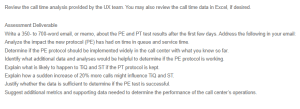
Write a 350- to 700-word email, or memo, about the PE and PT test results after the first few days. Address the following in your email:
Analyze the impact the new protocol (PE) has had on time in queue and service time.
Determine if the PE protocol should be implemented widely in the call center with what you know so far.
Identify what additional data and analyses would be helpful to determine if the PE protocol is working.
Explain what is likely to happen to TiQ and ST if the PT protocol is kept.
Explain how a sudden increase of 20% more calls might influence TiQ and ST.
Justify whether the data is sufficient to determine if the PE test is successful.
Suggest additional metrics and supporting data needed to determine the performance of the call center’s operations.
 Complete the order form and upload all of your files, including any instructions, rubrics, or other materials provided by your instructor.
  Complete the order payment after filling in the order form. We’ll receive your order and assign it to a writer.
 The assigned writer will complete your paper and forward it to our Editing Team for review and approval.
 Once approved by the editor, the completed paper will be uploaded to your account for you to download, review and approve.