
Academic and Professional Success Plan Template
Module 1 | Part 1: Developing an Academic and Professional Network
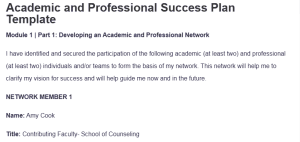
I have identified and secured the participation of the following academic (at least two) and professional (at least two) individuals and/or teams to form the basis of my network. This network will help me to clarify my vision for success and will help guide me now and in the future.
NETWORK MEMBER 1
Name: Amy Cook
Title: Contributing Faculty- School of Counseling
Organization: Walden University, College of Social and Behavioral Health
Academic or Professional: Academic: Academic and Professional Success Plan Template
Why I selected this individual and/or team and how they will support my success in the MSN program or Post-Master’s Certificate (PMC) and as a practicing nurse:
Notes:
I have selected Amy Cook as a key element of my academic and professional network for a number of reasons. Firstly, she possesses abundant experience in both academic and professional settings. She had a PhD in Educational Psychology from the University of Connecticut Storrs and provided services in both urban schools and mental health agencies. She excels in research and in promoting equitable access to education and development.
Amy Cook’s experience and expertise will support my success in the MSN program and as a practicing nurse, as I will get to learn about patient counseling and education. Providing counseling has been proven to be an evidence-based approach to reducing burnout and ensuring optimal working capacity among intensive care nurses who experience traumatic events by improving their attitudes and mental health (Abraham et al., 2022). I believe learning the basics of counseling from an expert will improve my capabilities to manage nursing teams as a future nurse.
NETWORK MEMBER 2
Name: Elizabeth Connole-pond
Title: Contributing Faculty- College of Nursing
Organization: Walden University
Academic or Professional: Academic
Why I selected this individual and/or team and how they will support my success in the MSN program or Post-Master’s Certificate (PMC) and as a practicing nurse:
Notes:
I have chosen Elizabeth Connole-pond as a guide in both my academic and professional journey in nursing. Elizabeth Connole-pond is significantly qualified to be my mentor as she already has a master’s degree in nursing, is qualified as an APRN and is a registered and practicing PMHNP-BC. She has over 25 years of experience in various nursing settings, including long-term care and acute care settings, both as a practitioner and a leader.
Currently, being a member of the Walden’s College of Nursing faculty, I believe she will be of great assistance in driving my academic success. Additionally, as mentorship is viewed as significant in supporting the successful transition of nurses from learning to practice (Gularte-Rinaldo et al., 2023), connecting with Elizabeth Connole-pond will provide the needed industry knowledge and skills to support my transition.
NETWORK MEMBER 3
Name: Dr. Miranda Dulek
Title: DNP, APRN, CNP, PMHNP-BC
Organization: River Bluffs Health and Wellness
Academic or Professional: Professional
Why I selected this individual and/or team and how they will support my success in the MSN program or Post-Master’s Certificate (PMC) and as a practicing nurse:
Notes:
Dr. Miranda is the major individual I have selected for my professional network. I believe that we share views on patient care in terms of supporting patients throughout their treatment journey. Dr. Dulek is a firm believer in collaborating with patients throughout their period of care. Collaborating with patients as key stakeholders throughout the treatment journey is sure to achieve patient-centered care within diverse healthcare settings (Linthicum et al., 2021).
She is also a holistic practitioner who believes in combining conventional and non-conventional interventions to achieve the highest levels of a patient. Dr. Dulek, therefore, presents an opportunity to learn from a professional how to integrate various techniques in patient care and management to achieve the best level of outcomes.
NETWORK MEMBER 4
Name: Linda D. Scott, PhD, RN, NEA-BC, FNAP, FAAN
Title: President
Organization: American Academy of Nursing
Academic or Professional: Professional
Why I selected this individual and/or team and how they will support my success in the MSN program or Post-Master’s Certificate (PMC) and as a practicing nurse:
Notes:
Dr. Linda D. Scott is the current president of the American Academy of Nursing. I have selected her as she has already risen to the highest levels of nursing leadership. She will support my success in the MSN program and as a practicing nurse through her work in promoting and advancing evidence-based health policy and practice.
She pushes for the utilization of nursing knowledge to impact health policy and ensure health for all. Her experience and insights can help further understand the nursing environment, including nursing practice and nursing policy, including my influence on nursing and health policy processes.
References
Abraham, S. P., Williams, S. L., VanDerWeele, L. J., & Magaña, E. (2022). The effects of counseling on intensive care unit nurses who have experienced traumatic events. International Journal of Science and Research Methodology, 23(2), 167–177. https://www.researchgate.net/publication/368294045
Gularte-Rinaldo, J., Baumgardner, R., Tilton, T., & Brailoff, V. (2023). Mentorship ReSPeCT study: A nurse mentorship program’s impact on transition to practice and decision to remain in nursing for newly graduated nurses. Nurse Leader, 21(2), 262–267. https://doi.org/10.1016/j.mnl.2022.07.003
Linthicum, M. T., dosReis, S., Slejko, J. F., Mattingly, T. J., & Bright, J. L. (2021). The importance of collaboration in pursuit of patient-centered value assessment. Patient, 14(4), 381–384. https://doi.org/10.1007/s40271-020-00446-3
Module 2 | Part 2: Strategies to Promote Academic Integrity and Professional Ethics
I have analyzed the relationship between academic integrity and writing, as well as the relationship between professional practices and scholarly ethics. I have also identified strategies I intend to pursue to maintain integrity and ethics of my academic work while a student of the MSN program or PMC, as well as my professional work as a nurse throughout my career. The results of these efforts are shared below.
Part 1: Writing Sample: The Connection Between Academic and Professional Integrity
The Relationship between Academic Integrity and Writing
Academic integrity and professional integrity are both matters of principle. Academic integrity means being honest, fair, responsible, ethical, original, and respectful of all rules in educational and academic work. It is a commitment to avoid plagiarism, whether intentional or unintentional, to ensure all academic work is original (Fatemi & Saito, 2020). Academic integrity is an essential aspect of writing, especially in academic and scholarly writing.
In academic and scholarly settings, writing is the main form of communication. Writing helps scholars and individuals within various educational settings to communicate and share ideas. Observing and sticking by the rules of academic writing rules helps avoid writing transgressions like plagiarism.
Plagiarism challenges all principles of academic integrity, including honesty and originality (Mulenga & Shilongo, 2024). Therefore, maintaining academic integrity when writing makes written work more reliable and credible and improves success in scholarly and academic settings while maintaining the integrity of the educational system (Mulenga & Shilongo, 2024).
Professional Practices and Scholarly Ethics
Professional practices are directly related to scholarly ethics. Scholarly ethics form the foundation for professional integrity during clinical practice. Professional practice demands that a nurse always adhere to the set ethical standards of practice, be accountable, be reliable, and show respect for patients, other practitioners, and staff. Additionally, nurses are the largest and most important human capital within a health system, with the obligation to provide care based on ethical principles (Cheraghi et al., 2023).
A student who has adhered to the principles of academic integrity and scholarly ethics during their learning years is more likely to perform their professional nursing duties in an ethical manner. Such nurses adopt evidence-based practice to provide care that is beneficial to the patient, improves overall patient well-being satisfaction, and further improves the nursing profession.
Grammarly, Turnitin, and Paraphrasing
Tools such as Grammarly and Turnitin and practices such as paraphrasing are important in writing as they help improve academic integrity. Academic integrity has become an issue of concern with the emergence of powerful artificial intelligence-powered tools for writing, such as ChatGPT (Currie, 2023). This has made it necessary to employ various strategies to ensure students and scholars adhere to and maintain the principles of academic integrity despite the existence of such AI-powered writing.
Despite the risks of AI-based writing in draining academic integrity, AI tools are increasingly becoming integral in improving writing and maintaining academic integrity (Hysaj et al., 2024). Grammarly and Turnitin are today AI-powered tools that help enhance writing and promote academic integrity. Grammarly, for example, helps students and other scholars and writers to improve and maintain correct grammar, tone, and clarity of topic during their writing.
Grammar proficiency is important in ensuring academic integrity as it helps writers to express their ideas ethically. The use of Grammarly during writing can also help flag and correct issues of plagiarism besides improving grammar proficiency.
Turnitin also utilizes the power of AI to improve plagiarism detection. Checking academic and scholarly work with Turnitin can help detect plagiarized sections or wrongly cited sources and guide the writer in making necessary changes in writing and citation to improve the written content’s originality. Both Grammarly and Turnitin support paraphrasing.
Paraphrasing is important in maintaining academic integrity as it rephrases another writer’s work without losing the original meaning while giving credit to the original author. This ensures that cases of plagiarism are avoided.
Part 2: Strategies for Maintaining Integrity of Work
Being an MSN Student means that I must maintain the highest levels of academic integrity. As a student, I aim to maintain integrity and ethics in my academic work by always ensuring I use the correct grammar by avoiding common writing mistakes. I intend to always paraphrase and cite any previous work I include in my writing.
I will also always utilize the best and most credible sources of information to improve the quality of my academic work. Most importantly, I will always use credible grammar and plagiarism checker tools such as Grammarly and Turnitin to review my work to ensure all presented academic work is original and free from errors or unintentional plagiarism.
Professional practice presents various scenarios that challenge integrity and ethics as a nurse. However, I intend to maintain integrity and ethics throughout my nursing career, always practicing and delivering patient care services as per the existing code of ethics. I will always ensure my practice focuses on being beneficial to the patient, reducing risks and harm, and promoting equity. I will also be humble, respectful, and transparent in my reporting and when talking to patients and other staff.
I also plan to engage in continuous professional growth as required in nursing to ensure promote evidence-based practice and that I am always updated on the current clinical and practice guidelines. In both settings, whether a student or a nurse in practice, my proposed resources to maintain integrity and ethics include collaboration with peers, the use of digital tools such as Grammarly and Turnitin, membership in a professional nursing organization, and the use of nursing evidence databases to gain more knowledge on emerging trends in nursing practice.
References
Cheraghi, R., Valizadeh, L., Zamanzadeh, V., Hassankhani, H., & Jafarzadeh, A. (2023). Clarification of ethical principle of the beneficence in nursing care: An integrative review. BMC Nursing, 22(1), 1–9. https://doi.org/10.1186/S12912-023-01246-4/TABLES/1
Currie, G. M. (2023). Academic integrity and artificial intelligence: Is ChatGPT hype, hero or heresy? Seminars in Nuclear Medicine, 53(5), 719–730. https://doi.org/10.1053/J.SEMNUCLMED.2023.04.008
Fatemi, G., & Saito, E. (2020). Unintentional plagiarism and academic integrity: The challenges and needs of postgraduate international students in Australia. Journal of Further and Higher Education, 44(10), 1305–1319. https://doi.org/10.1080/0309877X.2019.1683521;WGROUP:STRING:PUBLICATION
Hysaj, A., Freeman, M., & Hamam, D. (2024). Using AI tools to enhance academic writing and maintain academic integrity. Lecture Notes in Computer Science (Including Subseries Lecture Notes in Artificial Intelligence and Lecture Notes in Bioinformatics), 14704 LNCS, 57–66. https://doi.org/10.1007/978-3-031-61305-0_4
Mulenga, R., & Shilongo, H. (2024). Academic integrity in higher education: Understanding and addressing plagiarism. Acta Pedagogia Asiana, 3(1), 30‒43-30‒43. https://doi.org/10.53623/APGA.V3I1.337
ORDER A PLAGIARISM-FREE PAPER HERE
We’ll write everything from scratch
Question 
To Prepare:
- Reflect on the strategies presented in the Resources for this Module in support of academic style, integrity, and scholarly ethics.
- Reflect on the connection between academic and professional integrity.
The Assignment:
Using the Academic and Professional Success Development Template you began in Module 1, write a 2- to 3-paragraph analysis that includes the following:
- Explanation for the relationship between academic integrity and writing
- Explanation for the relationship between professional practices and scholarly ethics
- Cite at least two resources that support your arguments, being sure to use proper APA formatting.
- Use Grammarly and Turnitin to improve the product.
- Explain how Grammarly, Turnitin, and paraphrasing contributes to academic integrity.

Academic and Professional Success Plan Template
Part 2, Section 2: Strategies for Maintaining Integrity of Work
Expand on your thoughts from Section 1 by identifying and describing strategies you intend to pursue to maintain integrity and ethics of your:
- academic work as a student of the MSN or PMC program and
- professional work as a nurse throughout your career. Include a review of resources and approaches you propose to use as a student and a professional.
Note: Add your work for this Assignment to the original document you began in the Module 1 Assignment, which was built from the Academic Success and Professional Development Plan Template. (ATTACHED)
 Complete the order form and upload all of your files, including any instructions, rubrics, or other materials provided by your instructor.
  Complete the order payment after filling in the order form. We’ll receive your order and assign it to a writer.
 The assigned writer will complete your paper and forward it to our Editing Team for review and approval.
 Once approved by the editor, the completed paper will be uploaded to your account for you to download, review and approve.