
Reflections on Practicum Work
DB Q1: Case Update
Among the strongest aspects that I have witnessed in my experience working with Derrick as a client, which I presented in week 5, is his enduring motivation toward change. Although having a complicated history that includes the use of cocaine and alcohol and untreated depression, as well as childhood trauma, Derrick has been an active member of the intensive outpatient program at Serenity Recovery Centers. His eagerness to confront emotionally painful memories and feedback has played a significant role in achieving growth in emotional regulation and self-awareness. It has been this inner drive that has become the foundation of his development and underpins the significance of internal processes of change.
Nevertheless, difficulties still exist because Derrick still finds himself emotionally vulnerable during the abstinence periods. The episodes can take the form of intense cravings and problems with emotional control, and they frequently come up whenever he feels lonely or not supported. According to Muntigl (2020), managing emotional distress in clients is essential in counseling. Although trauma-informed therapy has provided an opportunity to heal, it has also brought to the surface suppressed emotions, which at times can overwhelm him. This complex situation between exposure and emotional safety depicts therapeutic benefits that can be seen as a delicate balance between exposure and safety in emotional well-being.
I have also observed that Derrick experiences mood swings when interaction with family members is minimal, and social isolation poses a significant obstacle. The housing in the transitional sober-living home provides him with structural stability, but it is not an alternative to emotional attachments. This has brought to mind questions I would like my peers to answer: How do you help clients manage the emotional pain secondary to sobriety, particularly when there is a relapse or emergence of the trauma? What psychoeducational tools or group boundaries do you find most effective when clients begin emotionally unloading in ways that may affect others? How would one uphold therapeutic momentum while maintaining emotional safety in shared group contexts?
Reference
Muntigl, P. (2020). Managing distress over time in psychotherapy: Guiding the client in and through intense emotional work. Frontiers in Psychology, 10(3052). https://doi.org/10.3389/fpsyg.2019.03052
DB Q2: Reflection on Professional Growth
My practicum has served as a mirror, helping me better understand myself not only as a clinician but also as a person in service to others. I have learned that I am more resilient than I initially believed, especially when faced with emotionally intense sessions that demand deep empathy and focus. Working with Derrick, who presents with a complex trauma background, has shown me how vital it is to remain grounded even when the client’s emotions are heavy. This experience has illuminated my strengths in patience, presence, and my ability to validate without absorbing emotional pain.
One area I have recognized for continued growth is boundary management, particularly in group sessions where clients’ disclosures can quickly shift the tone from productive to emotionally destabilizing. I find myself wanting to “rescue” clients from pain, which may interfere with the therapeutic process. To improve, I aim to refine my ability to hold space without over-identifying, especially with trauma survivors. Another area I want to develop is cultural humility. While I consider myself open-minded, I have realized there’s always more to learn about how culture, socioeconomic status, and systemic barriers shape mental health. These realizations will shape the next steps in my training.
Finally, I want to continue strengthening my clinical documentation and case conceptualization skills, as these are essential for comprehensive, ethical care. According to Demsash et al. (2023), clear, objective documentation allows for continuity in treatment and protects both client and provider. I have learned that writing progress notes demands accuracy, knowledge, and familiarity with a theory to which I am still learning (Hynnekleiv et al., 2025). This is a skill that I am acquiring day by day by giving active attention to my session notes during a consultation with my supervisor. In sum, this practicum has equipped me with a good moral standing and sense of meaning to take on my future role.
References
Demsash, A. W., Kassie, S. Y., Dubale, A. T., Chereka, A. A., Ngusie, H. S., Hunde, M. K., Emanu, M. D., Shibabaw, A. A., & Walle, A. D. (2023). Health professionals’ routine practice documentation and its associated factors in a resource-limited setting: a cross-sectional study. BMJ Health & Care Informatics, 30(1), 1–7. https://doi.org/10.1136/bmjhci-2022-100699
Hynnekleiv, I. I., Giske, T., & Heggdal, K. (2025). How is individualized nursing care documented in nursing records of cancer patients: A qualitative content analysis. BMC Nursing, 24(1). https://doi.org/10.1186/s12912-025-03230-6
DB Q3: Supervision Experience
One of the valuable lessons I have learned from my practicum supervisor is the significance of maintaining a certain level of therapeutic neutrality even during high-stakes emotional moments. At the beginning of the practicum, I was emotionally touched by the story of Derrick and had to resist the temptation to provide him with unsought comfort or personal judgments. My supervisor emphasized that, as much as it is not my place to remove or solve the pain a client carries as soon as possible, I should instead engage in holding a supportive, non-judgmental space to enable them to process their emotions and encourage healing at their own pace. This advice guided me to appreciate the fact that words are sometimes less effective than presence and attunement.
I will use this principle of therapeutic neutrality during my professional career, especially when I work with trauma-exposed populations. This will be one of the foundations of practical and ethical practice as it will ensure that my focus is on creating a setting where the client’s story is truly heard, appreciated, and respected without any personal or professional need. As a result, I will be able to establish trust, authenticity, and a therapeutic space that can facilitate meaningful engagement and encouragement of healing. I will also maintain engagement with regular supervision as a tool of reflective practice, applying it to working on countertransference and clinical instinct validation, and expanding my abilities in areas where I lack confidence, which, according to Prasko et al. (2022), is essential in counseling. The mentoring experience has confirmed that collaboration is an excellent learning strategy in building professional identity.
Reference
Prasko, J., Ociskova, M., Vanek, J., Burkauskas, J., Slepecky, M., Bite, I., Krone, I., Sollar, T., & Juskiene, A. (2022). Managing transference and countertransference in cognitive behavioral supervision: Theoretical framework and clinical application. Psychology Research and Behavior Management, 15(1), 2129–2155. https://doi.org/10.2147/prbm.s369294
ORDER A PLAGIARISM-FREE PAPER HERE
We’ll write everything from scratch
Question 
Reflections on Practicum Work
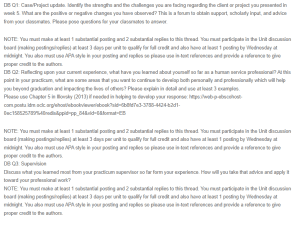
DB Q1: Case/Project update. Identify the strengths and the challenges you are facing regarding the client or project you presented in week 5. What are the positive or negative changes you have observed? This is a forum to obtain support, scholarly input, and advice from your classmates. Please pose questions for your classmates to answer.
Reflections on Practicum Work
NOTE: You must make at least 1 substantial posting and 2 substantial replies to this thread. You must participate in the Unit discussion board (making postings/replies) at least 3 days per unit to qualify for full credit and also have at least 1 posting by Wednesday at midnight. You also must use APA style in your posting and replies so please use in-text references and provide a reference to give proper credit to the authors.
DB Q2: Reflecting upon your current experience, what have you learned about yourself so far as a human service professional? At this point in your practicum, what are some areas that you want to continue to develop both personally and professionally which will help you beyond graduation and impacting the lives of others? Please explain in detail and use at least 3 examples.
Please use Chapter 5 in Illovsky (2013) if needed in helping to develop your response: https://web-p-ebscohost-com.postu.idm.oclc.org/ehost/ebookviewer/ebook?sid=6b8fd7e3-3788-4424-b2d1-0ec158525789%40redis&ppid=pp_84&vid=0&format=EB
NOTE: You must make at least 1 substantial posting and 2 substantial replies to this thread. You must participate in the Unit discussion board (making postings/replies) at least 3 days per unit to qualify for full credit and also have at least 1 posting by Wednesday at midnight. You also must use APA style in your posting and replies so please use in-text references and provide a reference to give proper credit to the authors.
DB Q3: Supervision
Discuss what you learned most from your practicum supervisor so far form your experience. How will you take that advice and apply it toward your professional work?
NOTE: You must make at least 1 substantial posting and 2 substantial replies to this thread. You must participate in the Unit discussion board (making postings/replies) at least 3 days per unit to qualify for full credit and also have at least 1 posting by Wednesday at midnight. You also must use APA style in your posting and replies so please use in-text references and provide a reference to give proper credit to the authors.
 Complete the order form and upload all of your files, including any instructions, rubrics, or other materials provided by your instructor.
  Complete the order payment after filling in the order form. We’ll receive your order and assign it to a writer.
 The assigned writer will complete your paper and forward it to our Editing Team for review and approval.
 Once approved by the editor, the completed paper will be uploaded to your account for you to download, review and approve.