
Week 7 Pharmacological Scenarios
Scenario One
The first prescription error involves acamprosate 666 mg PO TID. While the dose and frequency are correct, the prescription lacks an indication and a complete order format. The corrected order is: Acamprosate 666 mg, take two tablets by mouth thrice daily. Dispense #180 (30-day supply), zero refills. Acamprosate is a glutamatergic modulator that helps people with alcoholism regain the equilibrium between excitatory and inhibitory neurotransmitters (Ball et al., 2022). It reduces cravings and improves abstinence maintenance.
The second error concerns lisdexamfetamine 30 mg PO QAM. Although the dosing is correct, it should include monitoring parameters and potential interaction with serotonergic agents. Corrected order: Lisdexamfetamine 30 mg capsule, take one capsule orally every morning. Dispense #30, 1 refill. Lisdexamfetamine is a CNS stimulant and prodrug of dextroamphetamine that raises norepinephrine and dopamine levels in the brain to treat ADHD (MedlinePlus, 2021).
Thirdly, naltrexone ER 380 mg was incorrectly prescribed as a weekly injection. The correct frequency is every four weeks. Revised order: Naltrexone ER 380 mg, inject intramuscularly in the gluteal muscle once every four weeks. Dispense one syringe, three refills. Naltrexone is a mu-opioid receptor antagonist used for alcohol and opioid use disorder. It decreases cravings and blocks euphoric effects (Kranzler & Soyka, 2018).
Fourth, infliximab was inaccurately labeled as ‘Humira’ and prescribed subcutaneously. Infliximab is an IV medication. The intended medication appears to be adalimumab. Corrected order: Adalimumab (Humira) 40 mg/0.8 mL, inject subcutaneously weekly. Dispense two pens, one refill. Adalimumab is a TNF-α inhibitor that blocks inflammatory pathways in autoimmune conditions (Rutledge-Jukes et al., 2024).
Finally, colchicine 0.6 mg PO every 2 hours for a gout flare is incorrect due to the risk of toxicity. The maximum recommended dose is 1.8 mg per episode. Revised order: Colchicine 0.6 mg, take two tablets at the first sign of gout flare, then one tablet after 1 hour—maximum three tablets in 24 hours. Dispense #6, 0 refills (Sadiq et al., 2025). Colchicine inhibits microtubule polymerization, reducing neutrophil-mediated inflammation.
References
Ball, J. W., Dains, J. E., Flynn, J. A., Solomon, B. S., & Stewart, R. W. (2022). Seidel’s guide to physical examination: An interprofessional approach (10th ed.). Elsevier.
MedlinePlus. (2021, October 15). Lisdexamfetamine: MedlinePlus drug information. https://medlineplus.gov/druginfo/meds/a607047.html
Rutledge-Jukes, H., Jonnalagadda, P., McIntosh, A. P., Krstovski, S., Andriani, N., Smith, I. R., Prendergast, L., & Lynch, J. M. (2024). Lisdexamfetamine’s efficacy in treating attention deficit hyperactivity disorder (ADHD): A meta-analysis and review. Cureus. https://doi.org/10.7759/cureus.68324
Sadiq, N. M., Robinson, K. J., & Terrell, J. M. (2025, January 19). Colchicine. StatPearls – NCBI Bookshelf. https://www.ncbi.nlm.nih.gov/books/NBK431102/
Scenario Two
Bupropion is the optimal pharmacologic choice for a patient who presents with ADHD, depression, anxiety, and nicotine dependence. It is a norepinephrine-dopamine reuptake inhibitor (NDRI) approved for major depressive disorder and quitting smoking, and off-label use for ADHD. Unlike many antidepressants, bupropion lacks serotonergic activity, making it favorable for patients with comorbid anxiety and ADHD without increasing the risk of sexual dysfunction or sedation.
Complete medication order: Bupropion SR 150 mg tablet. Take one tablet orally once daily for three days, then increase to one tablet twice daily. Dispense #60 tablets—one refill. Bupropion inhibits the reuptake of dopamine and norepinephrine, increasing their synaptic concentrations to improve mood, concentration, and attention (Huecker et al., 2024). Additionally, it acts as a non-competitive antagonist at nicotinic acetylcholine receptors, thereby reducing the rewarding effects of nicotine and aiding in smoking cessation.
Before beginning treatment, the patient is not required to stop smoking. Bupropion is typically started 1–2 weeks before the target quit date to allow time for plasma stabilization (Ware et al., 2025). The medication should not be used in patients with seizure disorders or eating disorders due to its seizure risk. Monitoring should include blood pressure (due to norepinephrine effects), mood changes, suicidality, and sleep disturbances. Counseling should address the importance of adherence, set a quit date, and avoid evening dosing to minimize insomnia. Follow-up should occur within 2–4 weeks to assess efficacy and tolerability (Zhang et al., 2022).
References
Huecker, M. R., Smiley, A., & Saadabadi, A. (2024, September 2). Bupropion. StatPearls – NCBI Bookshelf. https://www.ncbi.nlm.nih.gov/books/NBK470212/
Ware, O. D., Stitzer, M. L., Umbricht, A., & Dunn, K. E. (2025). Exposure to bupropion-SR vs. placebo is associated with reductions in smoking among persons receiving methadone with no stated interest in smoking cessation. Addictive Behaviors, 161(57), 108202. https://doi.org/10.1016/j.addbeh.2024.108202
Zhang, H., Mansoursadeghi-Gilan, T., Hussain, S., Veldhuizen, S., Le Foll, B., Selby, P., & Zawertailo, L. (2022). Evaluating the effectiveness of bupropion and varenicline for smoking cessation using an internet-based delivery system: A pragmatic randomized controlled trial (MATCH study). Drug and Alcohol Dependence, 232(67), 109312. https://doi.org/10.1016/j.drugalcdep.2022.109312
Scenario Three
Zolpidem has a half-life of approximately three hours. If a patient takes 10 mg at 21:00, the plasma concentration would reduce by half every three hours, leaving about 1.25 mg by 06:00. Although subtherapeutic, this remaining drug may cause residual sedation, especially in older adults. Since zolpidem does not address depression, it is not ideal for patients with comorbid depression and insomnia (Edinoff et al., 2021). In such cases, sedating antidepressants like mirtazapine, trazodone, and doxepin offer dual therapeutic benefit and are safer long-term.
Mirtazapine, a noradrenergic and specific serotonergic antidepressant (NaSSA), increases norepinephrine and serotonin release by blocking presynaptic α2 receptors. It promotes both mood improvement and sedation. The appropriate order is Mirtazapine 15 mg tablet, and one tablet PO should be taken at bedtime. Dispense #30, 1 refill.
Next, trazodone, a serotonin antagonist and reuptake inhibitor (SARI), improves sleep by blocking serotonin reuptake, H1 histamine, and α1-adrenergic receptors. The prescription is: Trazodone 50 mg tablet, take one tablet PO at bedtime. Dispense #30, 1 refill (Shin & Saadabadi, 2024).
Doxepin, a tricyclic antidepressant used at low doses, selectively blocks H1 receptors to enhance sleep without a significant anticholinergic burden. Its prescription is: Doxepin 6 mg capsule, take one capsule PO within 30 minutes of bedtime. Dispense #30, 1 refill.
Monitoring for all agents includes sedation, orthostatic hypotension (especially with trazodone), mood worsening, and hepatic function (Almasi et al., 2024). Patients should be reassessed in 2–4 weeks for sleep quality, mood stability, and medication tolerance.
References
Almasi, A., Patel, P., & Meza, C. E. (2024, February 14). Doxepin. StatPearls – NCBI Bookshelf. https://www.ncbi.nlm.nih.gov/books/NBK542306/
Edinoff, A. N., Wu, N., Ghaffar, Y. T., Prejean, R., Gremillion, R., Cogburn, M., Chami, A. A., Kaye, A. M., & Kaye, A. D. (2021). Zolpidem: Efficacy and side effects for insomnia. Health Psychology Research, 9(1), 1–14. https://doi.org/10.52965/001c.24927
Shin, J. J., & Saadabadi, A. (2024, February 29). Trazodone. StatPearls – NCBI Bookshelf. https://www.ncbi.nlm.nih.gov/books/NBK470560/
Scenario Four
JL is a 50-year-old female taking metformin 1000 mg daily and Janumet 50/1000 mg twice daily, resulting in duplicated metformin exposure. This increases the risk of lactic acidosis, particularly without recent renal labs. Metformin, a biguanide, decreases hepatic glucose production and improves insulin sensitivity. Her reported fatigue and dizziness could reflect medication side effects or metabolic imbalance. Necessary labs include HbA1c, serum creatinine, eGFR, electrolytes, and liver function tests to guide adjustments (Corcoran & Jacobs, 2023).
Given the need for glycemic control and potential renal concerns, semaglutide is a preferred replacement. Semaglutide is a GLP-1 receptor agonist that mimics endogenous incretin hormones, enhancing insulin secretion, suppressing glucagon, and promoting weight loss. It is renally safe in patients with eGFR >15 mL/min and offers cardiovascular benefits in type 2 diabetes (Latif et al., 2024). Corrected order: Semaglutide 0.25 mg subcutaneously once weekly for 4 weeks, then increase to 0.5 mg once weekly. Dispense four pens, zero refills. Janumet may be continued if renal function permits, though dose reduction may be required based on future labs.
Based on JL’s medication profile, five possible disease states include type 2 diabetes, major depressive disorder, generalized anxiety disorder, irritable bowel syndrome, and recurrent herpes simplex virus. Monitoring includes renal and liver function, mood, blood glucose, and serotonin syndrome symptoms (Richardson et al., 2021). JL should receive education on semaglutide’s use and side effects, with a follow-up scheduled in 2–4 weeks to reassess labs, tolerance, and treatment effectiveness.
References
Corcoran, C., & Jacobs, T. F. (2023, August 17). Metformin. StatPearls – NCBI Bookshelf. https://www.ncbi.nlm.nih.gov/books/NBK518983/
Latif, W., Lambrinos, K. J., Patel, P., & Rodriguez, R. (2024, February 25). Compare and contrast the Glucagon-Like Peptide-1 Receptor Agonists (GLP1RAs). StatPearls – NCBI Bookshelf. https://www.ncbi.nlm.nih.gov/books/NBK572151/
Richardson, C. R., Borgeson, J. R., Van Harrison, R., Wyckoff, J. A., Yoo, A. S., Aikens, J. E., Griauzde, D. H., Tincopa, M. A., Van Harrison, R., Proudlock, A. L., & Rew, K. T. (2021, October 1). Management of type 2 diabetes mellitus. NCBI Bookshelf. https://www.ncbi.nlm.nih.gov/books/NBK579413/
ORDER A PLAGIARISM-FREE PAPER HERE
We’ll write everything from scratch
Question 
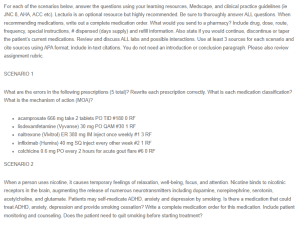
Week 7 Pharmacological Scenarios
For each of the scenarios below, answer the questions using your learning resources, Medscape, and clinical practice guidelines (ie JNC 8, AHA, ACC etc). Lecturio is an optional resource but highly recommended. Be sure to thoroughly answer ALL questions. When recommending medications, write out a complete medication order. What would you send to a pharmacy? Include drug, dose, route, frequency, special instructions, # dispensed (days supply) and refill information. Also state if you would continue, discontinue or taper the patient’s current medications. Review and discuss ALL labs and possible interactions. Use at least 3 sources for each scenario and cite sources using APA format; include in-text citations. You do not need an introduction or conclusion paragraph. Please also review assignment rubric.
Week 7 Pharmacological Scenarios
SCENARIO 1
What are the errors in the following prescriptions (5 total)? Rewrite each prescription correctly. What is each medication classification? What is the mechanism of action (MOA)?
- acamprosate 666 mg take 2 tablets PO TID #180 0 RF
- lisdexamfetamine (Vyvanse) 30 mg PO QAM #30 1 RF
- naltrexone (Vivitrol) ER 380 mg IM inject once weekly #1 3 RF
- infliximab (Humira) 40 mg SQ inject every other week #2 1 RF
- colchicine 0.6 mg PO every 2 hours for acute gout flare #6 0 RF
SCENARIO 2
When a person uses nicotine, it causes temporary feelings of relaxation, well-being, focus, and attention. Nicotine binds to nicotinic receptors in the brain, augmenting the release of numerous neurotransmitters including dopamine, norepinephrine, serotonin, acetylcholine, and glutamate. Patients may self-medicate ADHD, anxiety and depression by smoking. Is there a medication that could treat ADHD, anxiety, depression and provide smoking cessation? Write a complete medication order for this medication. Include patient monitoring and counseling. Does the patient need to quit smoking before starting treatment?
SCENARIO 3
Zolpidem has a half-life of 3 hours. If a patient takes 10 mg at 21:00, what will the blood level be at 06:00? Name 3 antidepressants/antipsychotics you might prescribe for patients with co-existing depression and insomnia. What is their MOA? Include complete medication orders and patient monitoring for each of the 3 medications.
SCENARIO 4
JL is a 50-year-old female presenting for medication refills. She has no recent lab work, but reports fatigue and occasional dizziness. Current meds: metformin 1000 mg daily, Janumet 50/1000 mg BID, paroxetine 20 mg daily, venlafaxine ER 150 mg daily, buspirone 5 mg TID PRN, valacyclovir 500 mg daily, dicyclomine 10 mg po QID PRN. She is unsure of her A1c or blood pressure. How would you assess and improve her regimen? What monitoring is needed? List 5 possible disease states based on her medications.
 Complete the order form and upload all of your files, including any instructions, rubrics, or other materials provided by your instructor.
  Complete the order payment after filling in the order form. We’ll receive your order and assign it to a writer.
 The assigned writer will complete your paper and forward it to our Editing Team for review and approval.
 Once approved by the editor, the completed paper will be uploaded to your account for you to download, review and approve.