
Social Policy Issue: Healthcare Access for Undocumented Immigrants
Healthcare access for undocumented immigrants is an essential and persistent social welfare concern that is influenced by immigration policy, healthcare structures, and socio-political belief systems. Even though undocumented individuals contribute appreciably to the US economy and society, they are disenfranchised from most federal health programs and, consequently, are at risk for untreated illnesses, psychological distress, and systemic injustices. Disparities are most severely impacted on populations of marginalized identity and point to fundamental assumptions about who is deserving of care. While federal and state governments are moving in different directions on how to address the concern, new federal proposals would dismantle efforts at the state level to increase accessibility. Through social policy, this paper reviews the intersection between healthcare accessibility and undocumented immigration. It identifies and discusses related human needs, the underlying cultural and moral premises, the past and present policy reactions, and a recent federal proposal.
The Social Welfare Issue
Healthcare among the undocumented is an alarming issue of social welfare that is a result of inequality and systematic alienation. Illegal immigrants residing in the United States are highly limited in receiving the correct medicine. For instance, they are not allowed in federal plans like Medicaid and the Affordable Care Act (ACA). Whereas it is possible to access emergency care according to the Emergency Medical Treatment and Labor Act (EMTALA) administration, routine and primary prevention care and chronic care remain largely inaccessible. High rates of untreated health conditions, health inequity, and delayed treatment are then experienced at their worst in populations of immigrants living in poverty who are most likely to work in labor-burdening jobs that do not cover all benefits. The problem is not only the issue of social justice and human rights but also of public health. Healthcare has been declared a fundamental human need by social workers, but barring undocumented immigrants from getting systemic, all-around support breaks the central tenets of equity and dignity. The immigrant healthcare access policy has, in turn, been evolving with time and has been determined by economic necessities, popular opinion, and attempts to modify immigration procedures.
Human Needs Associated with the Issue
The Physical Health and Medical Care Requirement
Undocumented immigrants should receive physical health care services to prevent the development of illnesses as well as chronic health issues and to treat and manage them. They lose their health in the long run without the primary care of having prevention checks or immunization, and treatment of their communicable diseases like diabetes or high blood pressure. This outstanding healthcare demand raises the likelihood of people of severe complications, hospitalization, and death. Reactive health care, compared to preventive care, is more expensive and decreases the quality of life. There is also a burden on emergency departments due to poor access to physical health services, where undocumented persons are inclined to use the emergency department as a last resort, prolonging other public health services.
The Requirement for Mental Health Care
The levels of stress, anxiety, and depression are elevated in most undocumented immigrants because of the fear of deportation, inability to get funds, and isolation as a result of cultural differences. However, they receive little or no exploratory mental health services, counseling, and psychiatric care. The inability to fulfill psychological needs increases vulnerability to mental health collapse and substance abuse, as well as suicidal activities. Mental health care is among the primary basic needs of any given individual, especially immigrants who go through trauma in their homeland or even when under immigration procedures or when they are abused in America (Nagy et al., 2024). This unmet need is compounded by the lack of culturally competent care, which has a direct impact on the disadvantaged population with low socioeconomic status and is disproportionately affected by health outcomes.
The Requirement for Economic Stability and Employment-Specific Benefits
Undocumented immigrants play an essential role in the US labor market as they primarily work in the farming, construction, and services sectors. They tend not to have health insurance as well as employment protection, through which they can be assured of care despite their work. This makes them unable to shoulder out-of-pocket medical services, causing some to go without treatment altogether. Health benefits linked to employment support are one of the top essential human necessities needed by any employee to get a sense of security. Policies that deny them access to healthcare tend to create new cycles of poverty, diseases, and exploitation that make the economic and physical survival of the population much harder.
The Need for Safety, Security, and Legal Protection
Access to healthcare is linked to broader needs for protection and safety from harm. Undocumented immigrants often forgo healthcare, even in emergencies, for fear of detection and deportation (Blackburn & Haeder, 2024). Avoidance of healthcare that is not safe and non-punitive deprives them of their need for individual safety and protection against harm. Public health is compromised when individuals are fearful of using services at times such as during disease epidemics or when they are pregnant. Safety while accessing healthcare is not only about laws but also about fundamental human rights, particularly for individuals most at risk of harm, whose fear of immigration enforcement prevents them from living healthy, stable lives.
Values, Assumptions, Ideologies, and Cultural Underpinnings Connected to the Issue
Healthcare for undocumented immigrants is intimately connected to American ideologies and values, especially individualism, individual meritocracy, and the deserving poor. There is a prevalent assumption that only citizens or legal residents are entitled to public benefits and an exclusionary, restrictive understanding of social obligation. This ideal is at odds with fundamental NASW Code of Ethics principles, such as faith in the inherent worth and dignity of every individual and an appreciation for human connections. Omitting undocumented immigrants from healthcare policy exhibits an absence of empathy and solidarity for at-risk populations and an emphasis on punitive over humanitarian responses.
This exclusion renders marginalized identity communities, especially those at multiple intersections of race and class and immigrant status and disability, particularly vulnerable. Undocumented individuals are disproportionately Latinx, Black, and Asian immigrants who are often marginalized by multiple forms of discrimination, economic instability, and inequities in health (Nayak et al., 2024). Non-citizens who lack legal status and private health insurance face systems-level barriers to care and concomitant vicious cycles of ill health and poverty. Women, especially undocumented mothers, have an increased likelihood of adverse maternal health outcomes; LGBTQ+ immigrants are often not able to access gender-affirming or culturally competent care. The inequities highlight that cultural biases and systemic racism are affecting policy options that hinder caring for the most marginalized in society.
Moreover, such cultural paradigms on fear and criminality of immigrants translate into policies where undocumented persons are treated as security threats and not as humans who deserve inherent needs. Age and ability status further complicate the issue since most aging undocumented individuals carry unresolved chronic conditions, and disabled individuals have minimal access to care appropriate to their needs. These are expressions of structural injustice and, hence, contrary to NASW’s ethical position on social justice and fair provision of services. Social workers are therefore required to challenge harmful assumptions through advocacy for inclusive healthcare policies that are respectful of diversity, oppressive of inequity, and assertive of all individuals’ humanity, regardless of their legal status.
Importance of the Issue
As a social worker, healthcare for undocumented immigrants is paramount to advancing human dignity, social justice, and equity. To begin, the problem aligns with my moral obligation to advocate for marginalized people. Also, it motivates me to challenge the institutional structures perpetuating health inequity. In addition, it motivates me to become culturally competent in the care of immigrants to avoid cultural and linguistic barriers. It also reflects my passion for inclusive policy mobilization where everyone, regardless of their status regarding immigration accessibility, should be able to get the needful attention.
For the social work profession, healthcare for undocumented immigrants presents an exemplary illustration of the fundamental principles of the NASW Code of Ethics. It is an obligatory appeal to advancing social justice by means of confrontations of institutional exclusion. It challenges practitioners to embrace cultural humility in their interactions with populations with diverse backgrounds. It demands that the profession should promote a policy of inclusiveness of health care on the macro-intervention level. It restates the across-discipline collaboration to the goal of defeating systematic inequities. By undertaking such a challenge, the profession states its mission in keeping vulnerable populations safe and assuring equal access to primary health and social services.
In broader society, healthcare for undocumented immigrants is necessary on ethical, economic, and public health grounds. Denying care to any group is at odds with society’s principles of compassion and fairness. Untreated diseases can be transmitted and cause public health problems for all. Spending money on preventive care for undocumented immigrants saves money on emergency care later and lightens the load on hospitals. Inclusive health policies are best for social solidarity and help to lower stigma, promoting trust and cooperation between diverse populations. Providing healthcare for all demonstrates society’s belief in justice, well-being, and shared dignity for all individuals.
General Approach that the State and Federal Government Have Taken
The federal government’s approach to healthcare for undocumented immigrants has been exclusionary. Federal law excludes undocumented immigrants from virtually all publicly funded health programs, such as Medicaid, Medicare, and health subsidies, in the ACA marketplace. The Personal Responsibility and Work Opportunity Reconciliation Act (PRWORA) of 1996 expressly prohibited undocumented immigrants from such federal public benefits as non-emergency health care. The EMTALA is still among the few federal statutes that demand hospitals provide emergency care to all patients, including those without proper immigration documents.
On the contrary, there are instances where some states have been more inclusive, particularly when it comes to progressive states. California and New York, for example, have increased accessibility to healthcare services for undocumented immigrants from state finances. California’s Medi-Cal program (the California Medicaid plan) provides full-scope Medicaid to low-income undocumented individuals who are under 26 years old and above 50 years old. In New York, Emergency Medicaid and other plans that give prenatal care and cancer care are offered, irrespective of immigration. Illinois also launched plans providing health coverage to undocumented seniors.
The similarity between federal and statewide strategies is the persistent acknowledgment of emergency care as a fundamental right, which is manifested in policies such as Emergency Medicaid and EMTALA. Those levels of government also prioritize cost control and public health, although federal policies tend to favor immigration control and enforcement over health equity and inclusion on the part of some states. Nevertheless, inequities are still profound because there is no national policy, and consequently, access to care for undocumented immigrants remains extremely localized.
A Recent Policy Related to This Issue
In May 2025, the US House of Representatives approved a reconciliation bill that would implement a vital policy change: a decrease in the federal matching rate for Medicaid from 90% to 80% for states that use their resources for healthcare coverage or support for some immigrant populations (Williams et al., 2025). The aim of this policy, called the Medicaid Federal Match Penalty, is to deter states from expanding health coverage for undocumented immigrants. The penalty directs its aim at 14 states and the District of Columbia that now finance programs for undocumented citizens. Even though subsequent changes narrowed the policy’s focus to bar from its reach of lawfully residing children and pregnant women, most states would still risk losing significant federal funding, which would put them under pressure to reverse their inclusive initiatives for coverage.
Its direct effect would be on healthcare for over 1.9 million presently insured undocumented individuals taking part in plans funded by states. States that have led the country in providing inclusive healthcare, like California, New York, and Illinois, would face billions of additional costs or be forced to unravel coverage altogether. The Congressional Budget Office estimates that over 1.4 million will lose their health coverage when states pull back on their coverage due to such a penalty come 2034. The states with trigger laws, such as Illinois and Utah, could be obligated to unwind all the Medicaid expansion they have made over the years into equity of public health. It will be economically and humanly expensive, and this will essentially fall on immigrant families living in poverty who are already much circumscribed when getting care.
Besides economic implications, the intended penalty shows an ideological tendency of punitive and restrictive federal healthcare policy; rather than continuing the work of expanding initiatives on the local front, such policy trifles the health, economic stability, and health outcomes of immigrants. It is also in contravention of ethical principles of equity, inclusiveness, and human dignity, which are part and parcel of social work. It will become a law that will raise healthcare disparities, stifle compassionate innovation at the grassroots, and spread fear and distrust in immigrant communities. It not only reverses the progress, but it also endangers millions of needy people and the design of the healthcare safety net of the United States itself.
Past State or Federal Policies that Sought to Address the Issue
Federal Policy: EMTALA – 1986
The Emergency Medical Treatment and Labor Act came up in 1986 to give people access to emergency services irrespective of their legality and their capacity to pay. In hospitals participating in Medicare, EMTALA legally obliges hospitals to offer emergency medical screening and stabilization services to everyone, both documented and undocumented immigrants (Brenner et al., 2021). On the one hand, this policy guards against life-threatening refusal of treatment. It is ineffective due to the fact that it applies only to emergency care but not to preventive care, chronic care, or follow-up treatment. Consequently, this causes most of the undocumented people to delay care until it is too late. EMTALA is not a universal solution to the problem of access to healthcare, but it has been a low-level safety net. It neither takes a load off the emergency rooms nor decreases long-term health inequities. Its narrow scope has revealed the need for more inclusive healthcare policies that extend beyond emergencies to address holistic health needs for undocumented populations.
State Policy: California’s Medi-Cal Expansion for Undocumented Youth and Seniors
California has been unusually ambitious about expanding healthcare coverage for unauthorized immigrants through its Medi-Cal program with state treasury funds. California was the leading state and was the first to provide full-scope Medi-Cal to all children under 19 years old in 2016 (Lipton et al., 2021). The Medi-Cal program was expanded to cover unauthorized adults over 50 years old in 2022, and plans were adopted in 2024 to cover unauthorized individuals aged between 26 and 49 years old. These expansions have significantly increased healthcare access for previously excluded individuals. The policy has done well to curb emergency care utilization and improve prevention care and health equity. Despite challenges for funding and enrollment looming, California’s template is noted for sophisticated thinking on immigrant-inclusive healthcare reform. However, its success also highlights inequity across states, where most offer minimal or no healthcare assistance to unauthorized individuals.
The Impact of a Recently Enacted Policy on Previous Policies
The new Medicaid Federal Match Penalty enacted for 2025 is an outright rejection of states’ efforts at expanding healthcare for undocumented immigrants at the state level. Instead of expanding on inclusive policies like EMTALA or California’s expansions of Medi-Cal, the policy itself seeks to punish states for spending their money on covering healthcare for immigrant populations. By reducing the federal matching rate for Medicaid from 90% to 80% for states that provide such care, the policy punishes states for adopting more just healthcare policies. It repudiates decades of innovations at the state level, which filled gaps due to exclusionary federal policies.
The proposal goes contrary to the spirit of the ACA, which spurred states to expand Medicaid to vulnerable populations for public health reasons and reduced costs for healthcare. Even though the ACA did not encompass undocumented immigrants under its protections, it included an architecture used by many states to offer partial or complete coverage from state funds. The proposed penalty defies such a trend by invoking financial penalties, essentially prioritizing budget cuts over health equity. It discourages states from utilizing flexibility to suit their citizens’ needs, particularly immigrants who are integral parts of any economy.
Instead of confronting the underlying sources of healthcare inequities, the proposal transfers costs to states and enhances the risk of loss of coverage. It refutes EMTALA’s precedent, which, though imperfect, recognized an ethical imperative for the treatment of all such individuals in an emergency. This proposal shows a trend toward an increasingly restrictive, punitive approach to immigrant healthcare access, privileging federal cost savings over community-based, inclusive models of healthcare. It indicates an about-face from policies where health is understood to be an individual right and substitutes political calculus deterrents that not only put the health of immigrants at risk but also the broader public health outcomes
Conclusion
In the course of conducting the research and writing this paper, I have realized a better appreciation of the role that social policy plays in defining the lives of marginalized groups, especially undocumented immigrants. Before, I evaluated healthcare access predominantly through the clinical perspective of healthcare access, whereas, in the analysis of federal and state policies, I now comprehend that legal edifice either supports or hinders access to the fundamental needs of human beings. I learned that decisions concerning policies taken in legislature houses directly and factually affect the health, dignity, and well-being of individuals and whole communities. This has given me more confidence in understanding the connection between advocacy and social justice and their real-life implications for vulnerable groups.
Among the most important lessons is that policy is neither a tool nor an uncharged tool that can either promote equity or entrench exclusionism because it is loaded with ideologies, assumptions, and values. The experience of studying the proposal to inculcate Medicaid Federal Match Penalty helped me sharpen my sensitivity to how policies may promote the feat against altruistic endeavors. I began revising my thoughts in terms of viewing policy work as complex and distant, to regard it as an interdisciplinary field of morality. Social workers are no longer allowed to remain mere observers of unjust policies. Instead, social workers must become key participants in crafting legislation and initiatives on the basis of ethical principles.
Social workers must participate in policy analysis and advocacy, which positions them to be agents of change at a higher level than at the individual level. Social workers are the only professionals with the ability to bridge the gap between their direct service experience and macro-level change by translating the real-life significance of policy decisions. By using policy work, social workers make sure that systems are developed to be inclusive, just, and responsive to the greatest needs. Engagement in policy is not just a work requirement; it is a valuable tool to eliminate suppression and safeguard the personal privileges and rights of all individuals.
References
Blackburn, C. C., & Haeder, S. F. (2024). US public opinion about interior border checkpoints and health care access for undocumented immigrants. Health Economics Policy and Law, 1–24. https://doi.org/10.1017/s1744133124000252
Brenner, J. M., Blutinger, E., Ricke, B., Vearrier, L., Kluesner, N. H., & Moskop, J. C. (2021). Ethical issues in the access to emergency care for undocumented immigrants. Journal of the American College of Emergency Physicians Open, 2(3). https://doi.org/10.1002/emp2.12461
Lipton, B. J., Nguyen, J., & Schiaffino, M. K. (2021). California’s Health4All Kids expansion and health insurance coverage among low-income noncitizen children. Health Affairs, 40(7), 1075–1083. https://doi.org/10.1377/hlthaff.2021.00096
Nagy, G. A., Zhan, C., Rossitch, S. S., Stafford, A. M., Mendoza, A., Reyes, N. F., & Gonzalez-Guarda, R. (2024). Understanding mental health service needs and treatment characteristics for Latin American immigrants and refugees: A focus on CBT strategies for reducing acculturative stress. The Cognitive Behaviour Therapist, 17, e12. https://doi.org/10.1017/S1754470X24000138
Nayak, S. S., Cardone, A., Soberano, K., & Dhond, M. (2024). The health status of undocumented immigrants from Asian countries in the United States: A scoping review and recommendations for future directions. Journal of Immigrant and Minority Health. https://doi.org/10.1007/s10903-024-01625-2
Williams, E., Pillai, D., Pillai, A., & Artiga, S. (2025, May 22). Proposed Medicaid federal match penalty for states that have expanded coverage for immigrants: State-by-state estimates. KFF. https://www.kff.org/medicaid/issue-brief/proposed-medicaid-federal-match-penalty-for-states-that-have-expanded-coverage-for-immigrants-state-by-state-estimates/
ORDER A PLAGIARISM-FREE PAPER HERE
We’ll write everything from scratch
Question 
Social Policy Issue: Healthcare Access for Undocumented Immigrants
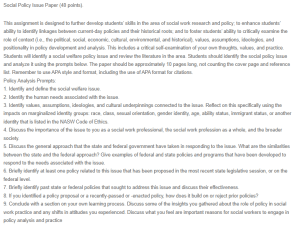
Social Policy Issue Paper (40 points).
This assignment is designed to further develop students’ skills in the area of social work research and policy; to enhance students’ ability to identify linkages between current-day policies and their historical roots; and to foster students’ ability to critically examine the role of context (i.e., the political, social, economic, cultural, environmental, and historical), values, assumptions, ideologies, and positionality in policy development and analysis. This includes a critical self-examination of your own thoughts, values, and practice.
Students will identify a social welfare policy issue and review the literature in the area. Students should identify the social policy issue and analyze it using the prompts below. The paper should be approximately 10 pages long, not counting the cover page and reference list. Remember to use APA style and format, including the use of APA format for citations.
Healthcare Access for Undocumented Immigrants
Policy Analysis Prompts:
1. Identify and define the social welfare issue.
2. Identify the human needs associated with the issue.
3. Identify values, assumptions, ideologies, and cultural underpinnings connected to the issue. Reflect on this specifically using the impacts on marginalized identity groups: race, class, sexual orientation, gender identity, age, ability status, immigrant status, or another identity that is listed in the NASW Code of Ethics.
4. Discuss the importance of the issue to you as a social work professional, the social work profession as a whole, and the broader society.
5. Discuss the general approach that the state and federal government have taken in responding to the issue. What are the similarities between the state and the federal approach? Give examples of federal and state policies and programs that have been developed to respond to the needs associated with the issue.
6. Briefly identify at least one policy related to this issue that has been proposed in the most recent state legislative session, or on the federal level.
7. Briefly identify past state or federal policies that sought to address this issue and discuss their effectiveness.
8. If you identified a policy proposal or a recently-passed or -enacted policy, how does it build on or reject prior policies?
9. Conclude with a section on your own learning process. Discuss some of the insights you gathered about the role of policy in social work practice and any shifts in attitudes you experienced. Discuss what you feel are important reasons for social workers to engage in policy analysis and practice
 Complete the order form and upload all of your files, including any instructions, rubrics, or other materials provided by your instructor.
  Complete the order payment after filling in the order form. We’ll receive your order and assign it to a writer.
 The assigned writer will complete your paper and forward it to our Editing Team for review and approval.
 Once approved by the editor, the completed paper will be uploaded to your account for you to download, review and approve.