
PRAC 6531: FNP Clinical Procedures Self-Assessment Form
| Procedure | Confident (Can complete independently) | Mostly confident (Can complete with supervision) | Beginning (Have performed with supervision or need supervision to feel confident) | New (Have never performed or does not apply) |
| Cerumen Impaction Removal (irrigation and curette) |
✓ |
|||
| Fluorescein Staining | ✓ | |||
| Corneal Foreign Body Removal | ✓ | |||
| Wood’s Light Examination | ✓ | |||
| Epistaxis management/nasal packing: PRAC 6531: FNP Clinical Procedures Self-Assessment Form |
✓ |
|||
| Remove Foreign Body (ear, eye, nose, soft tissue, other) |
✓ |
|||
| EKG Lead Placement and Interpretation | ✓ | |||
| Peak flow meter Measurements | ✓ | |||
| Pulmonary Function Tests | ✓ | |||
| Burn Treatment/dressing | ✓ | |||
| Cryotherapy | ✓ | |||
| Shave Biopsy | ✓ | |||
| Punch Biopsy | ✓ | |||
| Suturing
– Simple Interrupted Sutures and Suture Removal |
✓
|
|||
| Staple Placement | ✓ | |||
| Skin Adhesive Placement | ✓ | |||
| Toenail Avulsion | ✓ | |||
| Incision and Drainage | ✓ | |||
| Subungual Hematoma Evacuation | ✓ | |||
| Skin Tag Removal | ✓ | |||
| Wart destruction/removal | ✓ | |||
| Wound Care
Wound Debridement |
✓ | |||
| Steri Strip Application | ✓ | |||
| Tick Removal | ✓ | |||
| KOH skin slide for fungus | ✓ | |||
| Hemorrhoid, excision of thrombus | ✓ | |||
| Local/Field Block for Anesthesia | ✓ | |||
| Digital Block for Anesthesia | ✓ | |||
| Trigger Point Injection | ✓ | |||
| Joint Injection | ✓ | |||
| Splinting | ✓ | |||
| Basic microscopy (yeast, BV) | ✓ | |||
| Contraceptive Placement (Long term) | ✓ | |||
| IUD Placement and Removal | ✓ |
Summary of strengths:
| The self-assessment highlighted several procedures in which I feel confident or mostly confident, including EKG lead placement and interpretation, suturing, skin tag removal, splinting, wound care, and cerumen impaction removal. My proficiency in EKG interpretation stems from previous training in cardiac rhythm analysis and repeated hands-on practice in simulated and clinical settings. As Sattar & Chhabra (2023) note, accurate EKG lead placement is crucial for identifying arrhythmias and ischemic changes, particularly in adult populations with high cardiovascular risk.
I am also confident in performing simple interrupted sutures and suture removal, a skill I developed through hands-on workshops and clinical wound care experiences. Mastery of suturing is essential in primary care, where minor lacerations and incisions are commonly encountered. Similarly, I am comfortable managing wound care and Steri Strip application, aligning with guidelines for evidence-based wound management (RegisteredNurseRN, 2018). Other areas of strength include cryotherapy, peak flow measurements, and skin adhesive placement. These skills are frequently required for dermatologic and respiratory care and are supported by evidence-based protocols from the CDC and the Global Initiative for Asthma (Global Initiative for Asthma, 2024). Overall, my strengths reflect a solid clinical foundation and readiness to manage common conditions encountered in adult primary care settings. |
Opportunities for growth:
| Despite these strengths, the assessment also revealed several key procedures where I need improvement. The most notable area is IUD placement and removal, which I have not yet performed. As long-acting reversible contraception becomes increasingly popular, competence in IUD procedures is essential for providing full-spectrum reproductive health services. According to Lanzola et al. (2025), proper insertion techniques are critical to minimizing complications such as expulsion or uterine perforation.
I also identified a gap in performing digital block anesthesia, which is used to manage pain for distal procedures such as toenail avulsions or laceration repair. Although I understand the theoretical aspects, I have not had the opportunity to practice it under supervision. Acquiring this skill will enhance my ability to provide effective procedural anesthesia. Other areas for improvement include punch biopsy, KOH skin slide preparation, and hemorrhoid thrombus excision. Punch biopsies are vital for evaluating suspicious skin lesions, and competence in this technique can expedite the diagnosis of skin cancers. KOH prep, on the other hand, allows for quick identification of fungal infections and is an essential point-of-care diagnostic tool (Ramsey & Rostami, 2023). Finally, epistaxis management and foreign body removal in ENT settings are procedures I have only limited exposure to and would benefit from direct practice under supervision. These gaps present meaningful opportunities to expand my procedural skill set and contribute to more comprehensive care delivery during the practicum.
|
Now, write three to four (3–4) possible goals and objectives for this practicum experience. Ensure that they follow the SMART Strategy, as described in the Learning Resources.
Goal 1: Gain proficiency in IUD placement and removal by Week 12 of the practicum.
Goal 2: Demonstrate competency in digital block anesthesia by Week 10.
Goal 3: Improve skills in performing punch biopsies for dermatologic concerns by Week 11.
Goal 4: Achieve competency in KOH skin slide preparation and microscopy by the end of the practicum.
|
References
Global Initiative for Asthma. (2024). Global Strategy for Asthma Management and Prevention. https://ginasthma.org/wp-content/uploads/2024/05/GINA-2024-Strategy-Report-24_05_22_WMS.pdf
Lanzola, E. L., Auber, M., & Ketvertis, K. (2025, February 14). Intrauterine device placement and removal. StatPearls – NCBI Bookshelf. https://www.ncbi.nlm.nih.gov/books/NBK557403/
Ramsey, M. L., & Rostami, S. (2023, September 4). Skin biopsy. StatPearls – NCBI Bookshelf. https://www.ncbi.nlm.nih.gov/books/NBK470457/
RegisteredNurseRN. (2018, March 7). Pressure Ulcers (Injuries) Stages, Prevention, assessment | Stage 1, 2, 3, 4 Unstageable NCLEX [Video]. YouTube. https://www.youtube.com/watch?v=MDtPik1UE6k
Sattar, Y., & Chhabra, L. (2023, June 5). Electrocardiogram. StatPearls – NCBI Bookshelf. https://www.ncbi.nlm.nih.gov/books/NBK549803/
ORDER A PLAGIARISM-FREE PAPER HERE
We’ll write everything from scratch
Question 
Clinical Skills and Procedures Self-Assessment
Before embarking on any professional or academic activity, it is important to understand the background, knowledge, and experience you bring to it. You might ask yourself “What do I already know? What do I need to know? And what do I want to know?” This critical self-reflection is especially important for developing clinical skills, such as those for advanced practice nursing.
The Family Nurse Practitioner (FNP) Procedures List and Resource Review and FNP Clinical Skills and Procedures Self-Assessment Form or Adult Gerontology Primary Care Nurse Practitioner (AGPCNP) Clinical Skills Resource List and AGPCNP Clinical Skills and Procedures Self-Assessment Form provided in the Learning Resources can be used to celebrate your progress throughout your practicum and identify skills gaps. The lists cover all necessary skills you should demonstrate during your practicum course.
For this Assignment, you assess where you are now in your clinical skill development and make plans for your practicum. Specifically, you will identify strengths and opportunities for improvement regarding the required practicum skills and procedures.
In this practicum experience, when developing your goals and objectives, be sure to keep adult health guidelines and best practices in mind.
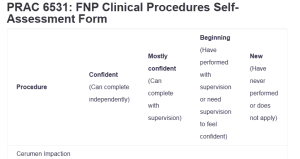
PRAC 6531: FNP Clinical Procedures Self-Assessment Form
To prepare:
- Review the resources and clinical skills in the Family Nurse Practitioner (FNP) Procedures List and Resource Review and FNP Clinical Skills and Procedures Self-Assessment Form or Adult Gerontology Primary Care Nurse Practitioner (AGPCNP) Clinical Skills Resource List and AGPCNP Clinical Skills and Procedures Self-Assessment Form specific to your selected NP track . It is recommended that you print out these documents to serve as guides throughout your practicum.
- Download the Clinical Skills and Procedures Self-Assessment Form that applies to your NP track to complete this Assignment.
Using the Clinical Skills and Procedures Self-Assessment Form specific to your NP track (i.e., FNP or AGPCNP):
- Rate yourself according to your confidence level performing the procedures identified on the Clinical Skills and Procedures Self-Assessment Form.
- Based on your ratings, summarize your strengths and opportunities for improvement.
- Based on your self-assessment and theory of nursing practice, develop 3–4 goals and objectives for this practicum experience. Include them on the designated area of the form.
Written Expression and Formatting – Paragraph Development and Organization: Paragraphs make clear points that support well-developed ideas, flow logically, and demonstrate continuity of ideas. Sentences are carefully focused—neither long and rambling nor short and lacking substance. A clear and comprehensive purpose statement and introduction is provided which delineates all required criteria.
Written Expression and Formatting – English writing standards: Correct grammar, mechanics, and proper punctuation
Written Expression and Formatting – The paper follows correct APA format for title page, headings, font, spacing, margins, indentations, page numbers, parenthetical/in-text citations, and reference list.
 Complete the order form and upload all of your files, including any instructions, rubrics, or other materials provided by your instructor.
  Complete the order payment after filling in the order form. We’ll receive your order and assign it to a writer.
 The assigned writer will complete your paper and forward it to our Editing Team for review and approval.
 Once approved by the editor, the completed paper will be uploaded to your account for you to download, review and approve.