
Interview and Interdisciplinary Issue Identification
This interview study involved a clinical nurse manager working in a mid-size urban hospital in Chicago, Illinois, in the United States of America. The subject of the study, the nurse manager, possesses more than 12 years of experience in nursing leadership and currently supervises a diverse group of staff across the emergency and inpatient services. Her accountabilities entail staff scheduling, policy implementation corrective measures and arrangements and implementation of clinical outcomes and safety measures.
In the interview, the nurse manager identified a critical issue: communication breakdown among interdisciplinary team members during patient handoffs between shifts. She clarified that this situation has led to the increased frequency of medication errors, repetitive lab tests, and delays in patient treatment, compromising the outcomes and frustrating the personnel.
Leadership introduced the SBAR training model but never gained the support it needed due to inadequate compliance and low staff participation. She pointed out that while the mission of the hospital encourages teamwork, the culture of the organization is still highly bureaucratic and hierarchical and has well-defined roles. The nurse manager also reported that she had positive experiences with interdisciplinary rounds at another healthcare organization and learned how an efficient collaborative approach could change for better patient care and safety.
This interview showed that there is a need for a systematic transitional, long-term, multiple-disciplinary communication plan to improve the care continuum, especially during handoffs. The findings contribute to the ongoing debates that advocate for any models of care and leadership to address the problem.
Issue Identification
The main issue identified is ineffective communication during patient handoffs among interdisciplinary teams, leading to poor care continuity and compromised patient safety. Evidence-based approaches, as well as interdisciplinary approaches, are suitable since handoffs involve many players such as nurses, physicians and pharmacists. Failure to communicate these changes effectively across these transitions also has increasing effects on clinical decisions.
This problem can be solved in an interdisciplinary manner because numerous studies have shown that the implementation of a well-structured and escalated communication system remains critical to avoiding adverse outcomes and enhancing patient care. Besides, Sharkiya’s (2023) study shows that proper collaboration results in improved clinical consistency, shortened decision-making time, and improved patient outcomes. When team members have shared goals and reliable communication processes, patient care becomes seamless. Consequently, it becomes necessary and crucial to present a formal interdisciplinary communication model to mitigate the existing gaps that have occurred in handoffs and improve continuity of care.
Change Theories That Could Lead to an Interdisciplinary Solution
Kurt Lewin’s Change Theory is a suitable framework for guiding the change process. It involves three stages: unfreezing existing behaviors, implementing the desired changes, and refreezing to solidify new practices. In the context of communication during handoffs, unfreezing would mean pointing at the weaknesses of the current processes. The change phase of the study would require the implementation of standardized handoff tools such as the I-PASS. Refreezing is the final stage, which involves a reinforcement process that includes auditing, feedback, and periodic education on the adopted practice (Barrow & Annamaraju, 2022).
This theory is reliable and relevant to really existent cycles of quality improvement in the context of healthcare and puts a strong emphasis on the involvement of the team and the accountability of the leadership. The source by Barrow and Annamaraju (2022) is considered to be credible because it is a peer-reviewed article published in a reputable journal, and the authors provide a comprehensive, evidence-based account of change theory in healthcare organizations.
Leadership Strategies That Could Lead to an Interdisciplinary Solution
A transformational leadership strategy is well-suited to develop an interdisciplinary solution to the issue of ineffective communication during patient handoffs. This approach focuses on nurturing and mobilizing people towards the goals, encouraging participation and sharing of ideas while allowing subordinates to be proactive (Lindert et al., 2022). In the given field of complex care delivery, it is within the transformative leader’s sphere of responsibility to improve collaboration by implementing positive verbal communication, acknowledging the value of the other team members, and advocating for successful hand-off tools. They also hold significant social roles during transitional periods to reduce staff resistance and secure their cooperation.
This leadership style, therefore, fosters creative thinking and flexibility, which are essential in maintaining team-based interventions. This strategy is very useful to the specified concern because it tackles both cultural and process-related problems. The source by Lindert et al. (2022) is in the National Institute of Health, and as such, the arguments provided are well reasoned and supported by compelling evidence on the positive relationship between transformational leadership and its impact on workplace teamwork, job satisfaction, and patient safety, making it highly suitable to tackle this organizational challenge.
Collaboration Approaches for Interdisciplinary Teams
Literature supports several effective collaboration strategies, particularly the use of structured communication protocols such as I-PASS (Illness severity, Patient summary, Action list, Situation awareness, and Synthesis by receiver). I-PASS is a validated handoff tool that standardizes how patient information is shared across teams, reducing variability and minimizing communication errors. Blazin et al. (2020) stated that I-PASS led to the reduction of medical mistakes and enhanced the quality of handoffs with enhanced clarity, consistency, and accountability among the teams in hospitals. This protocol directly fills the gap of poor communication found during the interview by providing an organized structure for managing care coordination among the interdisciplinary team.
Interdisciplinary Bedside Rounds are another beneficial collaboration model; they provide the opportunity to discuss the patient’s status in a face-to-face format in the patient’s isolated room. IBRs, as recommended by Heip et al. (2022), are effective in enhancing care planning, increasing team cohesiveness and creating better knowledge about the functions of the other team members. These rounds have been associated with improved patient benefits, minimized confusion and improved team relations. The nurse manager’s interview revealed that communication was broken down in the workplace; IBRs offer a systematic approach to counteract disjointed communication and foster collaboration, trust, and respect for each other in the course of decision-making. The article by Sharma et al. It is published in the Journal of Hospital Medicine, the research is peer-reviewed, and the field of inpatient care makes it credible and timely for interdisciplinary team practice.
Both I-PASS and IBRs are amenable to this problem of ineffective handoffs because they contain templated, evidence-based solutions to improve interdisciplinary communication, clarity, and efficiency. Their credibility is reinforced by their foundation in current, peer-reviewed research published in leading journals, making them reliable guides for improving communication and teamwork in healthcare settings. The source by Heip et al. (2022), published in the National Institute of Health, is a peer-reviewed and respected journal in the field of inpatient care, enhancing the credibility and relevance of its findings to interdisciplinary team practice. The source by Blazin et al. (2020) is highly credible, as it is a large-scale, peer-reviewed study published in The New England Journal of Medicine, a top-tier journal known for rigorous scientific standards and clinical impact.
References
Barrow, J. M., & Annamaraju, P. (2022, September 18). Change management in health care. StatPearls – NCBI Bookshelf. https://www.ncbi.nlm.nih.gov/books/NBK459380/
Blazin, L. J., Sitthi-Amorn, J., Hoffman, J. M., & Burlison, J. D. (2020). Improving patient handoffs and transitions through adaptation and implementation of I-PASS across multiple handoff settings. Pediatric Quality and Safety, 5(4), e323. https://doi.org/10.1097/pq9.0000000000000323
Heip, T., Van Hecke, A., Malfait, S., Van Biesen, W., & Eeckloo, K. (2022). The effects of interdisciplinary bedside rounds on patient centeredness, quality of care, and team collaboration: A systematic review. Journal of Patient Safety, 18(1), e40–e44. https://doi.org/10.1097/pts.0000000000000695
Lindert, L., Zeike, S., Choi, K., & Pfaff, H. (2022). Transformational leadership and employees’ psychological wellbeing: A longitudinal study. International Journal of Environmental Research and Public Health, 20(1), 676. https://doi.org/10.3390/ijerph20010676
Sharkiya, S. H. (2023). Quality communication can improve patient-centred health outcomes among older patients: A rapid review. BMC Health Services Research, 23(1). https://doi.org/10.1186/s12913-023-09869-8
ORDER A PLAGIARISM-FREE PAPER HERE
We’ll write everything from scratch
Question 
Interview and Interdisciplinary Issue Identification
Create a 2-4 page report on an interview you have conducted with a health care professional colleague. You will identify an issue from the interview that could be improved with an interdisciplinary approach, and review best practices and evidence to address the issue. This is the first of three assessments that build on each other.
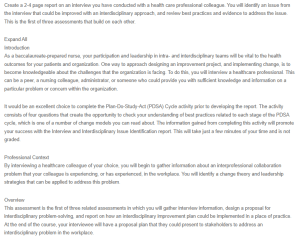
Interview and Interdisciplinary Issue Identification
Expand All
Introduction
As a baccalaureate-prepared nurse, your participation and leadership in intra- and interdisciplinary teams will be vital to the health outcomes for your patients and organization. One way to approach designing an improvement project, and implementing change, is to become knowledgeable about the challenges that the organization is facing. To do this, you will interview a healthcare professional. This can be a peer, a nursing colleague, administrator, or someone who could provide you with sufficient knowledge and information on a particular problem or concern within the organization.
It would be an excellent choice to complete the Plan-Do-Study-Act (PDSA) Cycle activity prior to developing the report. The activity consists of four questions that create the opportunity to check your understanding of best practices related to each stage of the PDSA cycle, which is one of a number of change models you can read about. The information gained from completing this activity will promote your success with the Interview and Interdisciplinary Issue Identification report. This will take just a few minutes of your time and is not graded.
Professional Context
By interviewing a healthcare colleague of your choice, you will begin to gather information about an interprofessional collaboration problem that your colleague is experiencing, or has experienced, in the workplace. You will identify a change theory and leadership strategies that can be applied to address this problem.
Overview
This assessment is the first of three related assessments in which you will gather interview information, design a proposal for interdisciplinary problem-solving, and report on how an interdisciplinary improvement plan could be implemented in a place of practice. At the end of the course, your interviewee will have a proposal plan that they could present to stakeholders to address an interdisciplinary problem in the workplace.
You may interview a healthcare professional such as a fellow learner, nursing colleague, administrator, business partner, or another appropriate person who could provide you with sufficient information regarding an organizational problem or an area in which the organization is seeking improvements. Consult the Interview Guide [DOCX] for an outline of how to prepare and the types of information you will need to complete this project successfully.
Instructions
For this assessment, you will report on the information gathered during your interview. You will discuss the interview strategy that you used to collect information. Your interview strategy should be supported by citations from the literature. The goal of this assessment is to analyze the interview data and identify an issue that would benefit from an interdisciplinary solution. This could be an issue that has not been addressed by an interdisciplinary approach or one that could benefit from improvements related to the interdisciplinary approach currently in use. Additionally, you will prepare for your Interdisciplinary Plan Proposal assessment by researching change theories, leadership strategies, and collaboration approaches that could be relevant to issue you have identified. Please be certain to review the scoring guide to confirm specific required elements of this assessment. Note that there are differences between basic, proficient and distinguished criteria.
Use the Interview and Issue Identification Template [DOCX] to help you stay organized and concise. As you complete the template, make sure you use APA format for in-text citations for the evidence and best practices that are informing your plan, as well as for the reference list at the end. (Because you’re using a template, a title page is optional.)
Additionally, be sure to address the following criteria. Please study the scoring guide carefully so you know what is needed for a distinguished score.
Summarize an interview focused on past or current issues at a healthcare organization.
Identify an issue from an interview for which an evidence-based interdisciplinary approach would be appropriate.
Describe change theories and a leadership strategy that could help in developing an interdisciplinary solution to an organizational issue.
Describe collaboration approaches from the literature that could be relevant in establishing or improving an interdisciplinary team to address an organizational issue.
Organize content so ideas flow logically with smooth transitions; contains few errors in grammar/punctuation, word choice, and spelling.
Apply APA formatting to in-text citations and references exhibiting nearly flawless adherence to APA format.
Additional Requirements
Length of submission: Use the provided template. Most submissions will be 2 to 4 pages in length. Be sure to include a reference page at the end of the plan.
Number of references: Cite a minimum of three sources of scholarly or professional evidence to support your central ideas. Resources should be no more than 5 years old. See the Capella University Library.
APA formatting: Make sure that in-text citations and reference list follow current APA style. See the APA Module.
Competencies Measured
By successfully completing this assessment, you will demonstrate your proficiency in the following course competencies and scoring guide criteria:
Competency 2: Explain how interdisciplinary collaboration can be used to achieve desired patient and systems outcomes.
Summarize an interview focused on past or current issues at a health care organization.
Describe collaboration approaches from the literature that could be relevant in establishing or improving an interdisciplinary team to address an organizational issue.
Competency 3: Describe ways to incorporate evidence-based practice within an interdisciplinary team.
Identify an issue from an interview for which an evidence-based interdisciplinary approach would be appropriate.
Competency 4: Explain how change management theories and leadership strategies can enable interdisciplinary teams to achieve specific organizational goals.
Describe change theories and a leadership strategy to develop an interdisciplinary solution to an organizational issue.
Competency 5: Apply professional, scholarly, evidence-based communication strategies to impact patient, interdisciplinary team, and systems outcomes.
Organize content so ideas flow logically with smooth transitions; contains few errors in grammar/punctuation, word choice, and spelling.
Apply APA formatting to in-text citations and references, exhibiting nearly flawless adherence to APA format.
 Complete the order form and upload all of your files, including any instructions, rubrics, or other materials provided by your instructor.
  Complete the order payment after filling in the order form. We’ll receive your order and assign it to a writer.
 The assigned writer will complete your paper and forward it to our Editing Team for review and approval.
 Once approved by the editor, the completed paper will be uploaded to your account for you to download, review and approve.