
Business Cultural Dimensions Analysis – China
Table of Contents
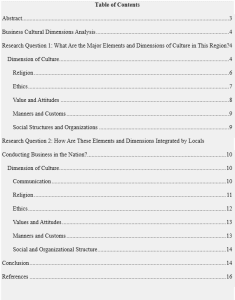
Abstract
Analyzing and understanding cultural dimensions in different cultures is crucial for multinational corporations. Cultural dimensions offer insights into patterns of behavior, social structures, business etiquette, and other elements core to long-term business success. This project will examine China’s cultural dimensions that may impact how business professionals interact during negotiations and other business activities. China has a solid cultural background dating thousands of years; hence, its people have unique cultures. The components of culture that will be investigated in this paper include communication, ethics, religion, values and ethics, manners and customs, and social and organizational structures. The first part of the paper will examine how the six cultural dimensions and subcultures manifest in Chinese culture. Subsequently, the second part of the paper highlights how individuals and organizations integrate these cultural dimensions in business.
Business Cultural Dimensions Analysis
The concept of business culture has become increasingly important in the era of globalization. As businesses expand to countries outside their mother country, there are complex cultural aspects that these organizations should consider to conduct successful operations. Leaders of multinational corporations (MNCs) face the challenge of aligning their company’s overall culture with the host country’s culture. Considering that every nation’s culture has subcultures, global organizational leaders must understand these subcultures and how they will affect an organization’s operations. Cultural dimensions, in this case, can be categorized into six broad categories, including communication, religion, ethics, values and attitudes, manners and customs, and social structures and organizations. A global manager must understand how each of these dimensions affects decision-making, negotiations, and organizational operations vital for long-term business success. Integrating these aspects of culture into the organization’s mainstream culture will go a long way to ensure that a business operates seamlessly, just like a successful local business. This paper delves into cultural dimensions in China that global business leaders operating in China or seeking to expand into the country must consider to operate successfully. The paper will also examine how the local businesses operating in China integrate these dimensions into their businesses.
Research Question 1: What Are the Major Elements and Dimensions of Culture in This Region?
Dimension of Culture
Communication
Communication is a crucial aspect of communication because it applies to all business levels. As global business professionals move to different countries, they are likely to encounter different cultures that are unique from their home country. People and organizations in these unique cultural settings communicate in a way that is unique to their culture. Understanding how culture affects communication is particularly crucial to avert stereotypes (Satterlee, 2023). For instance, there are cultures whose people do not communicate effectively, such that it is difficult to appreciate and value each other’s points of view, goals, and efforts. In such a case, individuals, the information they provide, and the way they behave are likely to be stereotyped. Besides, when global professionals from different cultures communicate, it may turn awkward, especially if one or both parties fail to conduct prior research before engaging the other party (Satterlee, 2023). Using words considered inappropriate may be misinterpreted, offend global professionals from other countries, and potentially jeopardize business deals.
China, unlike most Western cultures, has a long historical background that influences their communication style, and the Chinese people are strict sticklers to these communication norms. One aspect of the Chinese communication style is topic selection. Research into Chinese communication patterns reveals that the Chinese prefer talking about family, payment, and occupation (Yating, 2022). For instance, it is normal for friends, close acquaintances, and family to casually ask each other, Have you eaten? as a way of saying hello. The Chinese do not prefer maintaining eye contact since it is considered impolite (Yating, 2022). Another aspect of Chinese communication is about usage of personal pronouns. In China, it is acceptable to refer to people by any pronouns that draw their attention. For instance, phrases like ‘you, come here’ and ‘waiter, come over here’ are acceptable in the Chinese cultural setting even though they are considered impolite elsewhere (Yating, 2022). Also, China is considered a high-context culture, something that affects how the Chinese communicate. A high-context culture is present in countries where people are considered so close to each other for long enough that they can understand implicit or subtle communication styles. The communication style used in high-context communication implies that the communicating parties have considerable trust for each other, although an outsider may consider this as insignificant and casual.
Religion
Religion, which refers to the belief in the existence of a higher being or a divine being, is a crucial aspect of a country’s culture. Notably, China is religiously diverse, containing traditional religions based on Chinese values and minority foreign religions of Islam, Christianity, and Judaism. The traditional Chinese religions include Confucianism, Daoism, and Buddhism. Chinese religions are a particularly significant cultural aspect, given that they greatly influence people’s day-to-day lives prominently. Given the influence of Confucianism, Daoism, and Buddhism on Chinese culture, global business leaders should research the principles underpinning these religions to understand the people’s way of life.
Notably, Confucianism adherents consider it to be a way of life and not a religion. The primary underpinning of Confucianism is that every man should strive to attain nobility such that one can have a positive impact on society (Clobert, 2020). Also, Confucianism calls upon people to be just while discouraging them from playing the victim and asking for favors. On the other hand, Buddhism as a religion offers five principles that will help people attain spiritual peace. The religion recommends five principles, known as Buddhist precepts, which include cautioning people against killing, theft, adultery, lies, alcohol, and drugs (Clobert, 2020). Another notable aspect of Buddhism is a caution against preferring luxury at the expense of the economically disadvantaged. To that end, it is clear that Chinese religions mostly boil down to how people lead their lives rather than strict religious practices, as would be the case in religions like Islam.
Ethics
Ethics, the moral guidelines and standards of conduct expected from employees and other core organizational stakeholders, is significantly influenced by culture. Multinational corporations implement a code of conduct that provides guidelines with which employees are expected to align. Besides, organizations hire external consultants and subject matter experts, hoping that they will provide employees with much-needed advice to help them uphold ethical standards. It is worth noting that a discussion regarding ethics is related to religion because the latter offers principles that guide people’s daily lives. Ethics take a cultural dimension because they are founded on morals, and what is considered moral in one culture may not necessarily be moral in another culture. In China, Confucian and Buddhist principles are at the core of the ethics of Chinese people. To that end, foreign global business leaders operating in China should research and understand how the Confucian and Buddhist principles shape ethics in China.
Although there are arguments that suggest Western culture influences Chinese ethics, Chinese ethical values have largely remained deeply rooted in Chinese traditions. Yuan et al. (2022) aver that Chinese employees find it difficult to align with ethical codes of conduct authored by Westerners because they are unfamiliar with them. From a Confucian virtue ethics perspective, one key concept that influences ethics is ‘ren,’ loosely translated to humanness and humanity. The ren concept encourages people to love, trust, and be kind to one another besides upholding unbending loyalty (Yuan et al., 2022). Another Confucian concept that guides Chinese ethics is ‘yi,’ which means ‘righteousness or rightness.’ This principle encourages individuals to do things that bring greater good to the community beyond short-term or egocentric benefits (Yuan et al., 2022). On the other hand, another Confucian concept, ‘Li,’ guides people-to-people relationships and governance structures, cementing positive relationships among individuals and fair treatment of followers by those in authority.
Value and Attitudes
Values and attitudes, derived from beliefs and perceptions of what is right or wrong, are culture-specific. These values are derived from a nation’s culture, which is influenced by a nation’s environment and history. Different nations may have varied perceptions of what is wrong or right based on their social norms. Values and attitudes are significant for MNCs because individuals and organizations who align with a society’s social norms are accepted. Particularly, when it comes to decision-making on issues that affect the community, values matter because they will influence the stand an organization takes on certain issues. Lately, organizations have become more pronounced on issues that affect society. For instance, although diversity is encouraged, supporting the inclusion of members of the LGBTQ community as a matter of diversity in conservative societies may be counterproductive.
According to Wang and Bernardo (2021), a notable aspect that shapes business relationships is the practice of ‘going through the back door’ or zouhoumen. The practice of ‘going through the back door’ is acceptable in China. Zouhoumen helps individuals to get things done secretly, away from the public view, by leveraging one’s connections. Chinese people treat this as a social norm since it is an effective strategy individuals can use to achieve their goals using their influence. In other nations, especially those influenced by Western culture, ‘going through the back door’ is considered corrupt and even illegal. By practicing zouhoumen, the Chinese believe that it eliminates bureaucracy and helps individuals to solve their problems swiftly, considering the historical problems associated with China, such as poverty.
Manners and Customs
Gaining insight into acceptable manners and customs will help business leaders and organizational stakeholders understand how they should act in a foreign country. Manners and customs also influence etiquette during business meetings. Failure to uphold acceptable mannerisms in a given culture may be misinterpreted as disrespect, setting a negotiation meeting into a bad start.
Notably, business meetings in China can be quite formal, but Chinese business associates have perfected the art of ‘breaking the ice’ and setting a friendly environment. Another notable aspect is how the Chinese communicate through silence to express appreciation and respect (Hou et al., 2020). During business negotiations, Chinese business leaders take time to understand the bigger picture before narrowing it down to specifics. Also, Chinese executives value long-term relationships over short-term business gains (Fang et al., 2024). Besides, the Chinese prefer friendly relationships both in the negotiating room and outside.
Social Structures and Organizations
A culture’s social structure refers to the relations between members of society and the corresponding social groups, statuses, and roles. This aspect of culture delves into a number of cultural issues, including social status. In some cultures, social status is assigned at birth, a position that individuals hold throughout their lives without necessarily doing anything substantive to achieve it. Social status, whether achieved or ascribed, places individuals in certain positions, influencing their relationships with their colleagues and followers. Also, this aspect of culture shows how individuals’ social relationships affect their employment relationships.
Filial piety, a Confucian principle that emphasizes the need for adult sons to take care of their elderly parents, has a significant impact on the relationship between work stress and turnover intentions. Faced with the pressure to take care of their parents, filial employees face constant work stress that affects their productivity and ability to work (Li et al., 2021). In some cases, it has been reported that filial sons resign from jobs to provide care to their aging parents as the social pressure and guilt cannot allow them to focus on their work (Li et al., 2021). In extreme cases, reports indicate that some filial sons have gone to the extent of killing their elderly parents to eliminate such responsibility. To improve job satisfaction and ease the burden of caregiving, employers are expected to avail optimal resources to filial employees. For instance, availing healthcare insurance packages like ambulance evacuations for employees’ families will help employees who are expected to care for their parents become productive.
Understanding the global culture and its impact on business aligns with the Biblical teaching that encourages globalization. Matthew 28:19-20 says, “Therefore go and make disciples of all nations, baptizing them in the name of the Father and of the Son and of the Holy Spirit, and teaching them to obey everything I have commanded you. And surely I am with you always, to the very end of the age” (New International Version, 2011). This aligns with the mission of understanding other people’s way of life.
Research Question 2: How Are These Elements and Dimensions Integrated by Locals Conducting Business in the Nation?
Dimension of Culture
Communication
China, being a high-context culture, includes communication cues that align with a high-context culture. To that end, the main symbol of silent language in China is a standstill. Chinese negotiators utilize this ‘standstill’ feature to communicate crucial messages in a negotiation. Although the meaning of a standstill depends on the environment and context of the negotiation, it is commonly used to create an easy environment when other negotiators are tired (Zhao, 2022). However, it is worth noting that a standstill should be utilized moderately, as it may feel awkward if prolonged.
Also, silence is a crucial communication tool in China. Foreign companies operating in China hold negotiations with local companies, including their suppliers and service providers. During price determination negotiations, it is common for Chinese negotiators to impose silence after an offer has been made. Typically, the silence helps Chinese negotiators reflect on the offer made before responding (Zhao, 2022). Nonetheless, it has been established that silence has unintended consequences, such as potential price reduction by parties who may think that it is an expression of discomfort.
Also, body language affects communication during negotiations in China. Culturally, the Chinese maintain brief eye contact and withdraw thereafter. The initial eye contact establishes trust between the negotiators, while subsequent withdrawal is a sign of respect. In China, prolonged eye contact is considered aggressive and disrespectful, especially when interacting with those who hold positions of authority.
Religion
Buddhism, Confucianism, and Taoism principles deeply impact Chinese life and economics. A key underpinning of these religious and traditional principles is harmony in all relationships, whether personal or business-oriented. These principles emphasize a paternalistic approach to leadership, implying that the Chinese would rather have a male leader than a female leader. Buddhism and Confucianism encourage absolute obedience to leaders by followers. Unlike in the Western culture, where conflict is viewed positively as it is thought to improve operations, it is not welcome in the Chinese context. Followers are encouraged to embrace teamwork and offer unbending loyalty to their leaders without questioning their way of doing things. A global business leader operating in China should not expect junior Chinese employees to provide negative feedback even if they notice that something is wrong. In that case, the best way a global leader will have junior employees talking is if they conduct an anonymous survey.
Moreover, the principles of Buddhism and Confucianism encourage politeness, loyalty, and a win-win perspective. Unlike the Western culture, where employees strive for individual excellence, a Chinese workforce is concerned with collective team success. Employees are unlikely to compete for personal accolades but prefer a situation where everyone is appreciated for their contribution to team success. Understanding this philosophy helps when implementing reward systems. Instead of issuing individual rewards, employers should organize recognition programs that appreciate everyone’s efforts. For instance, organizing a brief vacation for all team participants will have more positive effects than issuing monetary rewards to individual employees.
Ethics
According to Chu and Vu (2021), corporate social responsibility (CSR) is deeply rooted in the Chinese culture based on Confucian principles that emphasize trust, love, and kindness. CSR in China was strengthened after 1949 when the state initiated concerted efforts to eliminate poverty, improve access to education, and improve people’s welfare. Initially, the economy was controlled by the government to ensure that even the most economically vulnerable in society were not left behind. However, following the adoption of an open economy in China in the late 1970s, Chinese companies have taken up the role of implementing CSR programs. Apart from CSR being a genuine concern to improve people’s welfare, rooted in Confucian principles, it is also a strategy to enhance the business image (Wan et al., 2020). MNCs operating in China should leverage CSR to improve public perception and ensure acceptance.
Values and Attitudes
According to Wang and Bernardo (2021), a cultural analysis of the Chinese people shows that they accept leveraging one’s connections to accomplish goals. Known as guanxi, this cultural attitude emphasizes the need to form long-term valuable relationships that may help in business. Facilitative guanxi goes a long way to eliminate bureaucracy and ensures that one removes roadblocks that may affect business. Also, issuing gifts is acceptable, and appreciating people who help one achieve their goals is not viewed as corruption. To that end, global business leaders in China should form positive relationships with government officials and other key decision-makers to avert bureaucracy that may affect business.
Manners and Customs
One of the aspects of business etiquette deeply rooted in Chinese culture is the need to hold an advance meeting before the main meeting is conducted. An advance meeting is meant to help negotiators familiarize themselves with each other and ease tensions during the actual meeting. Also, rank is crucial in the Chinese cultural setting. If a negotiation involves American and Chinese companies, only top executives from the American company can address their equals from China. Exchanging business cards is also important for the Chinese, and one is expected to offer the card while holding it with two hands and looking at it. Receiving a card nonchalantly and putting it away without looking at the information contained therein amounts to disrespect.
Social and Organizational Structure
Filial piety, a Confucian principle that places the burden of caring for elderly parents on adult sons, influences employment relationships in China. From the outset, filial employees are reported to show signs of anxiety, stress, reduced productivity, and turnover intentions (Xiao et al., 2024). To address this problem, Chinese companies conduct surveys to understand employee needs and how the company may help them cope. Although the organizations do not offer much in terms of resources, giving such employees flexible schedules helps them to attend to their dependents while working.
Understanding the culture of others aligns with the biblical principle of appreciating others as one appreciates oneself. In Leviticus 19:18, the Bible says, “Love others as you love yourself” (The Holy Bible, 1979). Analyzing other people’s culture and respecting it is a form of love one may extend to members from a different cultural background.
Conclusion
In summary, business cultural dimension analysis is crucial for all global business leaders since it helps them understand cultural diversity and its impact on relationships and business operations. Key cultural aspects leaders of businesses in foreign countries should analyze include communication, religion, ethics, attitudes and values, business manners and customs, and social and organizational structures. China is characterized by high-context communication associated with silence and pausing amid conversations. The Chinese also abhor prolonged eye contact since it is considered aggressive. When it comes to religion, the principles of Buddhism and Confucianism, such as harmony, love, and trust, encourage teamwork and respect for authority. Also, the Chinese ethical framework is deeply embedded in CSR. Also, ‘using the back door’ to eliminate bureaucracy and get things done is acceptable. Further, business etiquette among the Chinese is pegged on respecting social status and those in authority. Understanding the dimensions of Chinese culture and subcultures will help global business leaders establish long-term success.
References
Chu, I., & Vu, M. C. (2021). The nature of the self, self-regulation and moral action: Implications from the Confucian relational self and Buddhist non-self. Journal of Business Ethics, 180. https://doi.org/10.1007/s10551-021-04826-z
Clobert, M. (2020). East versus West: Psychology of religion in East Asian cultures. Current Opinion in Psychology, 40, 61–66. https://doi.org/10.1016/j.copsyc.2020.08.021
Fang, Q., Wen, C., & Xu, H. (2024). Long-term oriented culture, performance pressure and corporate innovation: Evidence from China. PLOS ONE, 19(5), e0302148. https://doi.org/10.1371/journal.pone.0302148
Hou, X., Tang, M., Lin, J., Huang, W., & Xu, J. (2020). Chinese Business Culture: Identifying Misunderstandings and Offering Recommendations for American Negotiators. The Frontiers of Society, Science and Technology, 2(10). https://doi.org/10.25236/FSST.2020.021019
Li, J., Liu, H., Van Der Heijden, B., & Guo, Z. (2021). The role of filial piety in the relationships between work stress, job satisfaction, and turnover intention: A moderated mediation model. International Journal of Environmental Research and Public Health, 18(2), 714. https://doi.org/10.3390/ijerph18020714
Satterlee, B. (2023). International business with biblical worldview. McGraw-Hill.
The Holy Bible: New International Version (NIV). (2011). Biblica, Inc. (Original work published 1973).
Wan, P., Chen, X., & Ke, Y. (2020). Does corporate integrity culture matter to corporate social responsibility? Evidence from China. Journal of Cleaner Production, 259, 120877. https://doi.org/10.1016/j.jclepro.2020.120877
Wang, T. Y., & Bernardo, A. B. I. (2021). Exploring Chinese people’s attitudes towards “going through the backdoor.” Journal of Pacific Rim Psychology, 15, 183449092199329. https://doi.org/10.1177/1834490921993291
Xiao, C., Patrician, P. A., Montgomery, A. P., Wang, Y., Jablonski, R., & Markaki, A. (2024). Filial piety and older adult caregiving among Chinese and Chinese-American families in the United States: A concept analysis. BMC Nursing, 23(1). https://doi.org/10.1186/s12912-024-01789-0
Yating, W. (2022). A comparative study of communication styles between China and America. Academic Journal of Humanities & Social Sciences, 5(5). https://doi.org/10.25236/ajhss.2022.050514
Yuan, L., Chia, R., & Gosling, J. (2022). Confucian virtue ethics and ethical leadership in modern China. Journal of Business Ethics, 182(1), 119–133. https://doi.org/10.1007/s10551-021-05026-5
Zhao, Y. (2022). A study of nonverbal communication in China-U.S. business negotiations. Studies in Social Science & Humanities, 1(4), 27–35. https://doi.org/10.56397/sssh.2022.11.04
ORDER A PLAGIARISM-FREE PAPER HERE
We’ll write everything from scratch
Question 
Business Cultural Dimensions Analysis – China
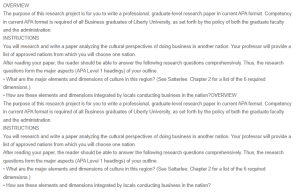
OVERVIEW
The purpose of this research project is for you to write a professional, graduate-level research paper in current APA format. Competency in current APA format is required of all Business graduates of Liberty University, as set forth by the policy of both the graduate faculty and the administration.
Business Cultural Dimensions Analysis – China
INSTRUCTIONS
You will research and write a paper analyzing the cultural perspectives of doing business in another nation. Your professor will provide a list of approved nations from which you will choose one nation.
After reading your paper, the reader should be able to answer the following research questions comprehensively. Thus, the research questions form the major aspects (APA Level 1 headings) of your outline.
• What are the major elements and dimensions of culture in this region? (See Satterlee: Chapter 2 for a list of the 6 required dimensions.)
• How are these elements and dimensions integrated by locals conducting business in the nation?OVERVIEW
The purpose of this research project is for you to write a professional, graduate-level research paper in current APA format. Competency in current APA format is required of all Business graduates of Liberty University, as set forth by the policy of both the graduate faculty and the administration.
INSTRUCTIONS
You will research and write a paper analyzing the cultural perspectives of doing business in another nation. Your professor will provide a list of approved nations from which you will choose one nation.
After reading your paper, the reader should be able to answer the following research questions comprehensively. Thus, the research questions form the major aspects (APA Level 1 headings) of your outline.
• What are the major elements and dimensions of culture in this region? (See Satterlee: Chapter 2 for a list of the 6 required dimensions.)
• How are these elements and dimensions integrated by locals conducting business in the nation?
Choose one nation from the approved nations below:
China
Canada
New Zealand
Iran
Singapore
Mexico
Argentina
Brazil
Russia
India
United Kingdom
Turkey
Israel
Trinidad and Tobago
Taiwan
France
Germany
United Arab Emirates
Belgium
Greece
-Use the following textbook for reference:
Liberty University Custom: Satterlee, B. (2023). International business with biblical worldview (2nd ed.). McGraw-Hill.
-The 10 sources must be peer-reviewed scholarly journal articles (under 5 years old)
 Complete the order form and upload all of your files, including any instructions, rubrics, or other materials provided by your instructor.
  Complete the order payment after filling in the order form. We’ll receive your order and assign it to a writer.
 The assigned writer will complete your paper and forward it to our Editing Team for review and approval.
 Once approved by the editor, the completed paper will be uploaded to your account for you to download, review and approve.