
Personal Leadership Philosophies
Core Values
Leadership is based on a set of key beliefs acquired by a leader that can influence the decision-making process, behavior and development. My core values for the organization are integrity, accountability and responsibility, people-centered, and knowledge and learning. I must uphold ethical standards in all aspects of leadership, and that integrity is essential in building trust. To an extent, accountability enhances my responsibility and ownership because it helps me to make proper and bias-free decisions. Empathy enriches me within the team framework and helps me to provide the means necessary to support the people I am working with (Kleynhans et al., 2022). Education refers to the continuous learning process that ensures that I am in a position to tackle every challenge and exploit any opportunity that comes my way.
Personal Mission and Vision Statement
My leadership vision and purpose are to encourage people to be their best by promoting professionalism, teamwork, and continued learning. One of my leadership qualities is following a positive example and creating a culture that will help to foster respect for every employee, inspire people, and encourage their accomplishments.
As a leader, my vision is to facilitate organizational change and development within my profession based on integrity, creativity and sustainability principles. I envision myself as a change leader who understands creating and empowering others for leadership development through coaching, training, and professional learning.
CliftonStrengths Assessment Summarizing the Results
Among my CliftonStrengths Assessment profile, I identified the five vital strengths: strategic thinking, adaptability, responsibility, verbal and empathy. Thinking strategically gives me the capacity to address hardships likely to be faced by the organization by coming up with unique solutions which have not been used before. Adaptability means I can be ready to transform and allow myself to change the situation while leading. Responsibility assists me in being proactive and persistent with my obligations, thereby completing my tasks as expected. Communication is one of my strong skills through which I effectively convey information and ensure cohesion in my team (Broome & Marshall, 2020). Empathy also plays an important role in meeting the needs of the people I manage and creating a working environment of trust. These aspects were further supported by the feedback that I had received from my colleagues, specifically concerning my interpersonal skills, including my capacity to establish rapport with others and share information effectively. They highlighted my capacity to keep my cool, be responsible for my work and inspire confidence in fellow workers and juniors.
Key Behaviors to Strengthen
Nevertheless, some areas can be improved to enhance my leadership skills further. Two adequate behaviors that I ought to develop are decisiveness and delegation. One more important function of the efficient leader is decisiveness because accurate and confident decisions affect personnel morale and productivity. I can be considered intelligent and introverted, with occasional indecisiveness resulting from thinking about the consequences of my choices. Deepening such leadership competencies as decision-making under pressure will be of great value to me (Guo, 2022). Other issues that require work include delegation. I often feel a high level of responsibility and hence take up many roles which do not augur well in the performance and cohesiveness of the team. Delegation of responsibilities will help enhance the abilities of my team members, develop trust within the team, and help with the proper coordination and allocation of tasks.
Development Plan and How to Improve
Therefore, to increase my decisiveness, I must deform a decision-making tool such as the OODA loop (Observe, Orient, Decide, Act). This approach will help me to handle information quickly and make decisions effectively, enabling me to work fast yet effectively. For instance, when there is pressure to complete a project within a given timeframe, I will be able to evaluate the team’s work and possible resources and redirect their work to complete the project on time without wasting time. Further, I will consult other effective leaders in decision-making processes to find out how they make decisions to boost confidence, mainly when dealing with high-risk decisions (Page, 2020). The exposure to leadership training workshops that include decision-making training, especially where the decisions are to be made urgently, will also afford practical exposure to the trainees.
The strategies I shall implement to improve my delegation skills include interviewing my subordinates to identify the areas of specialization within the group. For instance, if one team member is good at data analysis, I will have them in charge of reviewing trends and preparing reports. Other members will be assigned activities within that assignment in which they are proficient. A structured delegation process will ensure I can outline the expectations, give sufficient assistance, and track progress without being overbearing (Barrow & Sharma, 2023). I shall also ensure that I implement the use of project management tools to enhance accountability and provision of status to the members of the project team. By promoting a culture of trust and staff empowerment, I will ensure that the staff members can take up responsibilities that will benefit the organization.
Achieving My Vision
In order to ensure positive change within my field, I consider it important to participate in the practice of mentorship and exchange and provide guidance to young leaders. Firstly, I shall observe ethical standards in all aspects of my work about honesty and equal opportunities for all people. This way, I can ensure that my leadership approach is relevant and valuable through learning about industry trends and advancements. Professional development will continue throughout my time practicing leadership through leadership training and certification programs. Further, I will engage in research and policymaking regarding future trends and advancements in my field to synthesize effective leadership best practices (Din & Zhang, 2023). By partnering with other professionals and organizations, long-term and effective change will be promoted according to my vision.
References
Barrow, J. M., & Sharma, S. (2023, July 24). Five rights of nursing delegation. National Library of Medicine; StatPearls Publishing. https://www.ncbi.nlm.nih.gov/books/NBK519519/
Broome, M. E., & Marshall, E. S. (Eds.). (2020). Transformational leadership in nursing: From expert clinician to influential leader (3rd ed.). Springer Publishing Company.
Din, Q. M. U., & Zhang, L. (2023). Unveiling the mechanisms through which leader integrity shapes ethical leadership behavior: Theory of planned behavior perspective. Behavioral Sciences, 13(11), 928. https://doi.org/10.3390/bs13110928
Guo, K. (2022). The relationship between ethical leadership and employee job satisfaction: The mediating role of media richness and perceived organizational transparency. Frontiers in Psychology, 13(1). https://doi.org/10.3389/fpsyg.2022.885515
Kleynhans, D. J., Heyns, M. M., Stander, M. W., & De Beer, L. T. (2022). Authentic leadership, trust (in the leader), and flourishing: Does precariousness matter? Frontiers in Psychology, 13(798759). https://doi.org/10.3389/fpsyg.2022.798759
Page, A. (2020). Transformational leadership and evidence-based management. Nih.gov; National Academies Press (US). https://www.ncbi.nlm.nih.gov/books/NBK216194/
ORDER A PLAGIARISM-FREE PAPER HERE
We’ll write everything from scratch
Question 
Personal Leadership Philosophies
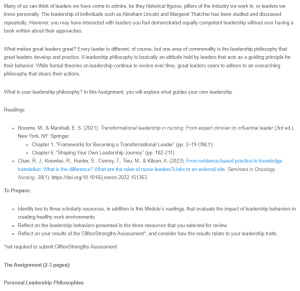
Many of us can think of leaders we have come to admire, be they historical figures, pillars of the industry we work in, or leaders we know personally. The leadership of individuals such as Abraham Lincoln and Margaret Thatcher has been studied and discussed repeatedly. However, you may have interacted with leaders you feel demonstrated equally competent leadership without ever having a book written about their approaches.
Personal Leadership Philosophiess
What makes great leaders great? Every leader is different, of course, but one area of commonality is the leadership philosophy that great leaders develop and practice. A leadership philosophy is basically an attitude held by leaders that acts as a guiding principle for their behavior. While formal theories on leadership continue to evolve over time, great leaders seem to adhere to an overarching philosophy that steers their actions.
What is your leadership philosophy? In this Assignment, you will explore what guides your own leadership.
Readings
- Broome, M., & Marshall, E. S. (2021). Transformational leadership in nursing: From expert clinician to influential leader (3rd ed.). New York, NY: Springer.
- Chapter 1, “Frameworks for Becoming a Transformational Leader” (pp. 2–19 ONLY)
- Chapter 6, “Shaping Your Own Leadership Journey” (pp. 182-211)
- Chan, R. J., Knowles, R., Hunter, S., Conroy, T., Tieu, M., & Kitson, A. (2023). From evidence-based practice to knowledge translation: What is the difference? What are the roles of nurse leaders?Links to an external site. Seminars in Oncology Nursing, 39(1). https://doi.org/10.1016/j.soncn.2022.151363
To Prepare:
- Identify two to three scholarly resources, in addition to this Module’s readings, that evaluate the impact of leadership behaviors in creating healthy work environments.
- Reflect on the leadership behaviors presented in the three resources that you selected for review.
- Reflect on your results of the CliftonStrengths Assessment*, and consider how the results relate to your leadership traits.
*not required to submit CliftonStrengths Assessment
The Assignment (2-3 pages):
Personal Leadership Philosophies
Develop and submit a personal leadership philosophy that reflects what you think are characteristics of a good leader. Use the scholarly resources on leadership you selected to support your philosophy statement. Your personal leadership philosophy should include the following:
- A description of your core values.
- A personal mission and vision statement.
- An analysis of your CliftonStrengths Assessment summarizing the results of your profile
- A description of two key behaviors that you wish to strengthen.
- A development plan that explains how you plan to improve upon the two key behaviors you selected and an explanation of how you plan to achieve your personal vision. Be specific and provide examples.
- Be sure to incorporate your colleagues’ feedback on your CliftonStrengths Assessment from this Module’s Discussion 2.
 Complete the order form and upload all of your files, including any instructions, rubrics, or other materials provided by your instructor.
  Complete the order payment after filling in the order form. We’ll receive your order and assign it to a writer.
 The assigned writer will complete your paper and forward it to our Editing Team for review and approval.
 Once approved by the editor, the completed paper will be uploaded to your account for you to download, review and approve.