
Designing, Protecting, and Ensuring a Long Life for Critical Infrastructure
Responsibility
This week’s agenda involves the establishment of Westland’s Emergency Operation Plans (EOP). The main hazard in the county is the nuclear power plant, whose accident could affect the entire location and its residents, alongside other critical infrastructure. The process will involve prioritizing Westland’s main assets. This prioritization should guide the allocation of resources such as funds, time, manpower, recognition, and other intangible applications. The EOP is expected to set out a response strategy for Westland if the nuclear power plant has an accident, severe or minor. The plan will be detailed enough to highlight specific roles and responsibilities, the time and resources allocated to each strategy, and the reporting authority (FEMA, 1996). My main responsibility will be guiding the entire process and bringing to the stakeholders’ attention the most critical aspects in case of a nuclear accident. However, the establishment of the EOP will involve all stakeholders’ opinions and concerns.
Prioritizations
| Priority | Allocation |
| 1. Fire Department hazmat capabilities | $600,000 |
| 2. U.S. Army Combat Readiness Training Area | $300,000 |
| 3. The area’s largest hospital and attendant capabilities | $600,000 |
| 4. The primary interstate through Westland | $300,000 |
| 5. The primary railway through Westland | $300,000 |
| 6. Emergency warning system | $300,000 |
| 7. Westland’s primary broadcasting resource | $200,000 |
| 8. Area schools | $500,000 |
| 9. Area nursing homes | $400,000 |
Justification
The allocations that are shown in the table above were made based on the priority’s importance to the process of mitigating any negative effects that could result from a nuclear power accident. The fire department’s HAZMAT capabilities take the largest share of the allocation because they are likely to be the first responders to such an emergency. Therefore, they should be able to control and manage the hazard to avoid extensive damage and injury. Thus, training and purchase of the necessary equipment during such an incident is critical. The area’s hospital and attendant capabilities have an allocation like the fire departments. This allocation is based on the need for skilled hospital attendants in the event of a nuclear accident. The necessary equipment to ensure the staff and victims’ safety is necessary. The army’s response to such an event is also critical because they would not only maintain law and order during the crisis, but also assist in rescue and recovery operations. Therefore, it is critical to train the army adequately. The first three prioritizations are based on their necessity to mitigation efforts if the accident occurred. Their importance to rescue and mitigation efforts are dependent on the skills and abilities of the first responders as well as those who handle the victims (Lewis, 2020).
References
FEMA. (1996). Guide for All-Hazard Emergency Operations. Retrieved from https://www.fema.gov/pdf/plan/slg101.pdf
Lewis, T. G. (2020). Critical Infrastructure Protection in Homeland Security: Defending a Networked Nation. John Wiley & Sons.
ORDER A PLAGIARISM-FREE PAPER HERE
We’ll write everything from scratch
Question 
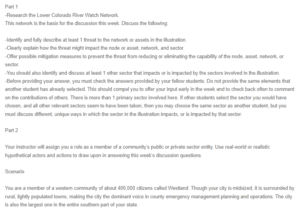
Designing, Protecting, and Ensuring a Long Life for Critical Infrastructure
Part 1
-Research the Lower Colorado River Watch Network.
This network is the basis for the discussion this week. Discuss the following:
-Identify and fully describe at least 1 threat to the network or assets in the illustration.
-Clearly explain how the threat might impact the node or asset, network, and sector.
-Offer possible mitigation measures to prevent the threat from reducing or eliminating the capability of the node, asset, network, or sector.
-You should also identify and discuss at least 1 other sector that impacts or is impacted by the sectors involved in the illustration.
-Before providing your answer, you must check the answers provided by your fellow students. Do not provide the same elements that another student has already selected. This should compel you to offer your input early in the week and to check back often to comment on the contributions of others. There is more than 1 primary sector involved here. If other students select the sector you would have chosen, and all other relevant sectors seem to have been taken, then you may choose the same sector as another student, but you must discuss different, unique ways in which the sector in the illustration impacts, or is impacted by that sector.
Part 2
Your instructor will assign you a role as a member of a community’s public or private sector entity. Use real-world or realistic hypothetical actors and actions to draw upon in answering this week’s discussion questions.
Scenario
You are a member of a western community of about 400,000 citizens called Westland. Though your city is midsized, it is surrounded by rural, lightly populated towns, making the city the dominant voice in county emergency management planning and operations. The city is also the largest one in the entire southern part of your state.
Westland is dominated by a few major industries, including several military bases and a nuclear power plant located 10 miles outside of city limits in Tiny Town. You have been asked to participate in planning and exercise development for the county’s emergency operations plan (EOP) to respond to an incident involving the nuclear reactor. There are a number of communities across the country that have published an EOP for nuclear plant incidents, and the Department of Homeland Security (DHS) provides guidance as well. However, Westland’s leaders want to solicit input from as many local and relevant stakeholders and prospective partners as possible. They realize that buy-in during the preparatory stages is key to an effective and integrated response involving all vital partners when and if a crisis occurs. Your organization is invited to play a role in establishing this EOP, and you are an enthused participant in the process. In at least 1 crisis scenario associated with nuclear plant incidents, a severe reactor accident results in significant radiation leakage. This is the worst-case scenario that emergency planners wish to plan for, believing other, lesser incidents will still benefit from such a plan.
To answer the questions that follow, do whatever research is appropriate to understand the entity you represent and to best estimate the realistic needs and preferences you will advocate.
-The following assets are being considered as potential critical infrastructure (CI), with each eligible for some application of resources to be used for hardening of physical structures, reinforcement of expertise and capabilities, increased manpower and training, or other forms of fortification. Westland has $3.5 million dollars to direct toward CI protection and resiliency.
The following are assets to be prioritized:
-The primary interstate through Westland
-The primary railway through Westland
-The area’s largest hospital and attendant capabilities
-Area schools
-Area nursing homes
-Fire Department hazmat capabilities
-Emergency warning system
-U.S. Army Combat Readiness Training Area
-Westland’s primary broadcasting resource
Answer the following questions in the Discussion Board area:
-Fully describe the role you are playing this week. Discuss what you believe your overarching agenda will be and how it will influence your prioritization of assets for community resource allocation. Remember that resources may include funds, manpower, recognition, time, and other intangible applications.
-What contributions can you provide to the pool of resources in your assigned role?
-Rank all 10 assets in order of priority. Allocate portions of the $3.5 million dollars to assets as you see fit. Explain why you selected these amounts and how the money might support critical infrastructure protection (CIP) and resiliency measures.
-Make a strong and clear argument on why you chose the top 3 assets you selected.
-Be willing to revisit your choices and negotiate your priorities to help the group come to a consensus, but be true to your perceived values as well.
Please Research these BOOKS & RESOURCES PLUS MORE FOR THIS ASSIGNMENT.
– CRITICAL INFRASTRUCTURE PROTECTION IN HOMELAND SECURITY Defending a Networked Nation Third Edition TED G. LEWIS
– Colorado River Basin Study Program.
– Vulnerability Analysis of the Hover Dam. Webinar
– East Plains Middle School.
– Lewis, T. (2005). Critical infrastructure strategy and strategic principles. Retrieved from the Naval Postgraduate School’s Center for Homeland Defense and Security Web site: http://www.chds.us/?media/resources&collection=63&type=LECTURE.
– Critical infrastructure sectors. (n.d.). Retrieved from the Department of Homeland Security Web site: http://www.dhs.gov/critical-infrastructure-sectors.
– Critical infrastructure. (n.d.). Retrieved from the U.S. Department of Homeland Security Web site: http://www.dhs.gov/files/programs/gc_1189168948944.shtm
 Complete the order form and upload all of your files, including any instructions, rubrics, or other materials provided by your instructor.
  Complete the order payment after filling in the order form. We’ll receive your order and assign it to a writer.
 The assigned writer will complete your paper and forward it to our Editing Team for review and approval.
 Once approved by the editor, the completed paper will be uploaded to your account for you to download, review and approve.