
Abdominal Assessment
Analysis of the Subjective Portion of the Note and Additional Information
Hire our assignment writing services if your assignment is devastating you.
The note’s list of subjective data thoroughly reviews the patient’s symptoms, previous medical history, current medicines, and allergies. The presence of nausea, the overall length of symptoms, the precise location of pain, changes in bowel movements, the frequency of dizziness or sweating after meals, the amount of activity impacted by abdominal pain, recent weight changes, the use of over-the-counter medications or herbs, previous abdominal problems, history of any recent abdominal surgery, small bowel obstruction, or gallbladder problems are all additional details that should be recorded in the documentation.
Analysis of the Objective Portion of the Note and Additional Information
The note’s objective section includes a summary of the patient’s vital signs and the results of the physical examination of the heart, lungs, skin, and abdomen. The physical exam’s paperwork should also include specific localizing symptoms like abdominal stiffness, rebound soreness, or pain worsening with breathing. Note should also be taken of any hernias, distensions, masses, organomegaly, guarding, costovertebral angle pain, fluctuation, and other conditions.
Why the Subjective and Objective Information Fails to Support the Assessment
The evaluation of abdominal aortic aneurysm, perforated ulcer, and pancreatitis lacks substantiation based on the subjective and objective data presented in the note. The patient’s primary concern regarding the manifestation of epigastric abdominal pain for a duration of two days, with subsequent radiation into the back, does not align with any of the diagnoses above. It is worth noting that abdominal aneurysms and pancreatitis typically induce a gradual onset of abdominal pain over an extended period, spanning multiple days. Conversely, perforated ulcers commonly present with acute and intense abdominal pain. These observations are supported by the scholarly works of Mohy-ud-din and Morrissey (2019), Shaw et al. (2020), and Stern et al. (2020). Furthermore, the lack of tangible physical examination manifestations suggestive of abdominal aortic aneurysm or pancreatitis further undermines the credibility of the diagnoses above.
Diagnostic Tests Appropriate for this Case and the Results Use to Make a Diagnosis
The diagnostic tests judged appropriate for this specific instance would include a full investigation of the complete blood count (CBC), electrolyte and glucose levels, liver function tests (LFTs), amylase and lipase levels, lipoprotein electrophoresis, and omega-3 fatty acid assays. In addition to ultrasonography (US) and computed tomography (CT) scans, the patient may need Magnetic Resonance Imaging (MRI) scan.
CBC data is critical in analyzing the presence of anemia or infection, suggesting an intra-abdominal disease causing abdominal pain. The results of the electrolytes and glucose tests will be used to assess dehydration, suggesting the existence of intestinal blockage. This disease occurs when a complete or partial obstruction inside the intestinal system hampers the patient’s capacity to digest fluids. The results of the liver function tests, in combination with the lipoprotein electrophoresis and omega-3 fatty acid analysis, would be used to determine the existence of gallstones, which might lead to cholecystitis. The amylase and lipase test results are used to evaluate probable pancreatic pathologies, such as pancreatitis or pancreatic cancer. Finally, MRI imaging would be used to dive further into the possibility of any underlying disease condition and to clearly validate the diagnostic finding.
The Current Diagnosis and Three Possible Conditions that may be considered Differential Diagnoses for this Patient
No, I would not accept the patient’s current diagnosis since they do not seem to have any risk factors for pancreatitis, a perforated ulcer, or an abdominal aortic aneurysm. The patient’s symptoms indicate an acute abdominal presentation and call for more research.
Intestinal obstruction, gastritis, and cholecystitis are the three probable diagnoses that might be used in this patient’s differential diagnosis. Acute abdominal discomfort in older adults is often brought on by intestinal blockage, which is typically brought on by adhesions from prior surgery, ingestion of foreign material, volvulus, hernias, and tumors (Smith & Nehring, 2018). Vomiting, stomach distention, and nausea are their hallmarks. In addition, the patient could only feel discomfort in one particular abdominal quadrant. Radiologic investigations may reveal air-fluid levels, which would corroborate the blockage.
The most common causes of gastritis are non-steroidal anti-inflammatory medicines, alcohol intake, smoking, infections, or immune-mediated processes. Gastritis is a disorder that results in inflammation of the stomach lining. Epigastric discomfort, nausea, and vomiting are often present (Information et al., 2018). Endoscopic findings that are confirmed by biopsy may indicate gastritis.
On the other hand, cholecystitis, a gallbladder inflammation, is often brought on by gallstones or strictures that block the cystic duct. It often affects the right upper quadrant of the abdomen and is followed by abdominal discomfort, nausea, and vomiting (Jones et al., 2019). Additionally, the patient may have a fever, chills, and jaundice. The preferred imaging study to confirm the diagnosis is ultrasound.
In conclusion, the patient’s stomach discomfort may be brought on by intra-abdominal pathology, which needs more testing. The patient has no linked risk factors for an abdominal aortic aneurysm, a perforated ulcer, or pancreatitis. Hence the current diagnosis should be disregarded. Intestinal obstruction, gastritis, and cholecystitis are three potential illnesses that may be considered in the differential diagnosis. Finding the precise source of this patient’s stomach discomfort will need clinical examination and research.
References
Information, N. C. for B., Pike, U. S. N. L. of M. 8600 R., MD, B., & USA, 20894. (2018). Gastritis: Overview. In www.ncbi.nlm.nih.gov. Institute for Quality and Efficiency in Health Care (IQWiG). https://www.ncbi.nlm.nih.gov/books/NBK310265/
Jones, M. W., Genova, R., & O’Rourke, M. C. (2019). Acute Cholecystitis. Nih.gov; StatPearls Publishing. https://www.ncbi.nlm.nih.gov/books/NBK459171/
Mohy-ud-din, N., & Morrissey, S. (2019, February 19). Pancreatitis. Nih.gov; StatPearls Publishing. https://www.ncbi.nlm.nih.gov/books/NBK538337/
Shaw, P. M., Loree, J., & Gibbons, R. C. (2020). Abdominal Aortic Aneurysm (AAA). PubMed; StatPearls Publishing. https://www.ncbi.nlm.nih.gov/books/NBK470237/
Smith, D. A., & Nehring, S. M. (2018). Bowel Obstruction. Nih.gov; StatPearls Publishing. https://www.ncbi.nlm.nih.gov/books/NBK441975/
Stern, E., Sugumar, K., & Journey, J. D. (2020). Peptic Ulcer Perforated. PubMed; StatPearls Publishing. https://www.ncbi.nlm.nih.gov/books/NBK538326/a:link {text-decoration: none;}a:visited {text-decoration: none;
}a:hover {text-decoration: underline;} a:active {text-decoration: underline;}
ORDER A PLAGIARISM-FREE PAPER HERE
We’ll write everything from scratch
Question 
ABDOMINAL ASSESSMENT
Subjective:
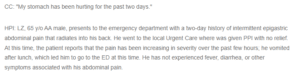
CC: “My stomach has been hurting for the past two days.”
HPI: LZ, 65 y/o AA male, presents to the emergency department with a two-day history of intermittent epigastric abdominal pain that radiates into his back. He went to the local Urgent Care where was given PPI with no relief. At this time, the patient reports that the pain has been increasing in severity over the past few hours; he vomited after lunch, which led him to go to the ED at this time. He has not experienced fever, diarrhea, or other symptoms associated with his abdominal pain.
Abdominal Assessment
PMH: HTN
Medications: Metoprolol 50mg
Allergies: NKDA
FH: HTN, Gerd, Hyperlipidemia
Social Hx: ETOH, smoking for 20 years but quit both 2 years ago, divorced for 5 years, 3 children, 2 males, 1 female
Objective:
- VS: Temp 98.2; BP 91/60; RR 16; P 76; HT 6’10”; WT 262lbs
- Heart: RRR, no murmurs
- Lungs: CTA, chest wall symmetrical
- Skin: Intact without lesions, no urticaria
- Abd: The abdomen is tender in the epigastric area with guarding but without mass or rebound.
- Diagnostics: US and CTA
Assessment:
- Abdominal Aortic Aneurysm (AAA)
- Perforated Ulcer
- Pancreatitis
THE ASSIGNMENT
- Analyze the subjective portion of the note. List additional information that should be included in the documentation.
- Analyze the objective portion of the note. List additional information that should be included in the documentation.
- Is the assessment supported by the subjective and objective information? Why or why not?
- What diagnostic tests would be appropriate for this case, and how would the results be used to make a diagnosis?
- Would you reject/accept the current diagnosis? Why or why not? Identify three possible conditions that may be considered as a differential diagnosis for this patient. Explain your reasoning using at least three different references from current evidence-based literature.
 Complete the order form and upload all of your files, including any instructions, rubrics, or other materials provided by your instructor.
  Complete the order payment after filling in the order form. We’ll receive your order and assign it to a writer.
 The assigned writer will complete your paper and forward it to our Editing Team for review and approval.
 Once approved by the editor, the completed paper will be uploaded to your account for you to download, review and approve.