
Workforce Shortage
The United States of America is currently experiencing a shortage in the healthcare workforce. According to the Healthcare Professional Shortage Areas (HPSAs) (2021), the worst workforce shortages and related outcomes are more likely to be experienced in the rural U.S. than in urban areas. Rural areas are mainly served by small to medium-sized hospitals. North Texas Medical Center is one of the significant rural hospitals serving communities in Gainesville, Texas. The hospital provides acute services, including inpatient medical, maternal care, surgical care, intensive care, and other outpatient services. This paper describes the problem of healthcare workforce shortage and its implications. It develops a short- and long-term plan to help the facility sustainably deal with workforce shortages and ensure continued care provision to the people of Cooke County and neighboring areas.
Healthcare Workforce Shortage and Its Implications
The health workforce shortage remains an issue of concern in the U.S. healthcare system. Healthcare shortage means that there is a limited number of healthcare providers to meet the health demands of the patients at any given time (Zhang et al., 2020). A report by Mercer based on an analysis of the U.S. healthcare labor market noted an undeniable healthcare workforce gap. The demand for healthcare workers is projected to outpace the supply of skilled workers by 2025 (Mercer.us, 2022). The Association of American Medical Colleges (2019) notes that based on the projections for physician demand, the U.S. will have a shortage of nearly 122,000 physicians by 2032. An additional 275,000 nurses will be needed to meet the demand for nurses by 2030 (Haddad et al., 2022).
Aspects of Healthcare Workforce Shortage
Various aspects contribute to the current healthcare workforce shortage in the U.S. Firstly, there is a limited capacity of healthcare faculties, which has reduced the ability to supply healthcare professionals such as specialty physicians and nurses to meet the healthcare system’s demands. According to Harris (2019), a shortage of qualified nursing faculty has affected the education system’s ability to meet the academic and development needs of the nurses, leading to a reduced nursing workforce.
Another aspect of the healthcare workforce shortage is the increased demand for healthcare services due to an aging population and chronic health conditions. The U.S. population is fast aging, creating a higher demand for health workers, such as specialized nurses, to meet this population’s demands. The aged population also has an increased risk for comorbid chronic diseases. The need for specialized care and attention time for the senior population creates an artificial shortage of skilled healthcare workers regardless of the supply. Another aspect of the healthcare workforce shortage related to age is the current workforce, composed of an aging and retiring healthcare workforce (Haddad et al., 2022). The retiring healthcare workforce leaves a gap, worsening the healthcare workforce shortage crisis in the U.S.
Rationale on Why These Aspects Need Attention
The healthcare workforce shortage contributes to the inequitable distribution of workers. As most health professionals work in urban centers, only a few are available to provide services in rural areas. Rural hospitals’ low number of physicians and nurses leads to high patient-to-nurse and physician ratios. High patient-to-nurse ratios translate to an increased workload for nurses and physicians. According to research, increased workloads areare the leading factor contributing to nurses experiencing burnout, dissatisfaction with work, and high turnover intentions (Musy et al., 2020).
Burnout also contributes to nurses making medical errors, negatively impacting patient safety (Garcia et al., 2019). On the other hand, medical errors lead to adverse effects and risk for higher mortality rates in hospitals with high patient-to-nurse ratios. Research has also linked nurse shortages to issues related to nursing scheduling, which negatively impacts patient experiences and hospital performance (Schoenfelder et al., 2020).
Financial Implications for Issues Related to Healthcare Workforce Shortage
Healthcare workforce shortages have various financial implications. The increased turnover means the organizations will spend substantial amounts on recruiting new and qualified staff. The organizations must also pay higher salaries to keep their current staff. Healthcare organizations in rural areas may find it hard to compete with urban areas by hiring qualified staff, leaving another gap in the available workforce. Besides these, risks related to medical errors can cost hospitals and healthcare organizations substantial financial losses due to compensation costs and loss of market due to negative reputation. Further, the shortage of healthcare professionals is linked to increased care costs.
Evaluation of alternatives with an explanation of the risks associated with these problems
Various alternatives can be applied to deal with the risks associated with the problem of healthcare workforce shortage. For instance, hospitals can assign specialty roles to specialized physicians and nurses and delegate other care roles to support staff such as registered and associate nurses. However, trusting non-specialized roles may lead to regulatory compliance issues impacting the quality of care delivered and patient experiences. Another alternative is reassigning the staff from various departments or regions with increased demand. However, this does not provide a permanent solution to the problems associated with workforce shortages.
Recommendations to Solve Problems Leading to Healthcare Workforce Shortage
Two recommendations were developed to help solve the healthcare workforce shortages in rural hospitals. They include Investing in healthcare technology and Improving the work environment. Investing in healthcare technologies such as Electronic Medical Records (EMR), telehealth systems, and health monitoring systems, especially for aged patients and patients with chronic health conditions, can reduce the time physicians and nurses physically monitor a single patient. A single care provider will be able to monitor multiple patients. Healthcare professionals will also be able to collaborate in care delivery irrespective of geographical location. Subsequently, improving the workplace environment can reduce stress, burnout, and dissatisfaction, improving work experiences and workforce retention.
Measures of Success of the Developed Plan
The development’s success measures will include the efficiency of service delivery, including time from check-in to the reception of care, level of patient satisfaction and length of stay, reported nurse satisfaction, and the level of nurse retention.
Contingency Steps in Case of Failure of the Plan
The contingency steps in case of the plan’s failure will include a recommendation to the concerned authorities to improve investment into the education programs for physicians and nurses, focusing on improving the number of physicians and nurse educators. This will help prepare a sufficient number of healthcare professionals to meet the current and future demands.
Conclusion
Several factors contribute to healthcare workforce shortages. These shortages impact nurses’ burnout, job satisfaction, and turnover intentions. They also negatively impact, on their hands, the safety and quality of healthcare services delivered. The effects of the shortage of healthcare professionals in rural settings can be reduced by investing in healthcare technologies and improving the attractiveness of the rural healthcare work environment. However, investing in education programs for healthcare professionals will provide short- and long-term solutions to the problem of healthcare workforce shortages.
References
Association of American Medical Colleges. (2019, April 23). New Findings Confirm Predictions on Physician Shortage | AAMC. https://www.aamc.org/news-insights/press-releases/new-findings-confirm-predictions-physician-shortage
Garcia, C. D. L., de Abreu, L. C., Ramos, J. L. S., de Castro, C. F. D., Smiderle, F. R. N., dos Santos, J. A., & Bezerra, I. M. P. (2019). Influence of Burnout on Patient Safety: Systematic Review and MMeta-analysis Medicine 2019, Vol. 55, Page 553, 55(9), 553. https://doi.org/10.3390/MEDICINA55090553
Haddad, L. M., Annamaraju, P., & Toney-Butler, T. J. (2022). Nursing Shortage. British Medical Journal, 3(5669), 534–535. https://doi.org/10.1136/bmj.3.5669.534-e
Harris, J. (2019). Challenges of Nursing Faculty Retention. The Midwest Quarterly, 60(3), 251–270. https://go.gale.com/ps/i.do?p=AONE&sw=w&issn=00263451&v=2.1&it=r&id=GALE%7CA583693211&sid=googleScholar&linkaccess=fulltext
Healthcare Professional Shortage Areas (HPSAs). (2021, September 30). Primary Care Health Professional Shortage Areas (HPSAs) | KFF. https://www.kff.org/other/state-indicator/primary-care-health-professional-shortage-areas-hpsas/?currentTimeframe=0&sortModel=%7B%22colId%22:%22Location%22,%22sort%22:%22asc%22%7D
Mercer.us. (2022). Healthcare Labor Market Analysis. https://www.mercer.us/our-thinking/career/demand-for-healthcare-workers-will-outpace-supply-by-2025.html
Musy, S. N., Endrich, O., Leichtle, A. B., Griffiths, P., Nakas, C. T., & Simon, M. (2020). Longitudinal Study of the Variation in Patient Turnover and Patient-to-Nurse Ratio: Descriptive Analysis of a Swiss University Hospital. J Med Internet Res 2020;22(4):E15554 Https://Www.Jmir.Org/2020/4/E15554, 22(4), e15554. https://doi.org/10.2196/15554
Schoenfelder, J., Bretthauer, K. M., Wright, P. D., & Coe, E. (2020). Nurse scheduling with quick-response methods: Improving hospital performance, nurse workload, and patient experience. European Journal of Operational Research, 283(1), 390–403. https://doi.org/10.1016/J.EJOR.2019.10.047
Zhang, X., Lin, D., Pforsich, H., & Lin, V. W. (2020). Physician workforce in the United States of America: Forecasting nationwide shortages. Human Resources for Health, 18(1), 1–9. https://doi.org/10.1186/S12960-020-0448-3/FIGURES/2
ORDER A PLAGIARISM-FREE PAPER HERE
We’ll write everything from scratch
Question 
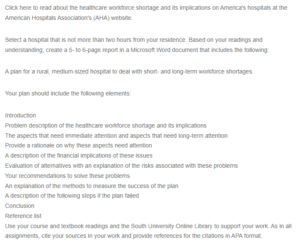
Click here to read about the healthcare workforce shortage and its implications on America’s hospitals at the American Hospitals Association’s (AHA) website.
Workforce Shortage
Select a hospital that is not more than two hours from your residence. Based on your readings and understanding, create a 5- to 6-page report in a Microsoft Word document that includes the following:
A plan for a rural, medium-sized hospital to deal with short- and long-term workforce shortages.
Your plan should include the following elements:
Introduction
Problem description of the healthcare workforce shortage and its implications
The aspects that need immediate attention and aspects that need long-term attention
Provide a rationale on why these aspects need attention
A description of the financial implications of these issues
Evaluation of alternatives with an explanation of the risks associated with these problems
Your recommendations to solve these problems
An explanation of the methods to measure the success of the plan
A description of the following steps if the plan failed
Conclusion
Reference list
Use your course and textbook readings and the South University Online Library to support your work. As in all assignments, cite your sources in your work and provide references for the citations in APA format.
 Complete the order form and upload all of your files, including any instructions, rubrics, or other materials provided by your instructor.
 Complete the order payment after filling in the order form. We’ll receive your order and assign it to a writer.
 The assigned writer will complete your paper and forward it to our Editing Team for review and approval.
 Once approved by the editor, the completed paper will be uploaded to your account for you to download, review and approve.