
Windshield Survey and Community Health Assessment: Austin, Minnesota
Part I: Windshield Survey and Community Analysis
Austin, Minnesota, is a mid-sized city located in Mower County, with a population of about 26,200 residents. Known for its cultural diversity, agricultural heritage, and economic base centred around Hormel Foods, Austin offers a dynamic setting for public health assessment. A windshield survey was conducted to observe and analyze community characteristics, available health services, public health challenges, and strengths. This report integrates these findings with secondary data to explore how public and community health nursing strategies can address population needs and promote equity.
Community Health Overview
The demographic composition of Austin includes White, Hispanic, Somali, and Southeast Asian populations. Families with young children are common, and the age distribution is balanced with a visible presence of older adults (Fan, 2023). The city’s public transportation system (SMART), along with bike paths and sidewalks, promotes mobility for residents without private vehicles. Most people, however, rely on personal cars for commuting.
Employment is primarily supported by Hormel Foods, complemented by small businesses, retail shops, and jobs in healthcare, education, and food services. There is clear economic diversity, with some neighbourhoods showing signs of financial hardship. Grocery needs are met through large stores like Walmart and Hy-Vee, along with smaller ethnic markets that reflect the city’s multicultural composition. Restaurants range from fast-food chains to local diners and culturally specific eateries. Services for families and children are plentiful, including public schools, early childhood programs, libraries, and nonprofits like the Parenting Resource Centre and Austin Aspires. Housing varies from well-maintained single-family homes to aging apartments and mobile homes, with some evidence of housing instability among low-income and immigrant residents.
The healthcare landscape is anchored by Mayo Clinic Health System – Austin, which provides primary, emergency, and specialty care. Mower County Public Health offers public health nursing services, immunizations, home visits, and WIC support. While dental and urgent care services are present, access to mental health and reproductive health care has declined due to recent clinic closures related to federal funding cuts.
The city is rich in recreational assets such as Mill Pond Park, Todd Park, and the Jay C. Hormel Nature Centre. These well-maintained spaces offer opportunities for exercise and socialization, contributing positively to physical and mental health. Several cultural, socioeconomic, and behavioural factors influence public health in Austin. Language barriers, health literacy gaps, and culturally specific beliefs impact how residents access and use health services. Lower-income families often delay preventive care, experience higher rates of chronic illness, and have reduced access to specialty services. Vulnerable populations include elderly individuals, immigrant families, low-income households, and undocumented residents, many of whom face overlapping barriers related to housing, education, and transportation (Crowley et al., 2020).
Public health policy plays a critical role in shaping service availability. Minnesota’s expansion of Medicaid has improved healthcare access, yet national-level funding cuts have forced some community clinics to close, disproportionately affecting women and low-income populations. Nonetheless, local organizations such as the Welcome Centre of Austin and the Parenting Resource Centre provide valuable support for housing, education, and mental health needs.
Health education is best disseminated through multilingual outreach efforts, school programs, local media, and trusted community centres. Public health nurses should leverage community events, health fairs, and culturally tailored materials to reach underserved groups. Communicable diseases like influenza, COVID-19, and tuberculosis are actively monitored by Mower County Public Health, which leads local prevention and vaccination initiatives.
Community Strengths and Risks
Three key strengths were identified in the Austin community. First, the presence of the Mayo Clinic Health System and Mower County Public Health ensures access to high-quality care and public health programming. Second, educational institutions and nonprofit organizations are actively engaged in supporting child development, academic success, and family well-being. Third, the abundance of well-kept parks and green spaces fosters physical activity and strengthens social connections across diverse groups (Iqbal et al., 2022).
Despite these strengths, several risks are present. First, access to reproductive and mental health services has declined due to clinic closures. This particularly affects underserved women, immigrants, and adolescents. Second, socioeconomic disparities remain a barrier for low-income residents who struggle with stable employment, housing, and healthcare access. Third, cultural and linguistic barriers prevent many immigrant residents from receiving timely and effective care, especially in the areas of chronic disease and mental health.
To address these issues, public health nurses must gather further data through community surveys, focus groups, and home visits, especially among undocumented or non-English-speaking residents. Identifying unspoken needs and engaging directly with cultural leaders and schools can help bridge trust gaps and improve care delivery.
Implications for Public Health Nursing
Public and community health nurses should approach their work in Austin with a view of the whole person and a recognition of cultural differences. To work with vulnerable people, we need to collaborate with schools, churches, food banks, and advocacy organizations. Nurses ought to ensure health education is suited to people who speak different languages or have various literacy skills. Having health programs in schools, using mobile clinics, or appointing health ambassadors from classes may improve how many receive care and the benefits from it (Flaubert et al., 2021).
Moreover, calling for public support to restore healthcare funds for mental and reproductive health is very important. As part of their role, community health nurses should work to prevent chronic illness by promoting vaccination, offering nutritional advice and encouraging people to exercise.
Part II: Course Reflection
This course deepened my understanding of the foundations of public and community health nursing by showing me how social, environmental, and economic conditions impact health outcomes. In the windshield survey of Austin, I witnessed how healthcare access, transportation, and housing safety differ from one neighborhood to another. It has taught me to examine not just the patient but also the entire community. I now ask questions regarding living situations and the availability of resources in clinical evaluation in order to find out the needs of the patients, aside from symptoms. I also understood how cultural, socioeconomic, and behavioral circumstances, such as language barriers and low health literacy, cause disparities in care. I have become more culturally competent and now tailor communications with the help of visual aids or interpreters to cater to immigrant families.
Through this course, I also evaluated how policy directly affects public health. For example, I researched how recent federal funding cuts led to clinic closures, limiting reproductive health services for low-income women. This made me pay closer attention to advocacy and connect my patients with nonprofit care providers in the area. I learned how to create strategies for healthcare that also address social problems, such as not having enough nutritious food and unstable housing. I cooperate with different in-school and shelter programs to make sure patients have supporting services that shape their long-term health.
Finally, I gained practical experience in collaborative public health efforts. Partnering with WIC and Austin Aspires for maternal and child health helped me realize how important community partnerships are for nurses. I used what I knew about communicable diseases by helping at vaccine clinics and explaining good hygiene practices and early warning symptoms to families. Combining this experience, I grew in understanding clinical matters and decided to focus on serving the whole community. Overall, I am now a more perceptive, active, and fair nurse capable of helping people who may need it through advocacy, knowledge sharing, and prevention.
References
Crowley, R., Daniel, H., Cooney, T. G., & Engel, L. S. (2020). Envisioning a better U.S. health care system for all: Coverage and cost of care. Annals of Internal Medicine, 172(2_Supplement), S7. https://doi.org/10.7326/m19-2415
Fan, Y. (2023). Centering the margins: The transportation experience of underserved communities. https://cts-d8resmod-prd.oit.umn.edu/pdf/mndot-2023-32.pdf
Flaubert, J. L., Menestrel, S. L., Williams, D. R., & Wakefield, M. K. (2021, May 11). The role of nurses in improving health equity. The Future of Nursing 2020-2030 – NCBI Bookshelf. https://www.ncbi.nlm.nih.gov/books/NBK573898/
Iqbal, A., Anil, G., Bhandari, P., Crockett, E. D., Hanson, V. M., Pendse, B. S., Eckdahl, J. S., & Horn, J. L. (2022). A digitally capable mobile health clinic to improve rural health care in America: A pilot quality improvement study. Mayo Clinic Proceedings: Innovations Quality & Outcomes, 6(5), 475–483. https://doi.org/10.1016/j.mayocpiqo.2022.08.002
ORDER A PLAGIARISM-FREE PAPER HERE
We’ll write everything from scratch
Question 
Windshield Survey and Community Health Assessment: Austin, Minnesota
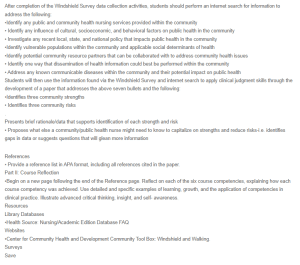
After completion of the Windshield Survey data collection activities, students should perform an internet search for information to address the following:
Windshield Survey and Community Health Assessment – Austin, Minnesota
•Identify any public and community health nursing services provided within the community
• Identify any influence of cultural, socioeconomic, and behavioral factors on public health in the community
• Investigate any recent local, state, and national policy that impacts public health in the community
•Identify vulnerable populations within the community and applicable social determinants of health
•Identify potential community resource partners that can be collaborated with to address community health issues
• Identify one way that dissemination of health information could best be performed within the community
• Address any known communicable diseases within the community and their potential impact on public health
Students will then use the information found via the Windshield Survey and internet search to apply clinical judgment skills through the development of a paper that addresses the above seven bullets and the following:
•Identifies three community strengths
• Identifies three community risks
.
Presents brief rationale/data that supports identification of each strength and risk
• Proposes what else a community/public health nurse might need to know to capitalize on strengths and reduce risks-i.e. identifies gaps in data or suggests questions that will glean more information
References
• Provide a reference list in APA format, including all references cited in the paper.
Part II: Course Reflection
•Begin on a new page following the end of the Reference page. Reflect on each of the six course competencies, explaining how each course competency was achieved. Use detailed and specific examples of learning, growth, and the application of competencies in clinical practice. Illustrate advanced critical thinking, insight, and self- awareness.
Resources
Library Databases
•Health Source: Nursing/Academic Edition Database FAQ
Websites
•Center for Community Health and Development Community Tool Box: Windshield and Walking.
Surveys
Save
 Complete the order form and upload all of your files, including any instructions, rubrics, or other materials provided by your instructor.
  Complete the order payment after filling in the order form. We’ll receive your order and assign it to a writer.
 The assigned writer will complete your paper and forward it to our Editing Team for review and approval.
 Once approved by the editor, the completed paper will be uploaded to your account for you to download, review and approve.