
Week 6 Methodologist Synchronous Meeting Summary
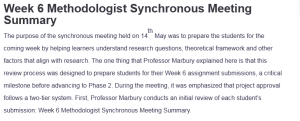
The purpose of the synchronous meeting held on 14th May was to prepare the students for the coming week by helping learners understand research questions, theoretical framework and other factors that align with research. The one thing that Professor Marbury explained here is that this review process was designed to prepare students for their Week 6 assignment submissions, a critical milestone before advancing to Phase 2. During the meeting, it was emphasized that project approval follows a two-tier system. First, Professor Marbury conducts an initial review of each student’s submission: Week 6 Methodologist Synchronous Meeting Summary.
If deemed satisfactory, the submission is then forwarded to the Doctor of Information Technology (DIT) program reviewer. Even so, he observed that a number of projects needed revision before they were approved for the next phase. It was clarified that the following phase involves data collection and the process of developing the details of the project plan.
In this section of the discussion, there was also a reminder of the importance of refining the problem statement and theoretical alignment. The discussion also touched on the importance of precision during research, ethical consideration and scholarly rigor. These were highlighted as major success factors in the research process.
The next phase involved students presenting their projects in the meeting. The first presentation was from Edward Lee, where the topic of discussion was the integration of post-quantum cryptography with legacy encryption systems in large enterprises. For this, Edward received feedback that he needed to strengthen his problem statement by embedding citations, especially after making claims. The second adjustment he needed to make was to validate frameworks.
Additionally, the project’s purpose statement had to be adjusted to have a more tentative language. Another highlighted improvement was changing from a “will inform” to a “may inform” perspective. Also, from the discussion, it emerged that his theoretical framework was relevant but not properly cited. In contrast, Professor Seon Trotman focused on the effectiveness of IoT security frameworks in critical infrastructure.
The feedback centered more on clarifying his dependent and independent variables. The professor advised that he needed to justify the use of the Technology-Organization-Environment (TOE) framework more thoroughly and to ensure permissions were obtained for any copyrighted instruments. Another point was that he needed to consult quantitative dissertations.
The next presentation was Prof. Seon Trotman’s Presentation. The topic was IoT security framework effectiveness in critical infrastructure sectors. The discussion focused on Samir Adlouni’s use of AI and machine learning-based cybersecurity tools in multi-cloud healthcare environments. The feedback they got was that there were some ethical bias issues he had to consider.
They were alerted that there were biases if he interviewed colleagues. He was also asked to clarify whether the concept of “effectiveness” is integral to his problem statement or if it should be removed from the research question. Furthermore, while he proposed using the CIA Triad and NIST frameworks, he was reminded that these are applied rather than theoretical models and would require recontextualization to meet theoretical expectations.
Overall, he was alerted that there were technicalities and challenges when one decided to conduct a study in their workplace. For the study itself, he was encouraged to refine his problem statement to focus more on why IT professionals apply training, rather than why they don’t, to reduce potential bias.
Overall, looking at all the presentations, the recurring theme was on citations. Students were encouraged to place citations correctly after main claims to strengthen scholarly credibility. The citations were mainly required in the problem and purpose section. Another theme that emerged was ethical consideration.
What came out clearly using the example of one of the colleagues was that interviewing coworkers was technical however, if one had to do so, then they must gain formal site permissions and should use purposeful or convenience sampling appropriately. Another takeaway was on the methodology. The instructor emphasized clarity in the methodology section.
Even so, the major concerns were the use of qualitative studies, where the students were advised to use interviews and not surveys when doing qualitative studies. Looking ahead, students should focus on refining their submissions for Week 6, emphasizing the significance of their research problems, the alignment of research questions, and the justification for selected theoretical frameworks.
ORDER A PLAGIARISM-FREE PAPER HERE
We’ll write everything from scratch
Question 
Instructions
Use the link and passcode below to get a the recording and use it to complete this assignment.
To confirm your participation in the required synchronous meetings held in Weeks 1, 3, 5, and 6, complete the following:
- Submit a brief list of the synchronous sessions that you attended this quarter. ( note I’m using the recording from week 6 as my attendance link to the recording is below)
- For each session, list the date, type of session (1:1, small group), and write a bullet point if there is anything you wish to be noted about your participation in the session.
- If you did not attend any synchronous sessions, please briefly explain your absence and note that you will not be given credit for any sessions you missed.

Week 6 Methodologist Synchronous Meeting Summary
Competencies Measured
By successfully completing this assignment, you will demonstrate your proficiency in the following course competencies and scoring guide criteria:
- Competency 8: Write in accordance with the academic and professional requirements of the discipline during the research process ensuring appropriate structure, grammar, usage, and style.
- Week 1: Acknowledge participation in the small-group synchronous meeting.
- Week 3: Acknowledge participation in the individual with faculty synchronous meeting.
- Week 5: Acknowledge participation in the small-group synchronous meeting.
- Week 6: Acknowledge participation in the methodologist synchronous meeting. (This is the meeting I shared a link below)
If you were unable to attend our live Zoom session on May 14th, you can still receive credit by watching the recording and submitting a summary.
🎥 Recording Access:
Link: https://strategiced.zoom.us/rec/share/l4BBAzv-rlSI5rcpTG0_lQRf6qKCozLo-OQEFvBQTB7wrOOQ33qsL0fJzjftCxkt.M7TyXGErVa0J5R8P
🔐 Passcode: k!AZX*8j
📌 To receive credit, please:
- Watch the full recording.
- Prepare a brief summary of your notes from the session and the key lessons learned.
- Submit your summary in the Week 6 – Assignment 2 folder in the courseroom.
 Complete the order form and upload all of your files, including any instructions, rubrics, or other materials provided by your instructor.
  Complete the order payment after filling in the order form. We’ll receive your order and assign it to a writer.
 The assigned writer will complete your paper and forward it to our Editing Team for review and approval.
 Once approved by the editor, the completed paper will be uploaded to your account for you to download, review and approve.