
Week 2 Assignment
Scenario 1: Prescription Errors, Rewrites, and Rationale
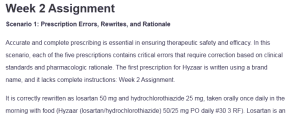
Accurate and complete prescribing is essential in ensuring therapeutic safety and efficacy. In this scenario, each of the five prescriptions contains critical errors that require correction based on clinical standards and pharmacologic rationale. The first prescription for Hyzaar is written using a brand name, and it lacks complete instructions: Week 2 Assignment.
It is correctly rewritten as losartan 50 mg and hydrochlorothiazide 25 mg, taken orally once daily in the morning with food (Hyzaar (losartan/hydrochlorothiazide) 50/25 mg PO daily #30 3 RF). Losartan is an angiotensin II receptor blocker (ARB), and hydrochlorothiazide is a thiazide diuretic; together they reduce blood pressure through vasodilation and natriuresis (Mulla & Siddiqui, 2022).
The second prescription, Lotrel, is also a brand name with reversed dosing strengths. It is revised as amlodipine 5 mg and lisinopril 40 mg taken once daily (Lotrel (amlodipine/lisinopril) 5/40 mg PO daily #30 3 RF). Amlodipine, a calcium channel blocker, and lisinopril, an ACE inhibitor, work synergistically to reduce peripheral vascular resistance and suppress the renin-angiotensin system (Bulsara & Cassagnol, 2024).
Hydralazine is incorrectly spelled and lacks food instructions. The corrected version advises 25 mg orally four times daily with meals (hydralizine 25 mg PO QID #120 1 RF). As a direct vasodilator, hydralazine relaxes arteriolar smooth muscle to reduce blood pressure.
The digoxin prescription specifies an unsafe dose. The corrected order prescribes 0.125 mg orally daily (digoxin 1.25 mg PO daily #30 1 RF), aligned with the narrow therapeutic range to improve cardiac output by inhibiting the Na+/K+ ATPase pump. Lastly, Repatha is improperly ordered as intravenous (David & Shetty, 2024). The corrected route is a subcutaneous injection every two weeks (Repatha 140 mg IV every 2 weeks #1 1 RF), appropriate for evolocumab’s PCSK9-inhibitor mechanism that reduces LDL cholesterol levels.
Scenario 2: Fentanyl, First-Pass Effect, and Bioavailability
Fentanyl is a synthetic opioid analgesic that undergoes extensive hepatic first-pass metabolism, which significantly reduces its systemic availability when administered orally. This metabolic process occurs primarily through the cytochrome P450 enzyme CYP3A4. As a result, the oral bioavailability of fentanyl is less than 33%, rendering the oral route clinically ineffective for pain control (Ramos-Matos et al., 2023). Understanding this pharmacokinetic barrier is critical for ensuring effective and safe pain management in clinical practice.
The only route of administration that achieves 100% bioavailability is intravenous (IV) delivery, which bypasses hepatic metabolism entirely. However, IV use is often limited to inpatient settings. To circumvent the first-pass effect in outpatient or palliative care, clinicians utilize alternative delivery systems such as transdermal patches, sublingual tablets, buccal tablets, intranasal sprays, and oral transmucosal lozenges (Price & Patel, 2023). These routes allow fentanyl to enter the systemic circulation directly through mucosal membranes or the skin, thereby avoiding the liver’s first-pass effect.
For patients experiencing breakthrough cancer pain who are already opioid-tolerant, the buccal route is both effective and convenient. This route provides a rapid onset of analgesia while bypassing gastrointestinal degradation. A correct evidence-based prescription for such use would be:
Fentanyl buccal tablet (Fentora) 100 mcg, place one tablet between cheek and gum every four hours as needed for breakthrough cancer pain. Maximum: four tablets per day. Dispense: #30. No refills (Fentanyl (Fentora) 100 mcg buccal tablet Q4H PRN x30, 0 RF) (Chiang et al., 2024).
Recognizing fentanyl’s pharmacokinetic properties, especially its limited oral bioavailability, allows clinicians to choose the most appropriate and safe route of administration, ultimately enhancing therapeutic effectiveness and patient safety.
Scenario 3: CYP450 Enzymes, Drug Metabolism, and MTM Relevance
The cytochrome P450 (CYP450) enzyme system is a critical component of drug metabolism, with the majority of its activity occurring in the liver. These enzymes, particularly CYP2C19, CYP3A4, and CYP2D6, are responsible for the metabolism of more than 75% of drugs used in clinical practice (Gilani & Cassagnol, 2023). Understanding their activity is essential in medication therapy management (MTM), where drug interactions, efficacy, and toxicity must be carefully balanced.
Using Medscape’s Pill Identifier tool, the medication imprinted with “292,” brown, oval-shaped, and without scoring, was identified as Carisoprodol 350 mg. Carisoprodol is a centrally acting skeletal muscle relaxant indicated for acute musculoskeletal pain. It is metabolized by the CYP2C19 enzyme into meprobamate, an active metabolite with sedative and anxiolytic effects (Medscape, 2024). CYP2C19 is known for genetic polymorphisms that may lead to poor or ultra-rapid metabolism in certain individuals, impacting therapeutic response and risk for adverse effects.
The MTM relevance of this information is significant. Patients taking CYP2C19 inhibitors (such as omeprazole and fluoxetine) may experience elevated levels of carisoprodol and meprobamate, increasing the risk of CNS depression, dizziness, or dependency. Additionally, poor CYP2C19 metabolizers may accumulate in the parent drug, leading to toxicity. Understanding these interactions helps guide clinical decisions, dose adjustments, and patient counseling during MTM reviews (Scherf-Clavel et al., 2024).
A safe and complete prescription for carisoprodol includes clear dosing and duration limits:
Carisoprodol 350 mg tablet, take one tablet by mouth three times a day and at bedtime for muscle spasms. Dispense: #60 tablets. No refills. Limit use to no more than three weeks (Carisoprodol 350 mg PO TID and HS PRN #60, 0 RF).
Proper identification and enzyme interaction awareness ensure safe prescribing and reduce preventable adverse drug events in clinical settings.
Scenario 4: Lipid Management Plan for DL
DL is 48 years old and has several heart disease risk factors, so he needs to see a doctor right away to prevent an event of atherosclerotic cardiovascular disease (ASCVD). He smokes one pack per day, weighs more than what is recommended and has a lot of cholesterol. The total cholesterol found in his fasting lipids is 245 mg/dL, LDL is 165 mg/dL, HDL is 41 mg/dL, and triglycerides are 175 mg/dL.
According to the 2018 ACC/AHA guidelines, the target goals for lipid management are total cholesterol <200 mg/dL, LDL <100 mg/dL (or <70 mg/dL for high-risk patients), HDL >40 mg/dL, and triglycerides <150 mg/dL (Shahjehan et al., 2024).
DL’s BMI is 32.0, calculated using the Medscape BMI calculator for a height of 5’10” (70 inches) and weight of 223 lbs. This classifies him as obese, a known independent risk factor for coronary artery disease (CAD). He has at least seven identifiable risk factors: age >45, active smoking, obesity, elevated total cholesterol, elevated LDL, low HDL, and elevated triglycerides.
The current regimen includes losartan 50 mg daily and linagliptin 5 mg daily, both of which should be continued. However, red yeast rice should be discontinued due to its variable potency and risk of hepatotoxicity when combined with statins (De La Luz Alvarez-Canales et al., 2021). Initiating a moderate- to high-intensity statin is appropriate per guideline recommendations.
A safe and guideline-aligned prescription is:
Atorvastatin 40 mg tablet, take one tablet orally at bedtime. Dispense: #30 tablets. Three refills. Monitor lipid panel and liver enzymes in 6–8 weeks (Atorvastatin 40 mg PO HS #30, 3 RF) (McIver & Siddique, 2020).
Patient education must emphasize smoking cessation, daily physical activity, dietary changes (DASH diet), and statin adherence. Monitoring should include liver function tests, fasting lipid panel, and assessment for statin-related side effects such as myopathy.
References
Bulsara, K. G., & Cassagnol, M. (2024). Amlodipine. National Library of Medicine. https://www.ncbi.nlm.nih.gov/books/NBK519508/
Chiang, Y.-H., Lien, C.-T., Su, W.-H., Yen, T.-Y., Chen, Y.-J., Lai, Y.-L., Lim, K.-H., Dai, K.-Y., Chung, H.-P., Hung, C.-Y., & Leu, Y.-S. (2024). Effectiveness of fentanyl buccal soluble film in cancer patients with inadequate breakthrough pain control. BMC Palliative Care, 23(1). https://doi.org/10.1186/s12904-024-01483-7
David, M. N. V., & Shetty, M. (2024, November 25). Digoxin. PubMed; StatPearls Publishing. https://www.ncbi.nlm.nih.gov/books/NBK556025/
De La Luz Alvarez-Canales, M. F., Salazar-López, S. S., Farfán-Vázquez, D., Martínez-López, Y. E., González-Mena, J. N., Jiménez-Ceja, L. M., Vargas-Ortiz, K., Evia-Viscarra, M. L., De Oca-Loyola, M. L. M., Folli, F., Aguilar-García, A., & Guardado-Mendoza, R. (2021). Effect of linagliptin on glucose metabolism and pancreatic beta cell function in patients with persistent prediabetes after metformin and lifestyle. Scientific Reports, 11(1). https://doi.org/10.1038/s41598-021-88108-8
Gilani, B., & Cassagnol, M. (2023, April 24). Biochemistry, cytochrome P450. PubMed; StatPearls Publishing. https://www.ncbi.nlm.nih.gov/books/NBK557698/
McIver, L. A., & Siddique, M. S. (2020, September 25). Atorvastatin. Nih.gov; StatPearls Publishing. https://www.ncbi.nlm.nih.gov/books/NBK430779/
Medscape. (2024). Pill identifier (drug & pill finder) – Medscape reference. Reference.medscape.com. https://reference.medscape.com/pill-identifier
Mulla, S., & Siddiqui, W. J. (2022). Losartan. PubMed; StatPearls Publishing. https://www.ncbi.nlm.nih.gov/books/NBK526065/
Price, G., & Patel, D. (2023, July 30). Drug bioavailability. PubMed; StatPearls Publishing. https://www.ncbi.nlm.nih.gov/books/NBK557852/
Ramos-Matos, C. F., Lopez-Ojeda, W., & Bistas, K. G. (2023). Fentanyl. PubMed; StatPearls Publishing. https://www.ncbi.nlm.nih.gov/books/NBK459275/
Scherf-Clavel, M., Weber, H., Unterecker, S., Frantz, A., Eckert, A., Reif, A., Deckert, J., & Hahn, M. (2024). The relevance of integrating CYP2C19 phenoconversion effects into clinical pharmacogenetics. Pharmacopsychiatry, 57(02), 69–77. https://doi.org/10.1055/a-2248-6924
Shahjehan, R. D., Bhutta, B. S., & Sharma, S. (2024). Coronary artery disease. National Library of Medicine; StatPearls Publishing. https://www.ncbi.nlm.nih.gov/books/NBK564304/
ORDER A PLAGIARISM-FREE PAPER HERE
We’ll write everything from scratch
Question 
WEEK 2 ASSIGNMENT (covers weeks 1 & 2)
The week 2 assignment covers material from weeks 1 and 2.
To Prepare:
- Review the assignment rubric and case studies. Be sure to answer ALL thoroughly
- Explain the problem and discuss how you would address the problem.
- When recommending medications, write out a complete prescription for each medication. What order would you send to a pharmacy? Include drug, dose, route, frequency, special instructions, # dispensed (days supply), refills, etc. Also, state if you would continue, discontinue or taper the patient’s current medications.
- Answer questions using your learning resources, Medscape, and clinical practice guidelines (ie, JNC 8, AHA, ACC, etc). Lecturio is an optional resource but highly recommended Include at least three references to support each scenario and cite them in APA format. Please include in-text citations. You do not need an introduction or conclusion paragraph.
- Assignments require evidence-based literature (primary resources and clinical guidelines) to support decisions/recommendations. Also, sources should be from within the last 5 years. Please review the rubric each week for EACH assignment to maximize points. The course resources (Lecturio) should be used as a starting point, but further research on the topic should include the most recent, up-to-date clinical resources and guidelines.
- References MUST include applicable clinical guidelines to support and provide a rationale for ALL RECOMMENDATIONS. Please review the following course announcements: Scholarly Sources Expectations and Evidence-Based Literature.
For each of the scenarios below, answer the questions using your learning resources, Medscape, and clinical practice guidelines (ie JNC 8, AHA, ACC etc). Lecturio is an optional resource but highly recommended. Be sure to thoroughly answer ALL questions. When recommending medications, write out a complete medication order.
Review and discuss ALL labs and possible interactions. Use at least 3 sources for each scenario and cite sources using APA format; include in-text citations. You do not need an introduction or conclusion paragraph. Please also review assignment rubric.
Week 2 Assignment
WEEK 2 ASSIGNMENT (covers weeks 1 & 2)
SCENARIO 1
What are the errors in the following prescriptions (5 total)? Rewrite each prescription correctly. What is each medication classification? What is the mechanism of action (MOA)?
- Hyzaar (losartan/hydrochlorothiazide) 50/25 mg PO daily #30 3 RF
- Lotrel (amlodipine/lisinopril) 5/40 mg PO daily #30 3 RF
- hydralizine 25 mg PO QID #120 1 RF
- digoxin 1.25 mg PO daily #30 1 RF
- Repatha 140 mg IV every 2 weeks #1 1 RF
SCENARIO 2
Does fentanyl have a high or low first pass effect? Please discuss why this is important to know and how it relates to bioavailability. What route has 100% bioavailability? In addition to parenterally, how can this medication be given to counter the first pass effect? Write a sample prescription for this medication.
SCENARIO 3
Where are the majority of cytochrome P450 (CYP) enzymes located? Using the Medscape pill identifier, enter the following characteristics to identify the medication. What CYP enzyme metabolizes this medication? How can this information be applied to medication therapy management? Write a sample prescription for the identified medication and strength.
Imprint (292) Shape (Oval) Color (Brown) Form (Tablet) Scoring (None)
SCENARIO 4
DL is a 48-year-old male following up on his labs that were drawn last week. He smokes 1 pack per day. He is currently on losartan 50 mg po daily, linagliptin (Tradjenta) 5 mg PO daily and red yeast rice supplement. Fasting lipid profile shows Total Cholesterol 245 mg/dL, LDL 165 mg/dL, HDL 41 mg/dL, and Triglycerides 175 mg/dL.
 Complete the order form and upload all of your files, including any instructions, rubrics, or other materials provided by your instructor.
  Complete the order payment after filling in the order form. We’ll receive your order and assign it to a writer.
 The assigned writer will complete your paper and forward it to our Editing Team for review and approval.
 Once approved by the editor, the completed paper will be uploaded to your account for you to download, review and approve.