
Week 10 Case Analysis: Chlamydia trachomatis
The patient, Emily B., is a 19-year-old Caucasian and a college student presenting with symptoms of increased vaginal discharge, slight dysuria, and pelvic discomfort. The presence of Chlamydia trachomatis infection is confirmed by a NAAT. Her unfinished HPV vaccine, inconsistency in using condoms, and multiple partners put her at risk of suffering long-term reproductive complications. According to Emily’s presentation, this analysis covers the pathophysiology, the host’s immune response, associated risk factors, and complications.
Pathophysiology
Chlamydia trachomatis is an intracellular, obligate, and Gram-negative pathogen. Its distinctive biphasic growth cycle allows it to proliferate inside host epithelial cells while evading immune system detection. The elementary body (EB) and reticulate body (RB) are its two developmental forms. The EB is the metabolically inactive, infectious form with the potency of attaching and getting inside mucosal epithelial cells through endocytosis. It changes to the non-infectious form but is metabolically active and reproduces RB in host cells. RB reproduces itself via binary fission in a vacuole called an inclusion, which is bounded by a membrane (Mohseni et al., 2023). RBs subsequently reorganize into EBs after several replication cycles, and are thus released via the lysis or the extrusion of the host cell so that the infection can spread to the neighboring cells.
One of the features of the Chlamydia trachomatis (C. trachomatis) infection involves the evasion of the host’s immune system. It suppresses the fusion of lysosomes and thus blocks the intracellular degradation. It also inhibits the host-MHC class I and class II proteins, reducing antigen presentation and delaying immune recognition. The organism also disrupts the host cells in a way that prevents the apoptotic pathways that would result in the death of the host cell (Wang et al., 2024). These immune evasion tactics also lead to continuous infections that may not have been visible and thus have a high chance of chronic inflammation, leading to prolonged complications.
Host Immune Response to Chlamydia
Innate immune reaction starts when host epithelial and immune cells recognize chlamydial components via sensors that recognize patterns, of which Toll-like receptors (TLRs), especially TLR2 and TLR4, boast considerable significance. These receptors identify the pathogen-associated molecular patterns (PAMPs), such as the chlamydial lipopolysaccharide and the heat shock proteins. Their stimulation leads to intracellular signaling cascades, in particular, via the NF-kB pathway, culminating in the transcription and secretion of proinflammatory cytokines, including IL1-1, IL-6, TNF-α, and chemokines, such as IL-8 (Yang et al., 2024). Accordingly, these cytokines aid in facilitating the influx of neutrophils, dendritic cells, and macrophages toward the area of infection and set an intensive inflammatory reaction in place.
Although this response is vital in the clearance of bacteria, it also causes tissue injury in cases where there is an overabundance or prolongation of the activity. Adaptive immune response entails CD4+ T-helper 1 (Th 1) cells, which release interferon-gamma, a compound that increases the effect of macrophage cells and killing of the bacteria (Vu et al., 2024). The immune system, however, does not usually develop long-term immunity, which is why most sexually active young adults record high rates of reinfections. Chronic infection and recurrent immune activation may lead to fibrosis and scar the upper reproductive tract, which is a factor in reducing fertility and even ectopic pregnancy.
Risk Factors and Associated Complications
Without proper treatment, chlamydia infection may have profound effects on the reproductive organs. It may lead to severe complications, including pelvic inflammatory disease (PID), chronic pelvic pain, as well as infertility and ectopic pregnancy. Pathogen enters the upper reproductive tract via the cervix and leads to the inflammation and scarring of the fallopian tubes, which can contribute to reducing fertility (Magley & Hinson, 2024). Moreover, consistent infection may cause cervical inflammation and, in the case of the presence of HPV co-infection, it contributes to cervical dysplasia and cancer.
Many risk factors predispose a person to chlamydia, as in the case of Emily. These include her age (19), having several sexual partners, not wearing condoms properly all the time, and not being completely vaccinated against HPV. Young women are particularly at risk because of cervical ectopy, whereby columnar epithelium is more exposed to infections. Failure to have regular screening further delays the initiation of treatment and increases the chances of developing complications (Magley & Hinson, 2024). Besides, chlamydia-associated mucosal inflammation promotes the spreading of HIV and increases the severity of other co-existing sexually transmitted infections such as HPV.
Conclusion
Conclusively, the case of Emily shows that chlamydial infection may have little effect on reproductive health, but the effects can be severe. Its complications result from the pathogen’s evasion of the immune system of the body, the inflammatory response, and patient-specific risk factors. This should be followed by early detection, effective treatment, partner notification, education, and vaccination, as it is essential to secure Emily’s reproductive health to prevent reinfection.
References
Magley, M., & Hinson, M. R. (2024, October 6). Eclampsia. PubMed; StatPearls Publishing. https://www.ncbi.nlm.nih.gov/books/NBK554392/
Mohseni, M., Sung, S., & Takov, V. (2023, August 8). Chlamydia. National Library of Medicine; StatPearls Publishing. https://www.ncbi.nlm.nih.gov/books/NBK537286/
Vu, A., Glassman, I., Campbell, G., Yeganyan, S., Nguyen, J., Shin, A., & Venketaraman, V. (2024). Host cell death and modulation of immune response against mycobacterium tuberculosis infection. International Journal of Molecular Sciences, 25(11), 6255. https://doi.org/10.3390/ijms25116255
Wang, X., Wu, H., Fang, C., & Li, Z. (2024). Insights into innate immune cell evasion by Chlamydia trachomatis. Frontiers in Immunology, 15. https://doi.org/10.3389/fimmu.2024.1289644
Yang, S., Zeng, J., Yu, J., Sun, R., Tuo, Y., & Bai, H. (2024). Insights into chlamydia development and host cell response. Microorganisms, 12(7), 1302. https://doi.org/10.3390/microorganisms12071302
ORDER A PLAGIARISM-FREE PAPER HERE
We’ll write everything from scratch
Question 
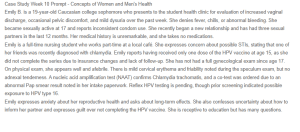
Case Study Week 10 Prompt – Concepts of Women and Men’s Health
Emily B. is a 19-year-old Caucasian college sophomore who presents to the student health clinic for evaluation of increased vaginal discharge, occasional pelvic discomfort, and mild dysuria over the past week. She denies fever, chills, or abnormal bleeding. She became sexually active at 17 and reports inconsistent condom use. She recently began a new relationship and has had three sexual partners in the last 12 months. Her medical history is unremarkable, and she takes no medications.
Week 10 Case Analysis – Chlamydia trachomatis
Emily is a full-time nursing student who works part-time at a local café. She expresses concern about possible STIs, stating that one of her friends was recently diagnosed with chlamydia. Emily reports having received only one dose of the HPV vaccine at age 15, as she did not complete the series due to insurance changes and lack of follow-up. She has not had a full gynecological exam since age 17.
On physical exam, she appears well and afebrile. There is mild cervical erythema and friability noted during the speculum exam, but no adnexal tenderness. A nucleic acid amplification test (NAAT) confirms Chlamydia trachomatis, and a co-test was ordered due to an abnormal Pap smear result noted in her intake paperwork. Reflex HPV testing is pending, though prior screening indicated possible exposure to HPV type 16.
Emily expresses anxiety about her reproductive health and asks about long-term effects. She also confesses uncertainty about how to inform her partner and expresses guilt over not completing the HPV vaccine. She is receptive to education but has many questions.
 Complete the order form and upload all of your files, including any instructions, rubrics, or other materials provided by your instructor.
  Complete the order payment after filling in the order form. We’ll receive your order and assign it to a writer.
 The assigned writer will complete your paper and forward it to our Editing Team for review and approval.
 Once approved by the editor, the completed paper will be uploaded to your account for you to download, review and approve.