
Video Reflection – Social Cognitive Theory (SCT)
Hello and welcome!
My name is Sherita Dobbins, and today, I’ll be discussing the Social Cognitive Theory (SCT) developed by Albert Bandura (Sharma & Romas, 2012). SCT is a behavioral theory that deals with the relationship between personal factors, behavior and environmental stimuli. According to Bandura, people learn and strengthen not only behavior but also motivation through observation and interaction with the environment. This theory has been adopted in health promotion to understand the change process with the aim of building better interventions.
Let’s begin by understanding the theory itself.
Social Cognitive Theory is grounded in the idea of reciprocal determinism, which means that a person’s behavior, personal characteristics (such as cognitive processes), and environment all influence each other. It asserts that learning does not take place only from experience. Rather, it affirmed that people are capable of changing their behavior by observing others, emulating, and subsequently modeling (Sharma, 2021). SCT is especially relevant to health education since it focuses on developing procedural knowledge regeneration approaches for the initial uptake of behavior in addition to context facilitation of the practice of the behavior.
Now, let’s move on to the key constructs of the theory.
SCT identifies several constructs that are critical for prompting health behavior change. First is self-efficacy, defined as an individual’s belief in their capacity to engage in a certain behavior and execute it appropriately. Higher self-efficacy leads to correct behavior adoption and maintenance and, therefore, should be encouraged (Sharma, 2021). Observational learning is a method of learning based on witnessing people’s behavior and the results of such actions. Behavioral capability can be defined as the ease with which a behavior can be enacted, as well as the individual’s awareness of the behavior. Outcome expectations refer to the consequences that are expected to follow a particular behavior, while reinforcements refer to the positive or negative incentives that are endogenous or exogenous to certain behavior and which dictate whether it will happen again or not. Finally, one can deduce how positive or negative changes in emotional intensity incite or counter behavior.
Let’s now discuss the strengths and limitations of this theory.
Another major advantage of SCT is that it assumes that cognition, person and context are intertwined. This is because it brings in the chance to create interventions that work not only on the person but also on the environment and other people around them. It has been used in developing efficacy-based interventions that target the improvement in confidence and competence in the targeted groups.
Nevertheless, SCT has its limitations, too. First, it can be quite vague and not specific enough in its predictions; not all constructs come with the same impact in every situation. Other external and internal activities can also be difficult to quantify- observational learning or expectations, for instance. Besides, it presupposes a deliberate decision-making process that does not consider individual and/or socio-economic factors.
Nevertheless, SCT is amongst the strongest and most flexible theories of health promotion that are currently used today.
Finally, let’s look at how we can apply this theory to health behavior.
SCT can be effectively used to encourage physical activity in sedentary adults. For example, a worksite health promotion program can enhance behavioral capability through aerobics during lunch and micro-skill training. This can be achieved by obtaining datasets of peer role models that engage in fitness activities and posting about them online. A convenient way through which self-efficacy can be increased is through CBT, and this can be achieved by setting specific goals, as it is possible because the application of tracking fitness or having friends to encourage you could be used as a goal.
Environmental factors can also be changed for the better through physical changes, such as the formation of ways that will make people take a walk and encouragement from leaders. The program also has the flexibility to adjust the caloric reductions based on encouraging and motivational experiences of similar individuals who have benefited from exercise. By applying several SCT constructs, the program enables the promotion of self-organized beliefs, social reinforcements and organizational environment to ensure long-term behavioral change.
References
Sharma, M. (2021). Theoretical foundations of health education and health promotion. Jones & Bartlett Learning.
ORDER A PLAGIARISM-FREE PAPER HERE
We’ll write everything from scratch
Question 
Video Reflection – Social Cognitive Theory (SCT)
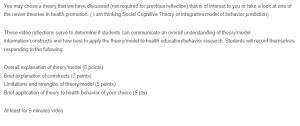
You may chose a theory that we have discussed (not required for previous reflection) that is of interest to you or take a look at one of the newer theories in health promotion. ( I am thinking Social Cognitive Theory or integrative model of behavior prediction)
Video Reflection – Social Cognitive Theory (SCT)
These video reflections serve to determine if students can communicate an overall understanding of theory/model information/constructs and how best to apply the theory/model to health education/behavior research. Students will record themselves responding to the following:
Overall explanation of theory/model (8 points)
Brief explanation of constructs (7 points)
Limitations and strengths of theory/model (5 points)
Brief application of theory to health behavior of your choice (5 pts)
At least for 5 minutes video
 Complete the order form and upload all of your files, including any instructions, rubrics, or other materials provided by your instructor.
  Complete the order payment after filling in the order form. We’ll receive your order and assign it to a writer.
 The assigned writer will complete your paper and forward it to our Editing Team for review and approval.
 Once approved by the editor, the completed paper will be uploaded to your account for you to download, review and approve.