
Video Reflection – Diffusion of Innovations (DOI) Theory
Hello and welcome!
My name is Sherita Dobbins, and today, I’ll be discussing the Diffusion of Innovations (DOI) Theory, a model developed by Everett Rogers (Sharma, 2021). This theory describes how change occurs in a system, organization, or community regarding the flow of new ideas, practices, or products. With regards to this theory, it is quite clear how ideas are disseminated and what really makes them grow and become popular.
Let’s begin by understanding the theory itself.
Diffusion of Innovation Theory postulates that the process of adopting innovations is done in five stages, which include knowledge, persuasion, decision, implementation, and confirmation. These stages encapsulate the procedure through which people become informed, reasoned and persuaded into accepting change (Sharma, 2021). The theory also subdivides adopters into five groups: Innovators, Early Adopters, Early Majority, Late Majority and Laggards. These categories make it easier to explain the pace at which different individuals in a specific society or a particular group accept certain changes.
Now, let’s move on to the key constructs of the theory.
There are several important constructs that affect the rate and level of adoption of an innovation. These include Relative Advantage, which is the perceived benefit of the new innovation over existing options; Compatibility, which regards the extent to which the innovation is adopted and appreciated by the target group; and Complexity, which is accepted as how complex the innovation is for the target consumers. Trialability refers to the fact that the intention does not have to be fully committed to before implementing the innovative idea; while on the other hand; observability is the extent to which others are able to see the benefits of the innovation. They help in assessing the likely adoption of the innovation with the following constructs being key.
Let’s now discuss the strengths and limitations of this theory.
In the Diffusion of Innovation Theory, there are certain factors that affect the adoption process. The relative Advantage dimension involves the comparison of the new opportunities available in a new solution or an innovation with the ones that existed before. This refers to the extent of the compatibility of the innovation with the organizational culture and structure. Complexity can be defined as the ease or otherwise of using the innovation. Trialability is one of the attributes that tells us that an innovation can be tested before a large-scale implementation is done. Usability is one of the processes through which the viability of new technology becomes tangible or evident, hence its adoption. These concepts determine the rate at which invention is taken up.
Finally, let’s look at how we can apply this theory to health behavior.
To illustrate the application of DOI theory, let’s look at an example—promoting sunscreen use to prevent skin cancer.
During the knowledge stage, people are educated through campaigns about the necessity of using sunscreen. In this stage of persuasion, health influencers and professionals state the claimed benefit of sunscreen over traditional methods of protection from the sun, including the prevention of skin cancer and sunburn. In the decision stage, people evaluate the benefits and whether it is convenient for them to apply sunscreens regularly. After that, they transition to the use phase, where it is incorporated into their daily practice or otherwise implemented. Finally, in the confirmation stage, people still use sunscreen, and they notice the benefits, which include reduced probability of skin damage.
References
Sharma, M. (2021). Theoretical foundations of health education and health promotion. Jones & Bartlett Learning.
ORDER A PLAGIARISM-FREE PAPER HERE
We’ll write everything from scratch
Question 
Video Reflection – Diffusion of Innovations (DOI) Theory
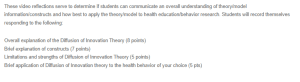
These video reflections serve to determine if students can communicate an overall understanding of theory/model information/constructs and how best to apply the theory/model to health education/behavior research. Students will record themselves responding to the following:
Diffusion of Innovations (DOI) Theory
Overall explanation of the Diffusion of Innovation Theory (8 points)
Brief explanation of constructs (7 points)
Limitations and strengths of Diffusion of Innovation Theory (5 points)
Brief application of Diffusion of Innovation theory to the health behavior of your choice (5 pts)
 Complete the order form and upload all of your files, including any instructions, rubrics, or other materials provided by your instructor.
  Complete the order payment after filling in the order form. We’ll receive your order and assign it to a writer.
 The assigned writer will complete your paper and forward it to our Editing Team for review and approval.
 Once approved by the editor, the completed paper will be uploaded to your account for you to download, review and approve.