
Unit 4 Journal: HEENT and Chest Exam
| Unit 4/Module 2 Journal NU552 |
| Date Student Name
|
| OBJECTIVE |
| GENERAL APPEARANCE
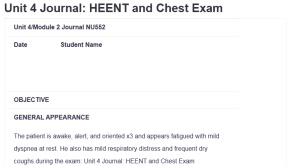
The patient is awake, alert, and oriented x3 and appears fatigued with mild dyspnea at rest. He also has mild respiratory distress and frequent dry coughs during the exam: Unit 4 Journal: HEENT and Chest Exam |
| HEENT
Head: Atraumatic, normal shape and size Eyes: Conjunctivae reddish, sclerae reddish Ears: Clean pinna, clean bilaterally, no exudate Nose: Nasal mucosa reddened bilaterally, moist without congestion, mild clear exudate noted. Mild pain rated 3/10 upon sinus palpation. Throat: Oropharynx mildly erythematous, tongue freely mobile, no lesions noted, no enlarged tonsils noted upon palpation Neck: No palpable lymph nodes, no enlarged thyroid noted upon palpation, the entire neck area is non-tender, trachea midline |
| CARDIOVASCULAR
92bpm RR, S1 and S2 present, no murmurs, rubs, or gallops. Capillary refill <2 seconds. |
| LUNGS
25R, chest symmetrical with normal expansion. Noted diminished breath sounds bilaterally, expiratory wheezes, and coarse rhonchi in bilateral lower lobes upon auscultation. No crackles. No dullness to percussion. Breathing was labored, and mild accessory muscle use was noted. |
| SKIN
Natural in color, warm, smooth, dry, and intact. Good skin turgor, no lesions, rashes, no nail clubbing. |
| How might diagnostic reasoning and clinical judgment be used to move toward a diagnosis in one of these systems? Include 2-3 evidence based resources, at least one of which is a clinical guideline for a condition that may be a differential. Word count 75-100 |
| The diagnosis of conditions based on cough as a symptom can be complicated as it is a non-specific symptom in most pulmonary and extrapulmonary conditions without any specific underlying cause or as a refractory condition to therapies (Chung et al., 2022). Clinical reasoning helps physicians to develop early hypotheses of conditions during patient encounters and compare their hypotheses with results from clinical assessments (Kourtidis et al., 2022).
This helps NPs to arrive at sound judgments on the conditions to make timely and correct diagnoses (Smith et al., 2022). In the case of George, clinical reasoning can be applied to compare presented symptoms, including worsening cough over two weeks and a history of conditions such as HTN, COPD, and DM2 (Global Initiative for Chronic Obstructive Lung Disease, 2024), to develop possible differentials such as acute exacerbation of chronic obstructive pulmonary disease and heart failure. This can narrow down lab testing and move down to a diagnosis. |
References
Chung, K. F., McGarvey, L., Song, W. J., Chang, A. B., Lai, K., Canning, B. J., Birring, S. S., Smith, J. A., & Mazzone, S. B. (2022). Cough hypersensitivity and chronic cough. Nature Reviews Disease Primers, 8(1), 1–21. https://doi.org/10.1038/S41572-022-00370-W;SUBJMETA=153,1785,308,692,699;KWRD=DRUG+DEVELOPMENT,RESPIRATORY+TRACT+DISEASES
Global Initiative for Chronic Obstructive Lung Disease. (2024). Pocket guide to COPD diagnosis, management and prevention: A guide for healthcare professionals. Global Initiative for Chronic Obstructive Lung Disease – GOLD. https://goldcopd.org/wp-content/uploads/2024/02/POCKET-GUIDE-GOLD-2024-ver-1.2-11Jan2024_WMV.pdf#page=9.33
Kourtidis, P., Nurek, M., Delaney, B., & Kostopoulou, O. (2022). Influences of early diagnostic suggestions on clinical reasoning. Cognitive Research: Principles and Implications, 7(1), 1–17. https://doi.org/10.1186/S41235-022-00453-Y/METRICS
Smith, S. K., Benbenek, M. M., Bakker, C. J., & Bockwoldt, D. (2022). Scoping review: Diagnostic reasoning as a component of clinical reasoning in the U.S. primary care nurse practitioner education. Journal of Advanced Nursing, 78(12), 3869–3896. https://doi.org/10.1111/JAN.15414;WGROUP:STRING:PUBLICATION
ORDER A PLAGIARISM-FREE PAPER HERE
We’ll write everything from scratch
Question 
Explore the process of assessment skills, diagnostic reasoning, and appropriate techniques necessary for a focused patient physical examination of the head, ears, eyes, nose, throat (HEENT) and chest across the lifespan.
In this competency assessment you will submit a Kaltura video and objective note, demonstrating your skill in completing this portion of an objective assessment. Use this Journal Template (ATTACHED).
Unit 4 Journal: HEENT and Chest Exam
I will record the Kaltura Video.The interview mock person’s details that I createdHello GeorgeMy name is X I am a NP.I will be assessing your lung fields and listening to your heart sound for murmurs.This is George, a 35-year-old African American male.You had been having a cough that was getting worse in the last two weeksNo allergyHx: HTN, COPD, DM2
- Two page
- APA format
- Citations after every paragraph
 Complete the order form and upload all of your files, including any instructions, rubrics, or other materials provided by your instructor.
  Complete the order payment after filling in the order form. We’ll receive your order and assign it to a writer.
 The assigned writer will complete your paper and forward it to our Editing Team for review and approval.
 Once approved by the editor, the completed paper will be uploaded to your account for you to download, review and approve.