
Theory of Human Caring on APN Role
Hello and welcome to this PowerPoint presentation on the theory of human caring in the APN role. This presentation will outline my future APN role and previous experience with this theory. It will also analyze this theory and outline its core concepts and the Caritas process defined in this theory. The presentation will be finalized by highlighting the implications of this theory to APNs.
My plans for the APN role are centered around psychiatry. I plan to pursue psychiatric mental health nursing upon completing my FNP. The basis of this selection is the high needs of patients in this nursing cadre, which has long been given relatively less attention than other illnesses. Additionally, my choice of this field has been informed by my passion for caring for these patients, having witnessed those around me suffer silently because of these illnesses. By being the difference in these clinics, I believe I can make a difference to these patients by caring in a manner that respects and affirms their humanity. Knowledge of the Watson theory of caring will enhance my care management expertise and enable me to carry out my duties in a manner that exhibits respect for my patients and optimizes their clinical outcomes.
Having worked at an oncology clinic and in a hospice center, I have experienced and appreciated patient caring, as drawn by Watson’s theory. These care facilities are mainly targeted at cancer patients. It is critically important to understand that these patients are incarcerated only on their health condition and that these incarcerations don’t make them lesser human beings. For this, their care providers handle them in a manner that promotes their health. Utilization of a holistic approach that targets their physical body healing and their spirits and minds. This is evident in the various treatment modalities utilized, such as psychosocial therapy and other mind-body techniques. This holistic approach aims to ensure that the patients feel valued, respected, understood, and assisted, as drawn by Watson’s theory.
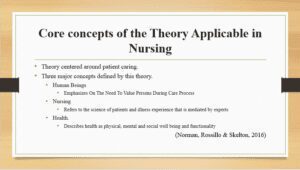
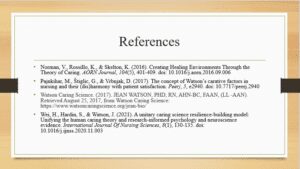
Watson’s theory of caring details a patient caring process that promotes the health of the patients as well as ensures a care environment that accepts the patients for who they are. This theory emphasizes the need to understand that patients are human beings and only present at the clinic because of their health-attributed incarcerations (Norman, Rossillo & Skelton, 2016). The theory postulates that the central concepts in nursing include the nursing process itself, health, and human beings or the person. The idea of human beings emphasizes the need to value persons during the care process and respect, nurture, understand, and assist in whichever way possible. Human beings are believed to be at the core of healthcare provision. They, therefore, deserve to be viewed not by their incarcerations and parts but as humans. On health, the theory describes health as physical, mental, and social well-being and functionality. Also, health entails adaptability to daily functionalization, freedom from disease, and the ability to exhibit efforts to prevent illness. As drawn by this theory, the nursing concept refers to the science of patients and infection experiences that persons with the necessary expertise and scientific knowledge mediate.
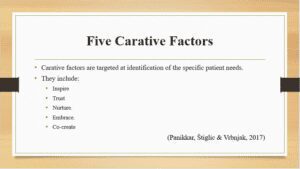
As postulated by Watson’s theory, curative factors are targeted at identifying specific patient needs. The approach addresses how these needs could be addressed in the overall attainment and maintenance of care that ensures better clinical outcomes.
These factors include trust, inspiration, nurturing, embracing, and co-creating. Trust entails trusting self and others by encouraging and promoting the beliefs of every individual and their growth and practices. Inspiration entails having faith, hope, and honor for the people around you. Embrace as we well entails the manifestation of altruistic values and practicing kindness and love with yourself and others around you. Nurturing entails developing relationships characterized by trust, care, and the ability to help. Co-creation entails the developing or promoting an environment that respects humanity and human dignity. This environment may be physical or spiritual (Panikkar, Štiglic & Vrbnjak, 2017).
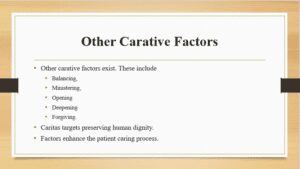
Other creative factors that define care processes include balancing, ministering, opening, deepening, and forgiving. The innovative elements inspiring hope and faith and embracing humanistic values systems form the philosophical foundation for the science of caring, At the same time, the other Caritas are founded on this philosophical foundation. The ten Caritas postulated in Watson’s theory aim to preserve human dignity. Factors are also targeted at enhancing the caring process for the patients.
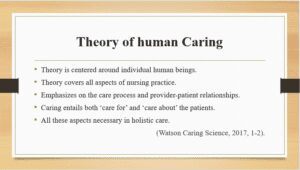
The theory of human caring, drawn by Watson, is centered on the individual patient. This theory asserts that “human beings cannot be treated as objects and that humans cannot be separated from self, as well as from nature and the entire workforce.” This theory covers all aspects of nursing practice while emphasizing process and patient-provider relationships(Watson Caring Science, 2017, 1-2). It expresses the significance of human caring and its healing potential for providers and patients. As drawn in the theory, caring entails both care for and care about patients. Care for patients is relatable to professional expertise and knowledge, whereas care about the patient is relatable to the psychological and spiritual considerations of the patients. Attainment of practical and holistic care depends on the exploitation of both of them.
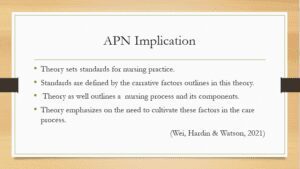
Watson’s theory sets standards for nursing practice by outlining the necessities of a care environment that ensures holistic care. These standards target the nursing care process and the individual patient’s welfare. This theory defines ten narrative factors limiting the care process. The APN is responsible for cultivating these attributes in their care processes. The idea also outlines a nursing process characterized by assessment, planning, intervention, and evaluation. These characteristics enable the realization of the desirable narrative factors outlined by the theory. The overall goal of these factors is to color nursing caring processes in a manner that allows them to care for and care about the patients as we analyze better clinical outcomes (Wei, Hardin & Watson, 2021). An effective way of cultivating these attributes in nurses is by cultivating them into the nursing education curriculum.
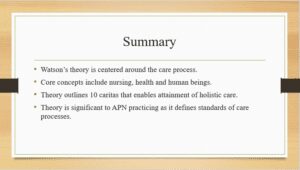
The Watson theory is centered around the care processes and the provider-patient relationships. The core concepts presented by this theory include human beings, nursing, and health. The idea is to target holistic care by utilizing an approach that can potentially affect the physical, spiritual, and mental aspects of the body. It describes ten Caritas that enable the creation of a caring environment that optimizes the care process and promotes holistic healing. This theory is considerably essential in APN practices as it not only sets standards for training but also outlines how holistic healing can be achieved for both the providers and their patients.
ORDER A PLAGIARISM-FREE PAPER HERE
We’ll write everything from scratch
Question 
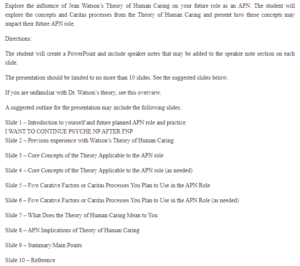
Explore the influence of Jean Watson’s Theory of Human Caring on your future role as an APN. The student will explore the concepts and Caritas processes from the Theory of Human Caring and present how these concepts may impact their future APN role.
Theory of Human Caring on APN Role
Directions:
The student will create a PowerPoint and include speaker notes that may be added to the speaker note section on each slide.
The presentation should be limited to no more than 10 slides. See the suggested slides below.
If you are unfamiliar with Dr. Watson’s theory, see this overview.
A suggested outline for the presentation may include the following slides:
Slide 1 – Introduction to yourself and future planned APN role and practice
I WANT TO CONTINUE PSYCHE NP AFTER FNP
Slide 2 – Previous experience with Watson’s Theory of Human Caring
Slide 3 – Core Concepts of the Theory Applicable to the APN role
Slide 4 – Core Concepts of the Theory Applicable to the APN role (as needed)
Slide 5 – Five Carative Factors or Caritas Processes You Plan to Use in the APN Role
Slide 6 – Five Carative Factors or Caritas Processes You Plan to Use in the APN Role (as needed)
Slide 7 – What Does the Theory of Human Caring Mean to You
Slide 8 – APN Implications of Theory of Human Caring
Slide 9 – Summary/Main Points
Slide 10 – Reference
 Complete the order form and upload all of your files, including any instructions, rubrics, or other materials provided by your instructor.
  Complete the order payment after filling in the order form. We’ll receive your order and assign it to a writer.
 The assigned writer will complete your paper and forward it to our Editing Team for review and approval.
 Once approved by the editor, the completed paper will be uploaded to your account for you to download, review and approve.