
The “Wait and See” Approach
The “wait and see” approach is considered a passive approach to leadership. While this leadership approach can provide a sense of caution and allow for the monitoring of the current state of the organization, it is crucial to ensure it doesn’t lead to missed business opportunities or neglect of pressing HR needs. According to Ing’ollan & Roussel (2019), the leadership style employed by managers greatly influences performance in many areas of an organization.
Responding to The CEO
According to Westover (2025), proactive HR strategies help create an engaged workforce aligned with the organization’s goals. However, understanding the rationale behind the CEO’s “wait and see” approach would be very important in choosing the best course of action. The CEO might be concerned about the organization’s financial position and, hence, choosing to avoid major investments in human resources. Additionally, the organization might be interested in evaluating the performance of its current strategies before committing to new changes.
Data and Information Gathering
Data collection and evaluation are crucial in decision making as it helps in assessing the effectiveness of past strategies and approaches. Some of the data points to be gathered would include employee turnover and retention rate, performance metrics, market conditions and competitor practices. These metrics would help identify areas where HR interventions are required and the risks of waiting too long to address them.
Next Steps
After evaluating the available data, the next steps I would take include discussing the findings with the CEO to outline the risks of waiting longer and the benefits of taking immediate action. Although the “wait and see” approach might be beneficial in some situations, I’d suggest balancing it with a more proactive approach to address more pressing HR concerns. In this balanced approach, I’d suggest first focusing on small, low-risk HR initiatives focused on improving existing processes, such as boosting employees’ morale without committing to major changes.
References
Ing’ollan, D. N., & Roussel, J. (2019). Passive leadership styles influence on employees’ performance in Kenya. Bussecon Review of Social Sciences (2687-2285), 1(2), 28–39. https://doi.org/10.36096/brss.v1i2.132
Westover, J. H. (2025). How a Proactive (Rather than Reactive) HR Department Contributes to Business Success. Human Capital Leadership., 18(3). https://doi.org/10.70175/hclreview.2020.18.3.2
ORDER A PLAGIARISM-FREE PAPER HERE
We’ll write everything from scratch
Question 
The “Wait and See” Approach
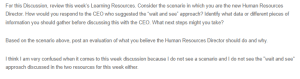
For this Discussion, review this week’s Learning Resources. Consider the scenario in which you are the new Human Resources Director. How would you respond to the CEO who suggested the “wait and see” approach? Identify what data or different pieces of information you should gather before discussing this with the CEO. What next steps might you take?
The “Wait and See” Approach
Based on the scenario above, post an evaluation of what you believe the Human Resources Director should do and why.
I think I am very confused when it comes to this week discussion because I do not see a scenario and I do not see the “wait and see” approach discussed in the two resources for this week either.
 Complete the order form and upload all of your files, including any instructions, rubrics, or other materials provided by your instructor.
  Complete the order payment after filling in the order form. We’ll receive your order and assign it to a writer.
 The assigned writer will complete your paper and forward it to our Editing Team for review and approval.
 Once approved by the editor, the completed paper will be uploaded to your account for you to download, review and approve.