
The Current State of Telehealth in South Dakota
Telehealth or telemedicine provides a promising future for healthcare provision in South Dakota. In this state, providers provide services to a large footprint, attending to patients who stay miles away from the offices of provision. The spread of South Dakota is more than 76,000 square miles, and out of 66 counties, nine have populations over 20,000 (Patrick et al., 2022). According to Patrick et al. (2022), Telehealth will likely bridge the significant care gaps and enhance general patient access. However, despite the state’s potential, findings show that telehealth services have historically not been fully utilized.
The COVID-19 pandemic brought the realization of the virtual system in almost every industry, if not all industries, including medicine. According to an analysis of the electronic medical records (EMR) data from providers in South Dakota in all specialties, there was a 1,600 increase in percent in telemedicine utilization, especially during the pandemic compared to 2019 (Patrick et al., 2022). It is crucial to note that the telehealth realm since 2020 has significantly differed from that in 2019. Since the wake-up call of the pandemic throughout the U.S. and worldwide, temporary changes were quickly integrated into telemedicine legislation. For instance, in March 2021, the state’s governor, Kristi Noem, signed a bill into law allowing healthcare providers to attend to patients through Telehealth without needing an in-person exam (Wicklund, 2021). South Dakota Senate Bill 96 entails emergency measures mentioned in the executive orders 2020-16 and 2020-07 (Wicklund, 2021). This bill is the first law in South Dakota to permanently expand connected health coverage and access beyond the COVID-19 pandemic. Governor Noem aimed to allow all providers in South Dakota to prescribe medications through Telehealth and even use audio only in telehealth platforms like phones. She is also adamant about permitting South Dakota to recognize medical licenses in all the states mentioned in the Uniform Emergency Management Assistance Compact (EMAC). EMAC is a mutual help agreement that permits all states to share resources during human-made and natural emergencies (Wicklund, 2021).
The Centers for Medicare & Medicaid Services (CMC) has drastically expanded telehealth breadth services, especially because of public health emergencies (Patrick et al., 2022). Following the same trend were public insurance companies that increased their insurance coverage as well as alternatives for telemedicine care (Patrick et al., 2022). Right now, providers in South Dakota have a broader telemedicine services array that qualifies for reimbursement due to the rapid temporary expansions they made during the wake of the pandemic. For example, Alina Telehealth uses HIPAA-compliant video teleconferencing technology to partner with outpatient clinics, hospitals, and healthcare facilities all around the country to provide a broader range of quality telemedicine services to the state of South Dakota (Alina Telehealth, 2022).
In a survey of 248 providers in South Dakota, within three months from 2019 and 2020, the telemedicine visits scheduled by the providers in South Dakota in all specialties in Sanford Health System had increased by 1,600 percent. In both periods, psychiatry and family medicine were the top telemedicine visit users (Patrick et al., 2022). The following table shows a telemedicine specialty increase in 2020 compared to 2019 before the COVID-19 pandemic (Patrick et al., 2022).
| SPECIALTY | 2019 | 2020 |
| Psychiatry | 586 | 6584 |
| Family Medicine | 1157 | 18,017 |
| Neurology | 4 | 2,206 |
| Hematology and oncology | 174 | 2,187 |
| Emergency medicine | 65 | 403 |
| Nephrology | 563 | 1,385 |
| Vascular surgery | 145 | 509 |
| Infectious disease | 360 | 547 |
| OB/GYN | 49 | 2,065 |
Now, the available telemedicine services in the state include telepsychiatry, tele-endocrinology, telecardiology, infectious illnesses, teleneurology, emergency telepsychiatry, telenephrology, locum tenens, and tele-ICU. Alina Telehealth (2022) describes all these services and what they entail. Telepsychiatry entails practicing the remote provision of psychiatric care via interactive and live video conferencing. Tele-endocrinology refers to a service entailing HIPPA-compliant video software that allows for remote treatment and treatment of arthritis, diabetes, osteoporosis, and other illnesses that are linked to hormones and glands. Telecardiology services allow cardiologists to reach their patients and give them consults, expert opinions, and echo readings and serve them in critical times. Infectious illnesses services give patients expert opinions through telemedicine communication technology. Teleneurology services entail remote services to neurology patients. Emergency telepsychiatry services entail services that give patients assessments, evaluations, and support systems. Locum tenens provides temporary qualified professional opportunities to staff. Lastly, tele-ICU helps ICU professionals to monitor their patients and help them in dire need by being backups for rural and urban healthcare facilities.
In addition, since July 2021, South Dakota Medicaid has eliminated the same community limitations for telehealth services. Initially, if a recipient and a provider were from the same community, telemedicine would not cover services unless the stated exceptions were met (South Dakota Department of Social Services, 2022). It was argued that the decision about having telemedicine or not and whether this was appropriate was made by the recipient and provider of the services. Other services that are now allowed to be issued remotely in South Dakota include speech-language pathology, teledentistry services, and audio-only behavioral health services, particularly those covered by Medicaid.
References
Alina TeleHealth (2022). Telemedicine Services in South Dakota connects your Healthcare Facility to Patients. https://alinatelehealth.com/telemedicine-services-south-dakota/
Patrick, R., Hegdah, D., Patrick, R., Shriver, J., Titus, K., & Ridgway, T. (2022). Telemedicine in the Wake of COVID-19: A Statewide Demographic Study on Provider Utilization and Perspective in South Dakota. South Dakota Medicine, 75(7).
South Dakota Department of Social Services (2022). Telemedicine and Audio-only Services. South Dakota Medicaid Billing and Policy Manual. https://dss.sd.gov/docs/medicaid/providers/billingmanuals/Professional/Telemedicine.pdf
Wicklund, E. (2021). South Dakota Governor looks to make Telehealth Coverage Permanent. mHealth Intelligence Healthcare Media.
ORDER A PLAGIARISM-FREE PAPER HERE
We’ll write everything from scratch
Question 
The Current State of Telehealth in South Dakota
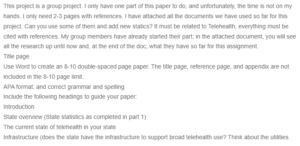
This project is a group project. I only have one part of this paper to do, and unfortunately, the time is not on my hands. I only need 2-3 pages with references. I have attached all the documents we have used so far for this project. Can you use some of them and add new statics? It must be related to Telehealth; everything must be cited with references. My group members have already started their part; in the attached document, you will see all the research up until now and, at the end of the doc, what they have so far for this assignment.
Title page
Use Word to create an 8-10 double-spaced page paper. The title page, reference page, and appendix are not included in the 8-10 page limit.
APA format, and correct grammar and spelling
Include the following headings to guide your paper:
Introduction
State overview (State statistics as completed in part 1)
The current state of Telehealth in your state
Infrastructure (does the state have the infrastructure to support broad telehealth use? Think about the utilities.
 Complete the order form and upload all of your files, including any instructions, rubrics, or other materials provided by your instructor.
  Complete the order payment after filling in the order form. We’ll receive your order and assign it to a writer.
 The assigned writer will complete your paper and forward it to our Editing Team for review and approval.
 Once approved by the editor, the completed paper will be uploaded to your account for you to download, review and approve.