
The Administrative Process of the IOC
Hello, and welcome to today’s presentation. The presentation delves into the administrative process of the International Olympic Committee (IOC). Among other things, the presentation highlights the IOC’s organizational structure, including its human resources and recruitment practices. Also, the presentation will highlight legal and ethical issues faced by the organization. The organization emerged in the 1920s as a small entity but has since grown into a large organization that plays a key role in sports administration and employs a significant number of staff members.
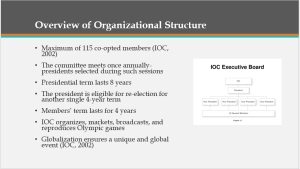
The core administrative organ of the IOC is made up of 115 co-opted members (International Olympic Committee [IOC], 2002). The committee meets once annually, and it is during one of such sessions that the IOC president is elected. The president serves for a term of eight years and is only eligible for re-election once. On the other hand, members serve for four-year terms. During the Olympic games, the president, committee members, and other key stakeholders meet daily to ensure that the games run smoothly. The IOC is charged with organizing, marketing, broadcasting, and reproducing the games. Given the globalized nature of the organizational structure, it organizes a unique and global event.
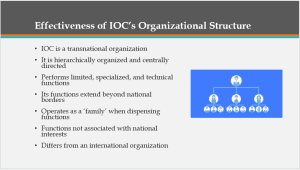
Given the role of the International Olympic Committee, it is a transnational organization in its own right. By having a single executive committee composed of 115 co-opted members, the IOC is hierarchically organized and centrally directed. Although the functions are limited, its jurisdiction extends beyond national borders. The IOC, as a transnational organization, differs from an international organization. Unlike in an international organization, where there are national interests to be considered, the IOC has uniform interests. This organizational structure is effective because it enables organizational members to focus on uniform objectives.

The IOC engages both permanent employees with an international status and contractual employees. Today, there are about 630 employees serving as the organization’s international cohort. On the other hand, contractual employees are incorporated for strategic purposes, such as when there are the Olympic games. IOC’s HR policy encourages diversity, embracing a non-discrimination policy against gender, sex, and race. Another notable highlight is that IOC offers employees the freedom to work autonomously as long as they are committed to collective objectives. At the core of IOC’s HR operations is formalization, a process in which the employer explains their expectations.
The hiring process of employees and volunteers poses one of the most difficult challenges for the IOC due to the need for international collaboration. For instance, legislative processes, which differ from country to country, impact the recruitment process. Therefore, constant communication with local entities is crucial to ensure compliance. Moreover, due to the large number of volunteers who turn up during recruitment, the IOC faces the challenge of balancing between formality and informality. It is worth noting that most positions require people with expertise in sports. To that end, the organization partly relies on peer recommendations while hiring to get the best talent.
Initially, the IOC faced resource challenges due to its overreliance on public financing, fundraising, and sponsorships. As a result, the organization would face difficulties organizing events. However, since the emergence and growth of sports marketing, the IOC no longer experiences resource shortages. The organization leverages fans’ enthusiasm, the resources they bring, and the audience they offer to enhance its revenues. Sports marketing offers the IOC resources through the sale of broadcasting rights, ticket sales, and sponsorship programs (Kulikov et al., 2024). With the increased global attention to sports and their rising stature, sports revenue continues to rise.
One of IOC’s legal aspects is the fact that it operates as an international organization in countries where it is present. The global nature of the organization is demonstrated by its hiring practices, as most of its staff are drawn from different countries. Following the approval by relevant legal authorities to operate in a given country, the organization has the freedom to operate as an international organization (Sabert & Graham, 2014). Another notable legal aspect of the IOC is that it has authority over states, particularly on sports matters within its functions. To that end, a decision made by the IOC cannot be legally contested by the affected country. Since the IOC operates as a non-profit organization, there is freedom to informally collaborate with other partners without state scrutiny (Sabert & Graham, 2014).
One of the ethical issues faced by the IOC relating to its core function of coordinating the Olympic Games is the balancing act of ensuring opportunity for all participants. To this end, the IOC faces the challenge of deciding who to include and exclude from competitions. One of the bones of contention has been the participation of athletes with sex development issues. While some feel that athletes should be allowed to participate in the gender they identify with, the science of varying hormonal levels (testosterone) impacts whether an athlete will be allowed to participate or not (Parry, 2012). Also, the commission faces the challenge of verifying athletes’ ages, which means that it is likely for younger athletes to compete with older athletes, leading to unfair competition (Parry, 2012). Other ethical issues include the fielding of poor football teams during the Olympic games and fairness in the determination of age groups to participate in specific competitions, especially when organizing youth events.
The International Olympic Committee is considered to be a transnational organization. Its hierarchical structure and centralization imply that key decisions are made at the highest level and implemented uniformly across the globe. With such a structure, the IOC avoids the challenges that face international organizations that have to align with national interests. Besides, the IOC is legally considered to be a non-profit organization; hence, limited government intervention. Although the IOC initially struggled with revenue availability, the emergence of sports marketing has created significant revenue through the sale of broadcasting rights, corporate sponsorships, and ticket sales.
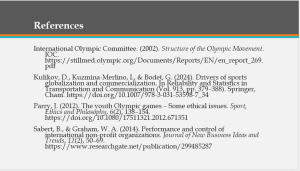
International Olympic Committee. (2002). Structure of the Olympic Movement. IOC. https://stillmed.olympic.org/Documents/Reports/EN/en_report_269.pdf
Kulikov, D., Kuzmina-Merlino, I., & Bodet, G. (2024). Drivers of sports globalization and commercialization. In Reliability and Statistics in Transportation and Communication (Vol. 913, pp. 379–388). Springer, Cham. https://doi.org/10.1007/978-3-031-53598-7_34
Parry, J. (2012). The youth Olympic games – Some ethical issues. Sport, Ethics and Philosophy, 6(2), 138–154. https://doi.org/10.1080/17511321.2012.671351
Sabert, B., & Graham, W. A. (2014). Performance and control of international non-profit organizations. Journal of New Business Ideas and Trends, 12(2), 50–69. https://www.researchgate.net/publication/299485287
ORDER A PLAGIARISM-FREE PAPER HERE
We’ll write everything from scratch
Question 
The Administrative Process of the IOC
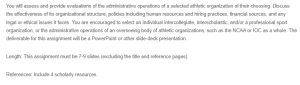
You will assess and provide evaluations of the administrative operations of a selected athletic organization of their choosing. Discuss the effectiveness of its organizational structure, policies including human resources and hiring practices, financial sources, and any legal or ethical issues it faces. You are encouraged to select an individual intercollegiate, interscholastic, and/or a professional sport organization, or the administrative operations of an overseeing body of athletic organizations, such as the NCAA or IOC as a whole. The deliverable for this assignment will be a PowerPoint or other slide-deck presentation.
Length: This assignment must be 7-9 slides (excluding the title and reference pages).
References: Include 4 scholarly resources.
 Complete the order form and upload all of your files, including any instructions, rubrics, or other materials provided by your instructor.
  Complete the order payment after filling in the order form. We’ll receive your order and assign it to a writer.
 The assigned writer will complete your paper and forward it to our Editing Team for review and approval.
 Once approved by the editor, the completed paper will be uploaded to your account for you to download, review and approve.