
Test and Assessment Development Analysis: WAIS-IV & MMPI-2
WAIS-IV
Cut Scores
As per the WAIS-IV findings, Ms. Z is an average intelligence person with a FSIQ score of 102. She had a higher PRI than WMI (92), which shows that she has minor problems with attention and working under pressure (Abdelhamid et al., 2021). Cut scores can help reveal cognitive strengths and weaknesses that may prompt the need for academic or therapeutic assistance.
Cultural Concerns
The WAIS-IV was standardized with a diverse sample of U.S. participants, so all findings should be interpreted with respect to the fact that Ms. Z is an African American woman. Also, language and access to education, as well as socioeconomic background, are all cultural aspects that can influence verbal subtests, and they may have to be treated with considerable care and a sensitivity to difference.
Ethical Issues
Ethically, there is a need to have and observe informed consent, respect the autonomy of the client, and minimize the fatigue of tests when the WAIS-IV is employed. Due to the recent hospitalization and the chronic depression history of Ms. Z, clinicians need to interpret the situation sensitively, situationally, and carefully to prevent miscommunication and misdiagnosis or strengthen false beliefs related to mental issues (Sharma & Gupta, 2023).
Methods
The WAIS-IV was carried out precisely in one-on-one method by a trained clinician in a quiet room free of distractors. The scoring was done both manually and with computer-based software in order to be more accurate. Its psychometric properties are shown to be robust as internal consistency values between .88 and .98 indicate high reliability, and thus, the tool is suitable for measuring cognitive functioning across any clinical population (Abdelhamid et al., 2021).
MMPI-2
Cut Scores
The MMPI-2 scores also showed considerable clinical elevations on several scales of depression (112), psychasthenia (86), and schizophrenia (90). All these scores are above the clinical cut-off of 65, thus indicating that she is experiencing a high degree of psychological distress, disorganization of thoughts, and emotional instability, consistent with her history of depression and recent mental hospitalization (Lang et al., 2024).
Cultural Concerns
The MMPI-2, though being normed on a representative U.S. sample, has to be administered with special attention to cultural context (Lang et al., 2024). The different demographics, like African Americans, may show high scores on some clinical scales because of special psychosocial factors, discrimination, or the culture-specific manifestation of distress that is not likely to be captured within normal normative data. Without incorporating such contextual backgrounds, clinicians will run the risk of misdiagnoses.
Ethical Issues
Given Ms. Z’s vulnerability, sharing results from elevated MMPI-2 scales must be done sensitively. Clinicians should avoid inducing distress and ensure that interpretation is delivered with compassion and cultural awareness (Floyd & Gupta, 2023), especially when suicide history is present.
Methods
The MMPI-2 was administered and scored using software. It consists of 567 true-false items and typically takes 60-90 minutes. Its test-retest reliability ranges from .60–.90, with high internal consistency for core clinical scales, making it a dependable tool for diagnostic clarification (Floyd & Gupta, 2023).
Clinical Formulation
Results
Ms. Z demonstrated average cognitive ability with significant psychological symptoms. WAIS-IV results support her academic potential, while MMPI-2 scores reflect severe emotional disturbances, including depression and cognitive disorganization, affirming the need for comprehensive mental health treatment.
Diagnosis
The assessment supports a diagnosis of Major Depressive Disorder, Recurrent, Severe with Psychotic Features. Schizophrenia scale elevations suggest possible schizoaffective disorder, but further evaluation is required to differentiate overlapping symptoms.
Psychometric Data
The WAIS-IV and MMPI-2 are psychometrically sound. WAIS-IV reliability ranges from .88 to .98, and MMPI-2 has strong test-retest and internal consistency. However, both require cultural sensitivity in interpretation to ensure accurate and ethical assessment.
References
Abdelhamid, G. S. M., Bassiouni, M. G. A., & Gómez-Benito, J. (2021). Assessing cognitive abilities using the WAIS-IV: An item response theory approach. International Journal of Environmental Research and Public Health, 18(13), 6835. https://doi.org/10.3390/ijerph18136835
Floyd, A. E., & Gupta, V. (2023, April 24). Minnesota multiphasic personality inventory. PubMed; StatPearls Publishing. https://www.ncbi.nlm.nih.gov/books/NBK557525/
Lang, P. A., Thomas, L., & Lidbury, B. A. (2024). Psychopathology and the validity of gastrointestisnal symptom reporting as revealed through cluster analyses of MMPI-2-RF results. Digestive Diseases and Sciences, 69(11), 4063–4071. https://doi.org/10.1007/s10620-024-08629-w
Sharma, N., & Gupta, V. (2023, August 2). Therapeutic communication. PubMed; StatPearls Publishing. https://www.ncbi.nlm.nih.gov/books/NBK567775/
ORDER A PLAGIARISM-FREE PAPER HERE
We’ll write everything from scratch
Question 
Test and Assessment Development Analysis: WAIS-IV & MMPI-2
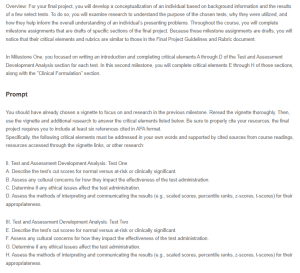
Overview: For your final project, you will develop a conceptualization of an individual based on background information and the results of a few select tests. To do so, you will examine research to understand the purpose of the chosen tests, why they were utilized, and how they help inform the overall understanding of an individual’s presenting problems. Throughout the course, you will complete milestone assignments that are drafts of specific sections of the final project. Because these milestone assignments are drafts, you will notice that their critical elements and rubrics are similar to those in the Final Project Guidelines and Rubric document.
Test and Assessment Development Analysis – WAIS-IV & MMPI-2
In Milestone One, you focused on writing an introduction and completing critical elements A through D of the Test and Assessment Development Analysis section for each test. In this second milestone, you will complete critical elements E through H of those sections, along with the “Clinical Formulation” section.
Prompt
You should have already chosen a vignette to focus on and research in the previous milestone. Reread the vignette thoroughly. Then, use the vignette and additional research to answer the critical elements listed below. Be sure to properly cite your resources; the final project requires you to include at least six references cited in APA format.
Specifically, the following critical elements must be addressed in your own words and supported by cited sources from course readings, resources accessed through the vignette links, or other research:
II. Test and Assessment Development Analysis: Test One
A. Describe the test’s cut scores for normal versus at-risk or clinically significant.
B. Assess any cultural concerns for how they impact the effectiveness of the test administration.
C. Determine if any ethical issues affect the test administration.
D. Assess the methods of interpreting and communicating the results (e.g., scaled scores, percentile ranks, z-scores, t-scores) for their appropriateness.
III. Test and Assessment Development Analysis: Test Two
E. Describe the test’s cut scores for normal versus at-risk or clinically significant.
F. Assess any cultural concerns for how they impact the effectiveness of the test administration.
G. Determine if any ethical issues affect the test administration.
H. Assess the methods of interpreting and communicating the results (e.g., scaled scores, percentile ranks, z-scores, t-scores) for their appropriateness.
IV. Clinical Formulation
A. Analyze the test results using industry-standard tools.
B. Determine a diagnosis based on the data provided.
Assignment Information
C. Interpret the psychometric data from the test results to address the reason for the referral.
 Complete the order form and upload all of your files, including any instructions, rubrics, or other materials provided by your instructor.
  Complete the order payment after filling in the order form. We’ll receive your order and assign it to a writer.
 The assigned writer will complete your paper and forward it to our Editing Team for review and approval.
 Once approved by the editor, the completed paper will be uploaded to your account for you to download, review and approve.