
Telehealth Technology Implementation
This research paper assesses the adequacy of the existing telehealth technology infrastructure in the institution. The implementation plan of the upgraded telehealth technology is then discussed. The project consists of five main steps. The first step is assigning tasks and responsibilities for deploying the technology. The second step is developing an implementation schedule. The next step is the identification of strategies and requirements for staff training. An interprofessional and professional-patient collaboration strategy is then identified. The last step is the development of a maintenance and post-deployment telehealth technology evaluation strategy.
The existing telehealth technology infrastructure mainly involves Store-and-forward. With this technology, healthcare providers can share the medical information of the patients. Examples of data that can be transmitted via this technology include laboratory reports, imaging reports such as X-rays, and treatment plans (Wootton et al., 2015). The technology is common in the departments of radiology and ophthalmology. Store-and-forward technology promotes inter-professional collaboration (Wootton et al., 2015). Patient details can be transferred from one facility to another and among health care providers in different departments. This promotes interprofessional consultations and improves the quality of care administered to patients.
The existing telehealth technology fails to address key healthcare issues. Patient compliance can not be evaluated or monitored using this technology. In this technology, the patient cannot upload and transmit their vitals to healthcare providers. Patients only interact with healthcare providers in the health facility. Furthermore, the existing technology fails to improve access to healthcare services. Currently, the ratio of patients to healthcare providers in the institution is high. A lot of delays are witnessed in accessing specialists’ services. This is associated with a poor prognosis of patients’ diseases.
The existing technology fails to promote evidence-based practice. Store-and-forward technology does not provide the opportunity to monitor patients’ responses to different treatment plans. This monitoring usually pinpoints the best care strategy for the patient and promotes future evidence-based nursing practice. The evidence-based practice promotes quality, individualized patient care. An area of uncertainty that can improve the assessment of this technology is the concern of patient privacy and confidentiality. Information on the security features that uphold privacy and confidentiality is very important. Therefore, even though the existing technology promotes interprofessional collaboration, it fails to provide adequate healthcare services. An upgrade in the technology that addresses the health issues is necessary.
Various team members will facilitate the deployment of the upgraded technology. Each team member has a task and a responsibility to fulfil. Team members involved in this process include the head of Information Technology, the director of technical training, the leader of patient services, and the director of quality management. The head of marketing services, program manager, and telehealth nurses will also take part in the deployment process. The head of Information Technology (IT) will coordinate various tasks. These tasks include the installation and update of the telehealth software, the structure of anti-virus software, and managing access levels by enforcing data encryption, two-factor authentication, and passwords (Tuckson et al., 2017). The head of IT will perform regular checks of the system logs and identify any instances of breaches.
The director of technical training will coordinate regular staff training sessions. Training will take place before, during, and after the deployment of the upgraded technology. Training equips staff with the relevant skills needed to use the technology. Enrolled patients will be trained in Remote patient monitoring (RPM) technology. Follow-up visits will be used to ensure that all patients can use the RPM technology. The head of patient services will coordinate the activities of telehealth nurses. Telehealth nurses identify eligible patients, enrol them and monitor them using the upgraded technology (Tuckson et al., 2017). The institution’s policies, such as consent from the patient, must be adhered to during enrolment. Telehealth nurses should consult a physician and other healthcare providers and maintain technological competency.
The director of quality management will ensure that services meet the quality standards of the State and Federal government. The director will be responsible for providing quality improvement initiatives. After the implementation of the industries, their effectiveness is evaluated based on the outcomes. The marketing personnel will be in charge of popularizing the upgraded technology in the external hospital environment (Tuckson et al., 2017). This will require collaboration with IT experts, technical training experts, and telehealth nurses. An example of a marketing point is that upgraded technology improves patient compliance. Marketing personnel is also responsible for addressing any concerns about the upgraded technology. The program manager will review State policies and ensure that all regulations are adhered to. The manager is in charge of drafting the institution’s upgraded telehealth policies.
The upgraded telehealth technology will be implemented over one year. The implementation process will occur in phases. Meetings will take place at the end of each step. The first phase will take place within the first three months. This phase is the pilot phase. During this phase, a small number of patients will be enrolled in the upgraded telehealth technology. This pilot phase of the program aims at determining the viability of the upgraded technology (Crossen et al., 2020). Key parameters that will be determined during this phase are the security features of the technology, the patient’s and healthcare worker’s ability to use the technology, ease of data transfer, and the effectiveness of the technology. This phase identifies any deficiencies of the upgraded technology. It enables the institution to manage any anticipated risk before the technology is implemented.
The second phase is the implementation phase. This phase will take place in six months. Feedback from the pilot phase will be used in this phase. Implementation will be done based on the tasks contained in the plan. During this phase, regular training of staff and enrolled patients will take place. All the stakeholders must ensure that they execute their tasks and responsibilities as planned. The institution’s policies must be adhered to when implementing telehealth technology. This phase focuses on fulfilling the deliverables of the program (Crossen et al., 2020). The upgraded TTelehealth mainly aims at improving key health issues such as patient compliance and evidence-based practice. Furthermore, patients’ access to health care services should be improved.
The last phase is the post-implementation phase. After six months of implementation, the effectiveness of the upgraded telehealth technology will be assessed based on the achievement of various deliverables. Post-implementation will occur immediately after performance and continue for three months. During this phase, outcome measures of the technology’s effectiveness will be evaluated (Crossen et al., 2020). Fulfilment of key healthcare issues such as patient compliance indicates point. Inadequate energy will prompt a review of the collected data and re-evaluation of the technology.
Training of staff on how to use the upgraded technology is important. Analysis of the needs and goals of the upgraded technology will be used to plan the activity (King et al., 2020). Staff should know all policies that govern the use of the technology. Such policies include privacy policies, safety requirements, and regulatory requirements. The other condition is the skills to use both the software and hardware of the upgraded technology. Such skills include password setting, use of two-factor authentication, accessing information sent by patients and other health care providers, and sending feedback. The additional training requirement is constant continuous medical education to foster professional relevance.
Training of staff will take place weekly. Both internal and external resources will be used in the training process. The head of technical training will carry out internal training, the director of IT services, the project manager, and the leaders of various departments. Interactive group sessions, online sessions, coaching, and mentoring are the strategies that will be used (King et al., 2020). The Director of IT services will provide training on various security measures such as passwords and two-factor authentication. The program manager will provide training services on the policies, safety requirements and State regulatory requirements. Interdepartmental heads are responsible for the weekly continuous medical education of their staff.
External resources used in the training include conferences and seminars. External strategies can be used to gain both professional knowledge and technical skills. Meetings and workshops will be organized quarterly. They will be used to supplement the internal training strategies. The assumption used in determining the training strategies is that the institution will secure the budget allocated for training. The other belief is that the institution will retain most of its staff after they have received appropriate training. This will increase the productivity of the institution.
Collaborative healthcare practice is important in ensuring quality patient care. This is because interprofessional collaboration promotes the exchange of ideas and information (Reeves et al., 2017). Such discussions are important in determining the best treatment plan or seeking clarity. Collaboration minimizes potential errors in health care and promotes the well-being of the patient. Patient-healthcare provider collaboration is essential in ensuring that patient-centred care is provided (Reeves et al., 2017). It helps to avert cases of hypersensitivity and improve the prognosis of a patient’s illnesses. An example is patient-healthcare provider collaboration in the management of diabetes mellitus. Patients can take part in the direction by dietary modifications and avoiding sedentary lifestyles.
The interprofessional collaboration will be enhanced by creating a policy that requires input from all healthcare providers before an intervention is made. After the telehealth nurse receives patients’ vitals through Rapid Patient Monitoring (RPM) technology, the entrails will be availed to the interprofessional committee. The committee will take part in the decision-making process to establish the progress of the patient. This collaboration will improve the quality of decisions made, hence improving patient care. The patient-nurse cooperation will be enhanced by the regular feedback that the nurse will deliver to the patient after monitoring their vitals through RPM. Regular feedback encourages communication and collaboration. The strategy is based on the assumption that there is a psychological willingness for collaboration among the health care providers and patients.
According to Agboola et al. (2014), a post-deployment telehealth evaluation strategy should involve outcome measures that are relevant to stakeholders. The outcome measures that are relevant to this telehealth technology are improved healthcare outcomes. They include improved patient compliance, evidence-based practice, increased access to health care services, and better interprofessional collaboration. Evaluation of these outcome measures is the strategy that will be used. An example is the use of surveys to determine whether access to healthcare services has increased. Feedback from the evaluation will be used to develop the maintenance strategy (Agboola et al., 2014). The maintenance strategy will involve making necessary adjustments to needed to improve the outcome measures. An example of such a strategy is enrolling more patients to increase access to healthcare. The fulfilment of the outcome measures in the next scheduled evaluation demonstrates the success of the process.
The existing telehealth technology is inadequate in fulfilling the needs of the organization. This necessitates the implementation of the upgraded technology. Various team members play crucial roles and responsibilities in the deployment of the upgraded technology. An implementation schedule provides a timeline for the deployment of the technology. A post-deployment evaluation strategy should focus on the fulfilment of various outcome measures of the effectiveness of the technology.
References
Agboola, S., Hale, T. M., Masters, C., Kvedar, J., & Jethwani, K. (2014). “Real-World” Practical Evaluation Strategies: A Review of Telehealth Evaluation. JMIR Research Protocols, 3(4), e75. https://doi.org/10.2196/resprot.3459
Crossen, S., Raymond, J., & Neinstein, A. (2020). Top 10 Tips for Successfully Implementing a Diabetes Telehealth Program. Diabetes Technology and Therapeutics, 22(12), 920–928. https://doi.org/10.1089/dia.2020.0042
King, K., Ford, D., Haschker, M., Harvey, J., Kruis, R., & McElligott, J. (2020). Clinical and technical considerations of an open-access telehealth network in South Carolina: Definition and deployment. Journal of Medical Internet Research, 22(5). https://doi.org/10.2196/17348
Reeves, S., Pelone, F., Harrison, R., Goldman, J., & Zwarenstein, M. (2017). Interprofessional collaboration to improve professional practice and healthcare outcomes. Cochrane Database of Systematic Reviews, 2017(6). https://doi.org/10.1002/14651858.CD000072.pub3
Tucson, R. V, Edmunds, M., Ph, D., & Hodgkins, M. L. (2017). Spe ci a l R e p or t Telehealth. 1585–1592.
Wootton, R., Liu, J., Bonnardot, L., Venugopal, R., & Oakley, A. (2015). Experience with quality assurance in two store-and-forward telemedicine networks. Frontiers in Public Health, 3(NOV), 1–10. https://doi.org/10.3389/fpubh.2015.00261
ORDER A PLAGIARISM-FREE PAPER HERE
We’ll write everything from scratch
Question 
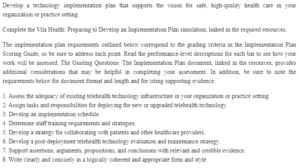
Develop a technology implementation plan that supports the vision for safe, high-quality health care in your organization or practice setting.
Telehealth Technology Implementation
Complete the Vila Health: Preparing to Develop an Implementation Plan simulation, linked in the required resources.
The implementation plan requirements outlined below correspond to the grading criteria in the Implementation Plan Scoring Guide, so be sure to address each point. Read the performance-level descriptions for each bar to see how your work will be assessed. The Guiding Questions: The Implementation Plan document, linked in the resources, provides additional considerations that may be helpful in completing your assessment. In addition, be sure to note the requirements below for document format and length and for citing supporting evidence.
1. Assess the adequacy of existing telehealth technology infrastructure in your organization or practice setting.
2. Assign tasks and responsibilities for deploying the new or upgraded telehealth technology.
3. Develop an implementation schedule.
4. Determine staff training requirements and strategies.
5. Develop a strategy for collaborating with patients and other healthcare providers.
6. Develop a post-deployment telehealth technology evaluation and maintenance strategy.
7. Support assertions, arguments, propositions, and conclusions with relevant and credible evidence.
8. Write clearly and concisely in a logically coherent and appropriate form and style.
 Complete the order form and upload all of your files, including any instructions, rubrics, or other materials provided by your instructor.
 Complete the order payment after filling in the order form. We’ll receive your order and assign it to a writer.
 The assigned writer will complete your paper and forward it to our Editing Team for review and approval.
 Once approved by the editor, the completed paper will be uploaded to your account for you to download, review and approve.