
Teaching Plan and Worksheet for The Self-Management of Hypertension
Name: K.W.
Age: 54-year-old
Ethnicity: African-American
Gender: Male
Health Condition: Hypertension
This teaching plan will equip K.W. with the right knowledge and strategies to help manage his high blood pressure status by adopting a healthier lifestyle. The teaching plan is tailored to fit K.W.’s health needs. Tailored self-management education improves the health literacy of elderly hypertensive patients, which impacts their overall blood pressure management(Delavar et al., 2020). Hypertension, if not well managed, risks the development of other complications such as cardiovascular diseases eye, and kidney problems. Through Lifestyle changes, K.W. can control hypertension and prevent the development of related complications effectively. Do you need help with your assignment ? Get in touch with us at eminencepapers.com.
Teaching Plan Objectives
The teaching plan will help K.W. improve the following:
- His understanding of hypertension, factors that exacerbate high blood pressure, and the risks associated with unmanaged hypertension,
- His eating and physical activity levels
- Implement essential lifestyle changes to resolve underlying factors for his high blood pressure.
Teaching Plan Content
The teaching plan’s content will cover three vital health education areas necessary to help K.W. manage and improve his blood pressure readings to safer levels.
Content 1
Understanding Hypertension
Hypertension is any blood pressure reading above 130/80 mmHg (American Heart Association, n.d.). Hypertension can exist without any notable symptoms. Regardless of whether there are symptoms or not, hypertension can lead to very unexpected complications and even death. The aim is to improve K.W.’s overall health literacy regarding hypertension.
Content 2
Risk factors for Hypertension
People whose family has a history of hypertension and are above 50 (Li et al., 2021) mostly live a sedentary lifestyle with a higher intake of unhealthy foods, cigarette smoking, and high amounts of alcohol, as well as gaining weight uncontrollably, are at a higher risk of hypertension. Additionally, living with prolonged periods of stress and having diabetes can further exacerbate hypertension (Li et al., 2021).
Content 3
Necessary Lifestyle Changes for Self-Management of Hypertension
K.W., whether supervised or unsupervised, will be expected to remain disciplined with his eating habits and stick to healthy eating habits. These include avoiding eating high-sodium content foods, especially fast foods, reducing the intake of alcohol and fizzy drinks, reducing the intake of foods and beverages with added sugar, and improving the intake of fruits and vegetables. A dietician will continuously advise K.W. on the foods to incorporate into his meal diary, including when and how to prepare the foods for consumption.
K.W.’ will also be expected to remain physically active by improving his rate of physical activity. The plan requires him to move frequently whether at home or within the care facility. Aerobic exercises such as park walks and cycling are suggested to improve K.W.’s activity levels. K.W. is also expected to enroll at the elderly gym in the local community. He is required to exercise up to 40 minutes, 3 times a week, with peers. Physical activities aim to improve weight management. Additionally, K.W. will be assessed for any other behaviors that exacerbate his hypertensive state, such as alcohol use and smoking, and the necessary cessation strategies employed.
Teaching Methods and Materials
The nurse in charge of coordinating K.W.’s care and teaching plan will hold regular discussions with the client. The discussions will help identify areas in which K.W. requires further clearance. The nurse will also demonstrate to K.W. how to take his blood pressure readings at home and how to keep records of such readings, as well as how to interpret them.
A visualized brochure and a poster with information on hypertension, how to manage the condition, risk factors, and what to do in case of an emergency will be provided to K.W. Some related websites such as the American Heart Association, the CDC, among others, will also be recommended as well as on how to use the provided resources.
Evaluation of the Teaching Plan
The teaching plan will be evaluated by asking K.W. questions that help identify progress, such as:
- How do you feel since the teaching plan was implemented?
- What major areas of this care and teaching plan have you covered so far?
- How have you changed your lifestyle?
- How do you feel after implementing the new lifestyle changes?
- What part of the teaching plan do you feel is not well with you?
| Goals and Objectives | Educational Topic
|
Educational Strategy | Plan for each week for each Goal:
|
Expected Outcomes:
|
Resources you will create for your participant to help them achieve their goals |
| Week1
Short-term Goal Improve K.W’s blood pressure monitoring rate to two times daily for the next three weeks. Long-term Goal K.W. to reduce the overall intake of high-sodium fast foods prepared with saturated fats by the end of the three weeks.
|
· Blood pressure monitoring
· Reduction of Sodium intake and fast food consumption |
· Hands-on demonstration on how to take blood pressure readings and a discussion on how to record and interpret the results.
· Hands-on demonstration and practice |
· Demonstrate and discuss with K.W. how blood pressure is measured and records are taken. Also, explain to him why keeping track of his blood pressure is necessary. Additionally, strategies should be developed to motivate and remind K.W. to observe the times to check his blood pressure.
· Provide evidence and discuss with K.W. how sodium and fast foods contribute to the exacerbation of hypertension. · Show him how to refer to the recommended daily allowances for people with hypertension before consuming packed and processed foods. |
· K.W.’s improved knowledge of blood pressure monitoring, interpretation of readings, and adherence to blood pressure recording timelines.
· Improved knowledge of major risk factors for hypertension. · Significant reduction in the consumption of high-sodium foods and fast foods. |
· Blood pressure monitoring and recording kit.
· Daily food diary · Visualized booklet for high- and low-sodium foods. |
|
Week 2 Short-term Goal
Improve K.W.’s intensity of daily physical activity from 30 minutes a day to 40 minutes a day four times a week by the end of the second and third week of the session.
Long-term Goal
K.W. to achieve notable weight loss (5 pounds) by the end of the third week |
· Physical activity and training
· Weight management |
· Hands-on demonstration and training
· Hands-on demonstration and training
|
· Improve K.W.’s appreciation of exercises and physical activity in improving hypertension.
· Relate body weight status to risk of hypertension · Train K.W. on calorie intake monitoring. · Develop a list of physical activities K.W. is expected to complete in a day and train him on how to use smartphone training apps. |
· Improved physical strength
· Improved blood pressure readings · Improved weight loss · Reduces excess calorie intake |
· Visualized physical activity training manual
· Fitness training smartphone app. · Calorie counter smartphone app. |
| Week 3
Short-term Goal
K.W. will practice guided meditation and yoga for 10 minutes daily in the morning to help manage his job-related stress by the end of the third week.
Long-term Goal K.W. will be expected to adhere to this teaching and management plan till the end of the third week. |
· Stress management
· Adherence to teaching and hypertension management plan. |
· Hands-on demonstration and training
· Hands-on demonstration and training |
· Discuss with K.W. the importance of meditation and following through with the plan.
· Demonstrate and train K.W. on how to meditate and adhere to the plan in the third week. |
· Improved stress management
· Reduced blood pressure levels · Adherence to the plan to the final week. |
· Daily planner and logging template
· Daily reminder system · Guided meditation kit including sounds, guidelines for meditation, and headphones. |
References
American Heart Association. (n.d.). Understanding Blood Pressure Readings. Retrieved May 11, 2023, from https://www.heart.org/en/health-topics/high-blood-pressure/understanding-blood-pressure-readings
Delavar, F., Pashaeypoor, S., & Negarandeh, R. (2020). The effects of self-management education tailored to health literacy on medication adherence and blood pressure control among elderly people with primary hypertension: A randomized controlled trial. Patient Education and Counseling, 103(2), 336–342. https://doi.org/10.1016/J.PEC.2019.08.028
Li, A. Le, Peng, Q., Shao, Y. Qin, Fang, X., & Zhang, Y. Ying. (2021). The interaction of hypertension between family history and diabetes and other risk factors. Scientific Reports 2021 11:1, 11(1), 1–7. https://doi.org/10.1038/s41598-021-83589-z
ORDER A PLAGIARISM-FREE PAPER HERE
We’ll write everything from scratch
Question 
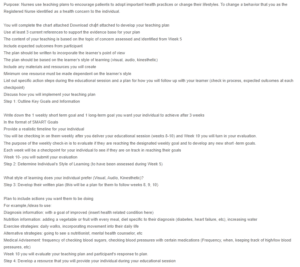
Purpose: Nurses use teaching plans to encourage patients to adopt important health practices or change their lifestyles. To change a behavior that you, as the Registered Nurse, identified as a health concern to the individual.
Teaching Plan and Worksheet for The Self-Management of Hypertension
You will complete the chart attached. Download the chart attached to develop your teaching plan.
Use at least 3 current references to support the evidence base for your plan.
The content of your teaching is based on the topic of concern assessed and identified from Week 5
Include expected outcomes from the participant
The plan should be written to incorporate the learner’s point of view
The plan should be based on the learner’s style of learning (visual, audio, kinesthetic)
Include any materials and resources you will create
Minimum one resource must be made dependent on the learner’s style
List out specific action steps during the educational session and a plan for how you will follow up with your learner (check-in process, expected outcomes at each checkpoint)
Discuss how you will implement your teaching plan
Step 1: Outline Key Goals and Information
Write down the 1 weekly short-term goal and 1 long-term goal you want your individual to achieve after 3 weeks.
In the format of SMART Goals
Provide a realistic timeline for your individual
You will be checking in on them weekly after you deliver your educational session (weeks 8-10), and in Week 10, you will turn in your evaluation.
The purpose of the weekly check-in is to evaluate if they are reaching the designated weekly goal and to develop any new short-term goals.
Each week, there will be a checkpoint for your individual to see if they are on track to reach their goals.
Week 10- you will submit your evaluation.
Step 2: Determine the Individual’s Style of Learning (to have been assessed during Week 5)
What style of learning does your individual prefer (Visual, Audio, Kinesthetic)?
Step 3: Develop their written plan (this will be a plan for them to follow weeks 8, 9, 10)
Plan to include actions you want them to be doing
For example,/ideas to use:
Diagnosis information: with a goal of improved (insert health-related condition here)
Nutrition information: adding a vegetable or fruit with every meal, having a diet specific to their diagnosis (diabetes, heart failure, etc.), increasing water
Exercise strategies: daily walks, incorporating movement into their daily life
Alternative strategies: going to see a nutritionist, mental health counselor, etc
Medical Advisement: frequency of checking blood sugars, checking blood pressures with certain medications (Frequency, when, keeping track of high/low blood pressures, etc.)
In week 10, you will evaluate your teaching plan and participants’ responses to the plan.
Step 4: Develop a resource that you will provide your individual during your educational session
Examples: pamphlet, brochure, education packet, wellness planner, habit tracker, wellness journal, etc
Make copies of your material(s) and/or resources to give to your individual
Give these when you are having your educational strategy session
You will need to upload at least 1 of the resources you provided to your participant and attach them to your assignment.
Step 5: Develop a set of 5 questions you will ask your participant prior to and after your teaching intervention.
Develop 5 questions to assess the knowledge of your participant prior to and after your teaching session.
Give to your participant prior to your teaching session in Week 7
You will then give the questions again to your participant after the teaching session
Attach this to the assignment.
Chart for Assignment 6 Download Chart for Assignment 6
 Complete the order form and upload all of your files, including any instructions, rubrics, or other materials provided by your instructor.
 Complete the order payment after filling in the order form. We’ll receive your order and assign it to a writer.
 The assigned writer will complete your paper and forward it to our Editing Team for review and approval.
 Once approved by the editor, the completed paper will be uploaded to your account for you to download, review and approve.