
Sun Protection and Vitamin D
Using the information from article #5, please answer the following questions.
- What is the primary focus of the study described in the article?
The primary focus of the study was to examine how different sun protective behaviors such as staying in the shade, wearing long sleeves, wearing hats, and using sunscreen are associated with serum 25-hydroxyvitamin D [25(OH)D] levels in the general U.S. population (Linos et al., 2012).
- Describe the central sun protective behaviors examined in the study.
The study focused on four sun protective behaviors commonly recommended for skin cancer prevention: staying in the shade, wearing long-sleeved shirts, wearing hats, and using sunscreen.
- What is the significance of 25(OH)D levels in the context of this study?
25(OH)D levels measure vitamin D status, which is important for bone health and linked to cancer and heart disease.
- Why is there concern regarding the impact of sun protection on vitamin D levels, according to the article?
The increase in scientific understanding of vitamin D benefits has led to concerns about its synthesis because sun protection practices may reduce skin production of vitamin D. The use of sunscreen to prevent skin cancer risks could lead to vitamin D deficiency, which may result in multiple health problems together with autoimmune diseases and higher rates of mortality (Linos et al., 2012).
- Explain the study’s methodology used to assess sun protective behaviors and 25(OH)D levels.
A study team measured 25(OH)D levels using radioimmunoassay among 5,920 adults who reported their sun behaviors while accounting for factors including BMI and supplement usage (Linos et al., 2012).
- What were the key findings regarding the association between sun protective behaviors and 25(OH)D levels across different racial groups?
Using shade combined with extended sleeve coverage among white participants weakened Vitamin D levels and raised deficiency risk. The study found that these results lack significance in Black and Hispanic groups because melanin provides sun protection, and the participant numbers were limited (Linos et al., 2012).
- Discuss the limitations of the study as outlined by the authors.
The study’s limitations include its cross-sectional methodology, its dependence on self-reported results, a single assessment of vitamin D, and data collection in a specific season. The research did not include specific measurements of skin pigmentation alongside detailed reporting of direct sun exposure. The study results could have been distorted by unmeasured cultural factors or health behaviors (Linos et al., 2012).
- How did the authors address confounding factors in their statistical analyses?
The authors conducted linear regression modeling that included age, gender, BMI, season, supplement use, diet, and socioeconomic status. Race-based stratification occurred to understand different sun exposure practices and skin tones between groups (Linos et al., 2012).
- What implications do the findings of this study have for public health recommendations regarding sun protection and vitamin D supplementation?
The research indicates that seeking shade and dressing with long sleeves leads to lower vitamin D levels for white people, but sunscreen use does not have this impact. Strict adherents to sun protection need to increase their vitamin D supplementation to achieve sufficient levels, according to Linos et al. (2012).
- What further research is suggested by the authors to understand better the relationship between sun protection and vitamin D levels?
The authors recommend longitudinal and randomized studies to understand better how sun protection impacts vitamin D levels over time (Linos et al., 2012).
References
Linos, E., Keiser, E., Kanzler, M., Sainani, K. L., Lee, W., Vittinghoff, E., Chren, M., & Tang, J. Y. (2012). Sun protective behaviors and vitamin D levels in the US population: NHANES 2003–2006. Cancer Causes & Control, 23(1), 133–140. https://doi.org/10.1007/s10552-011-9862-0
ORDER A PLAGIARISM-FREE PAPER HERE
We’ll write everything from scratch
Question 
Sun Protection and Vitamin D
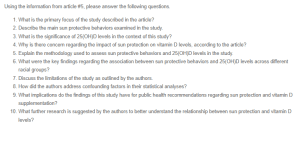
Sun Protection and Vitamin D
Using the information from article #5, please answer the following questions.
- What is the primary focus of the study described in the article?
- Describe the main sun protective behaviors examined in the study.
- What is the significance of 25(OH)D levels in the context of this study?
- Why is there concern regarding the impact of sun protection on vitamin D levels, according to the article?
- Explain the methodology used to assess sun protective behaviors and 25(OH)D levels in the study.
- What were the key findings regarding the association between sun protective behaviors and 25(OH)D levels across different racial groups?
- Discuss the limitations of the study as outlined by the authors.
- How did the authors address confounding factors in their statistical analyses?
- What implications do the findings of this study have for public health recommendations regarding sun protection and vitamin D supplementation?
- What further research is suggested by the authors to better understand the relationship between sun protection and vitamin D levels?
 Complete the order form and upload all of your files, including any instructions, rubrics, or other materials provided by your instructor.
  Complete the order payment after filling in the order form. We’ll receive your order and assign it to a writer.
 The assigned writer will complete your paper and forward it to our Editing Team for review and approval.
 Once approved by the editor, the completed paper will be uploaded to your account for you to download, review and approve.